Professional Pool Service
Automation System Troubleshooting in Manteca
Pool automation acting up in Manteca, CA? We fix dead controllers, stuck valve actuators, lost app connections, and bad schedules. Licensed pool techs.
Professional Pool Service
Pool automation acting up in Manteca, CA? We fix dead controllers, stuck valve actuators, lost app connections, and bad schedules. Licensed pool techs.
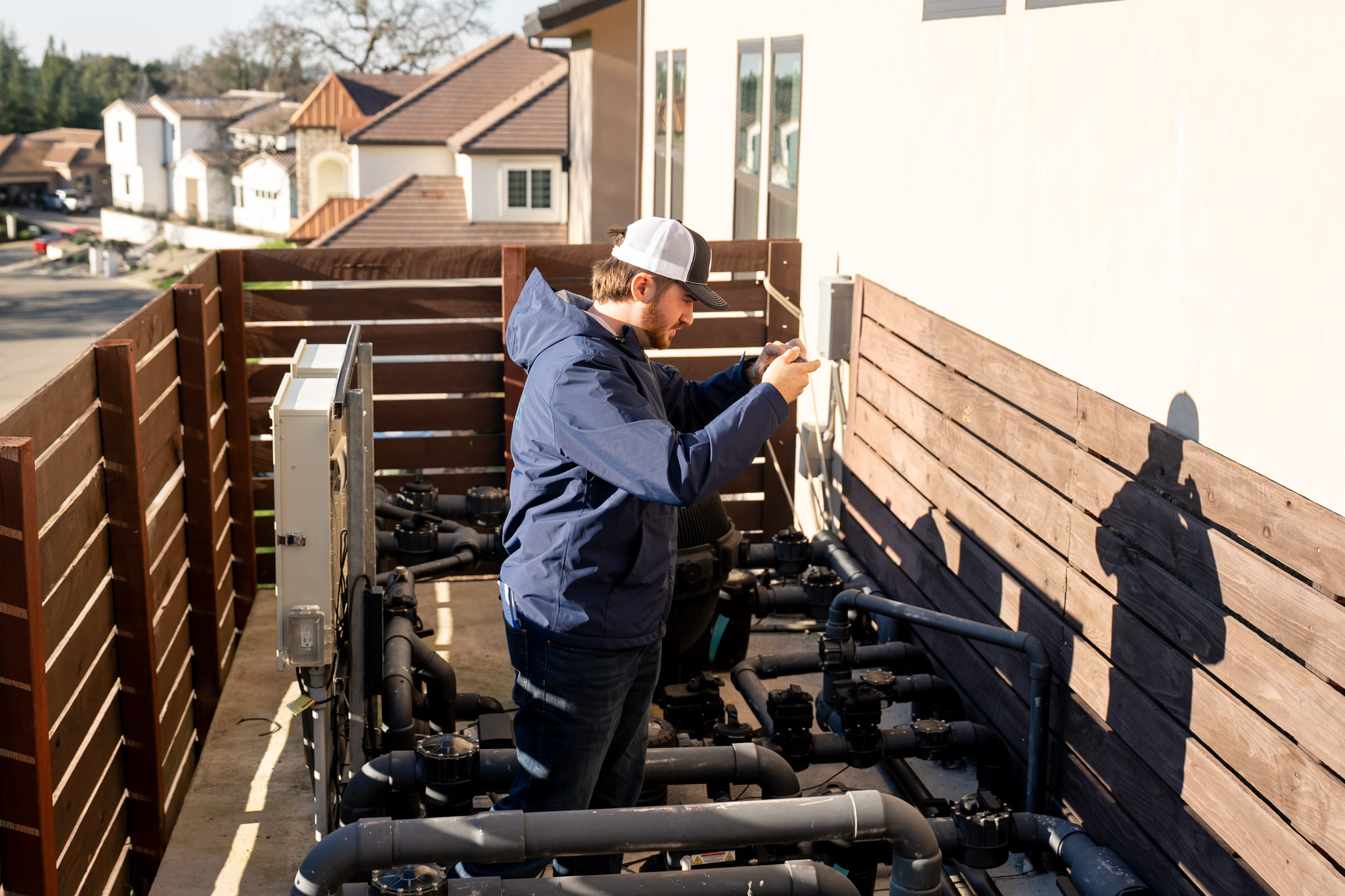
The most common automation call sounds like this: you open the app to start the cleaner, the screen spins, and it reports that the controller is offline. You walk out to the equipment pad and the panel lights are on, the display is awake, the pump is silent, and the spa valve is sitting halfway between pool and spa. Nothing looks broken, which is exactly what makes automation faults frustrating.
These faults almost never have a single cause. Sometimes it is a relay that welded itself shut after years of switching a two horsepower pump. Sometimes it is an actuator whose plastic gears stripped, so the motor hums and the valve never turns. Sometimes the controller is perfectly healthy and the wireless bridge simply lost the router after a firmware push. The correct fix depends entirely on which link in the chain failed, and the only way to know is to test the chain in order instead of guessing at parts.
That is the approach we take on automation system troubleshooting in Manteca. Nevergreen Pools works in partnership with Vintage Pool Service, which has run its shop and retail store on East Yosemite Avenue for years and has seen every generation of pool control gear installed in this town, from mechanical time clocks to the current app driven systems. Between the two crews, most calls get diagnosed on the first visit.
An automation system is a chain, and every call comes down to finding the broken link. Power arrives at the panel, the controller runs the logic, relays switch the loads, actuators turn the valves, and sensors report back what is happening in the water. A network radio or communication card sits on top of all of it so the app can talk to the board. Test that chain in order with a meter and the answer shows up quickly. Start by swapping parts and you can spend a week and a lot of money and still have a pool that will not turn on.
The faults that come up most often fall into a short list:
Each of those has its own test. A relay gets checked for coil voltage and continuity across the contacts. An actuator gets pulled, cycled by hand, and inspected for gear damage and correct cam position. A sensor gets read for resistance and compared against the temperature it should be reporting. Connectivity gets checked at the board first, then the radio, then the house network, in that order, because most of the time the pool is fine and something inside the house changed. Once the failed component is identified, the repair itself is usually small.
Voltage gets checked at both ends of the chain, not just at the panel. A loose lug on a load terminal or a corroded bonding connection will pass a quick look and still drop enough voltage under load to make a pump stall or a relay chatter. On variable speed pumps the drive has its own control wiring and its own fault log, so the drive gets read before the board gets blamed. A pump that ignores the automation but runs fine on its own keypad is a communication problem, not a pump problem.
Before we leave, the working configuration gets written down: pump speeds and run times for each program, valve positions for pool, spa, and spillover, heater setpoints, freeze protect temperature and the speed the pump runs at during freeze, and the firmware version on the board. If the controller loses its memory in the next outage, that sheet puts it back in ten minutes instead of an hour. On boards with a backup battery, the battery gets tested and replaced if it is weak, because a dead battery is what turns a five second power blip into a wiped schedule.


Manteca water is hard. High calcium and high alkalinity mean pH climbs on its own and scale builds on tile, inside heat exchangers, and across the flow and temperature sensors that automation depends on. A scaled temperature probe reads low, so the controller keeps calling for heat the water does not need. A scaled flow switch can stop closing entirely, which makes the board shut the heater down and throw a fault that has nothing to do with the heater itself. Cleaning or replacing those sensors and getting the chemistry back in balance resolves more heater faults than any control board ever does.
Orchard dust is the other problem. Fine dust blows into the pool and onto the equipment pad all season, heaviest at bloom in spring and again through harvest. It settles inside panel enclosures, coats relay contacts, and packs into the cooling vents on variable speed drives. Pad temperatures run over 100 degrees from late May into October, so boards are already running hot and the dust acts as insulation on top of that. Keeping the enclosure sealed, the gasket intact, and the vents blown clear buys years of service life. Cold, foggy winter mornings put freeze protection to work regularly, and that is when a bad air sensor announces itself.
Older plaster pools often had controls added long after the pool was built, with retrofit wiring and mismatched parts stacked up over the years. Newer pebble finish pools came with a full system from day one. We service the same gear in Lathrop, Ripon, and Tracy, so parts for both generations stay on the truck.
Not every failure is worth repairing in place. If the board is a current generation, parts are available, and the rest of the system is healthy, a relay, an actuator, a sensor, or a firmware update puts it back to work for a fraction of what a new system costs. If the controller is a discontinued model, the manufacturer no longer supports the app it was built for, and three of the four relays have already been replaced, you end up paying twice: once to keep it limping and again when it quits next season. In that case a retrofit that reuses the existing valves, conduit, wiring runs, and mounting is the better spend. Most retrofits are a one day job because the plumbing does not change, and the actuators and sensors can often be carried over if they test good.
You get told which situation you are in before any work begins, and if the honest answer is that your system has five good years left, that is what you will hear. Either way, you get a clear account of what failed and why, which is the point of automation system troubleshooting in Manteca.
Related services in Manteca: Automation & Control Systems in Manteca and Pool Heater Repair in Manteca.