We respond same day.
Emergency services available!
Professional Pool Service
Filter Cleaning in Manteca
Cartridge, sand, and DE filter cleaning in Manteca, CA. We hose, soak, backwash, and recharge, then set a clean pressure baseline for your pool.
Professional Pool Service
Cartridge, sand, and DE filter cleaning in Manteca, CA. We hose, soak, backwash, and recharge, then set a clean pressure baseline for your pool.
It usually starts the same way. The pool looked fine in April, and now it is mid July, the pump is running its full schedule, and the water has gone dull. You check the gauge on the filter tank and it reads eight or ten pounds above where it sat when the pool was opened. The returns push weak, the sweep drags and stalls in the deep end, and a fine gray film keeps settling on the steps a day after you brush it. Nothing is broken. The filter is simply full.
That is the normal cycle in Manteca. The city sits at the junction of Highway 99 and Highway 120 with almond orchards on nearly every side, and those orchards give up dust all summer and petals every spring. The delta breeze that finally cools things off after a 104 degree afternoon carries that dust straight across the water. Add municipal water that runs high in calcium and alkalinity, and a filter here takes on two loads at once, organic debris packing the outside and mineral scale working into the media itself.
Nevergreen Pools handles filter cleaning in Manteca in partnership with Vintage Pool Service, whose shop and retail store sit on East Yosemite Avenue. That means a tech who has pulled filters on the older plaster pools in the center of town and on the newer pebble finish pools out in the subdivisions, and who knows what a cartridge in this part of the valley actually looks like at the end of a hot season.
The first move is a pressure reading taken with the pump running and the system fully primed. That number only means something next to the clean starting pressure for that same filter. If clean was 12 pounds and the gauge now reads 20, flow is restricted enough to hurt circulation, heater performance, and the sweep. Waiting much past that point costs more than the cleaning does, because a starved pump runs hot and a heater that cannot get enough flow will start shutting itself down on its high limit.
On a cartridge system the elements come out of the housing and get spread open. A garden hose with a straight nozzle, not a pressure washer, gets worked down every pleat from top to bottom on both faces. Pressure washers drive grit into the fabric and split the pleats, and a split pleat sends dirt right back to the pool. Once the loose dirt is off, the elements go into a soak, because sunscreen, body oil, and the waxy film off orchard bloom bind fine dust into the fabric where water alone will not reach. A degreaser soak overnight and a rinse pulls that out. If the pleats still feel stiff and chalky afterward, that is calcium out of Manteca tap water, and it takes a separate dilute acid soak, done after the degreaser and never mixed with it, then a heavy rinse before anything goes back in the tank.
The signs that a filter has gone too long are consistent:
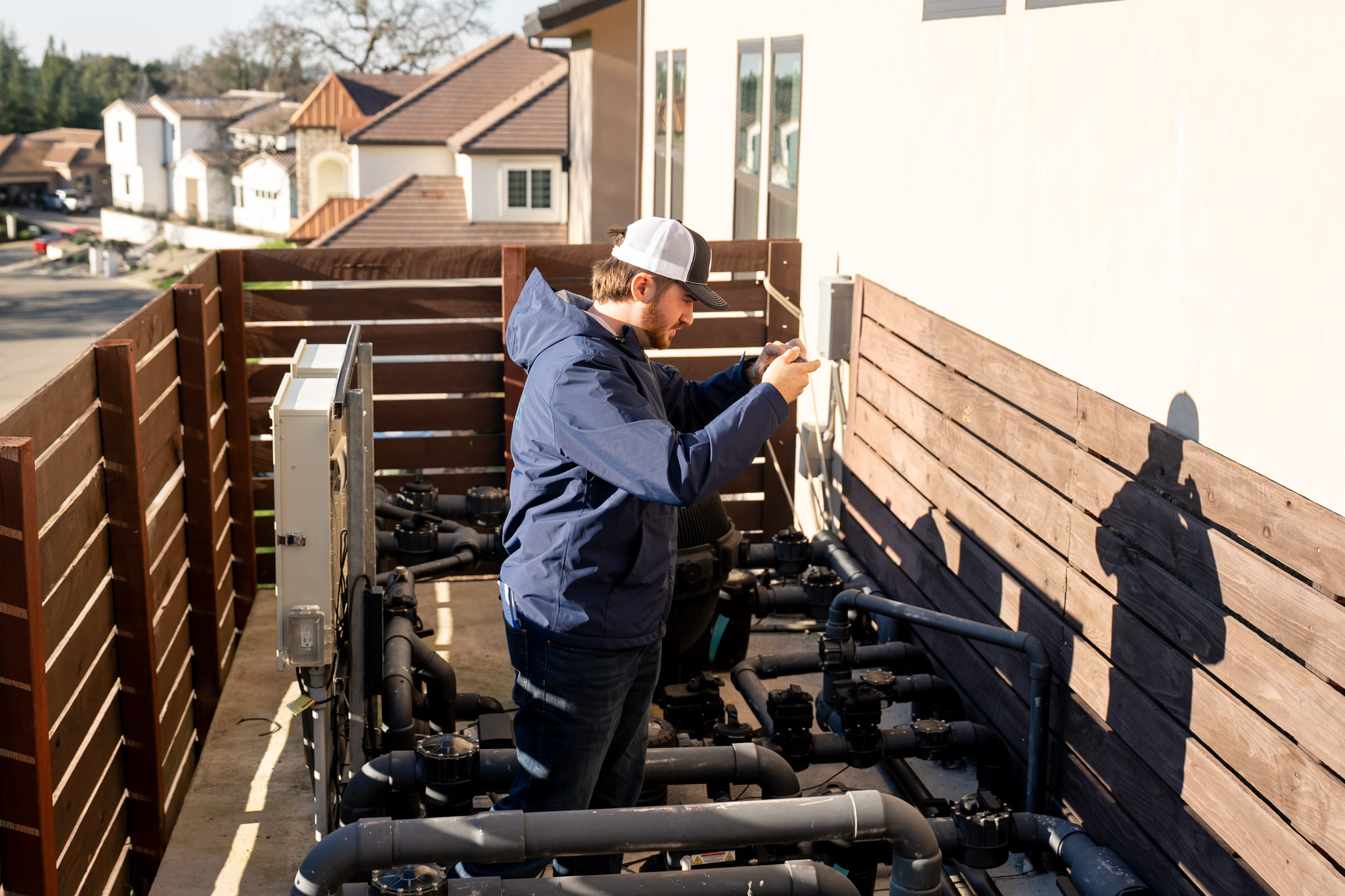
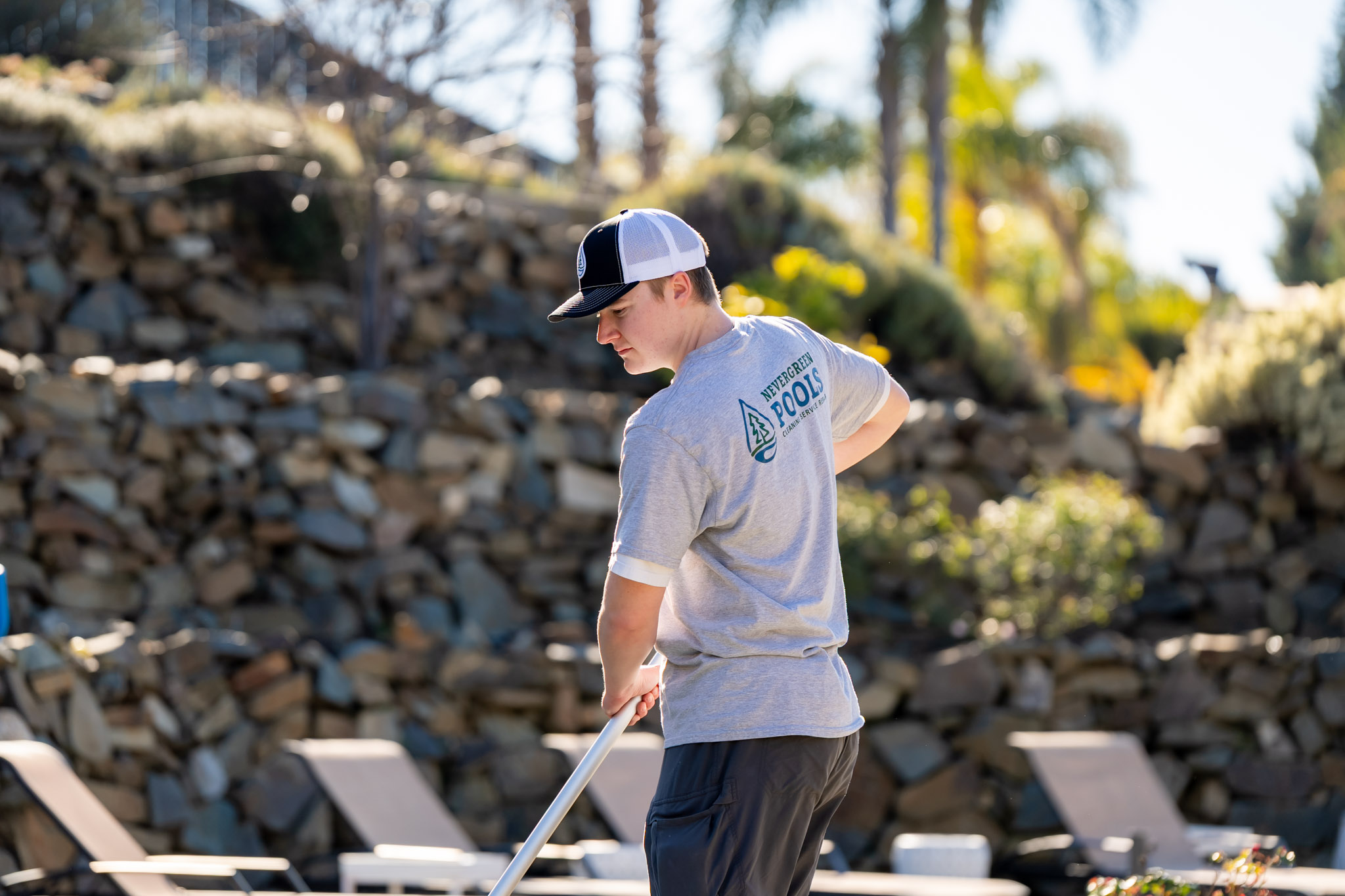
A sand filter gets backwashed rather than taken apart. Valve to backwash, pump on, run until the sight glass runs clear, then rinse for roughly thirty seconds to settle the bed before going back to filter. Backwashing costs a fair amount of water and it does not touch oils or scale, so a sand filter in Manteca also needs a chemical clean once or twice a year, with the media raked and treated to break up the grease that turns loose sand into a channeled crust. Sand that has been in service more than five or six years in this climate is usually worn round, and no cleaning brings back the sharp edges that catch fine dirt.
DE filters backwash the same way and then take a fresh charge of powder through the skimmer, measured to what the manufacturer calls for on that grid area. Short charging is a common mistake and it lets the grids blind over with dirt sitting directly on the fabric. Twice a year those grids should come out for a full teardown, hose, and soak, because a season of Manteca dust and bloom will pack the manifold solid, and a teardown is also the only reliable way to catch a split grid before it starts blowing powder back into the pool.
Timing matters more here than in most places. The schedule for filter cleaning in Manteca is set by dust and bloom, not by the calendar. Most cartridge systems in town, and in Lathrop, Ripon, and Tracy, want a hose and soak every three to four months, while pools downwind of orchards often need it closer to every eight to ten weeks through the summer. A heavy bloom in February and March can load a filter in a matter of weeks. Fall leaves and the first tule fog do the same at the other end of the year. The gauge settles the argument. When it climbs eight to ten pounds over clean, it is time, whatever the calendar says.
A cartridge is finished when a full cleaning no longer drops the pressure back near where it started, when the pleats stay gray after a proper soak, when the fabric feels thin and limp, or when the end caps have begun to pull away from the fabric. Bands of pleats collapsed flat against each other are done as well, because a collapsed section filters nothing. Most cartridges give two to three years of service in Manteca, less if the pool sees heavy use or the filter is undersized for the pump. Running a worn element is a slow drain on the whole system, since the pump works harder, the water stays hazy, and chlorine gets burned on dirt that should have been trapped.
Every service ends the same way: clean and lubricated O rings, the housing reassembled and the air purged off the top of the tank, and a fresh clean pressure reading written down so the next cleaning has something real to measure against. If your water in Manteca has gone flat and the gauge has been creeping up since spring, the filter is the first place to look.
Related services in Manteca: Filter Repairs in Manteca and Pool Maintenance in Manteca.