How we run a pool rebalance in Manteca
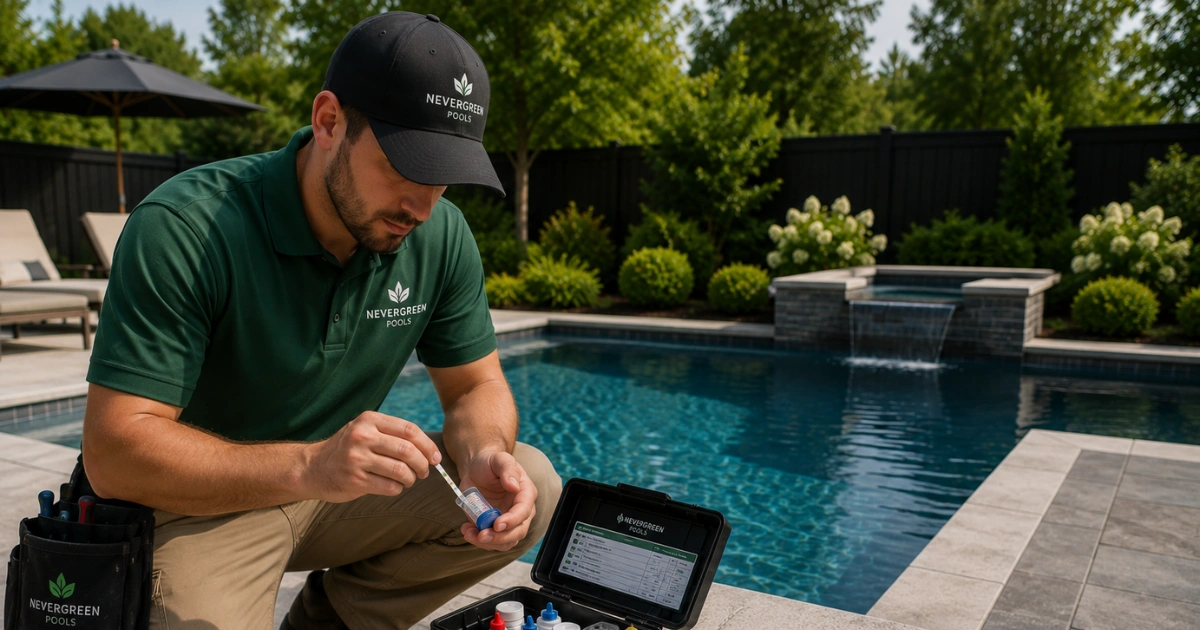
The first step is a real test, done on site with a full panel and not a strip: pH, total alkalinity, calcium hardness, cyanuric acid, free and total chlorine, and salt if the pool runs a chlorine generator. Those numbers feed the Langelier Saturation Index, the single figure that tells you whether the water is scaling, etching, or sitting neutral. It weighs pH, temperature, calcium, and alkalinity together, which is why a reading that looks acceptable on its own can still be a problem. Calcium at 500 with pH at 7.8 in an August pool at 88 degrees is scaling water, even though no individual number looks alarming.
Corrections then run in sequence, because the order changes the result.
Alkalinity first. Total alkalinity comes down with muriatic acid before pH gets chased, otherwise pH climbs right back where it was. On hard Manteca fill water we usually aim for the lower end of the range so the water has somewhere to move without dragging pH up with it.
pH second. Once alkalinity is settled, pH stays where it is put. Most Manteca pools land around 7.6, sometimes 7.4 on one with high calcium, whatever keeps the saturation index balanced.
Stabilizer and calcium next. Neither of these can be lowered with a chemical. Cyanuric acid builds from every tab and every bag of dichlor, and past roughly 80 parts per million it locks up chlorine so the sanitizer reads fine and does very little. Calcium hardness climbs from years of topping off with hard water. The only real fix for either is dilution, so part of the pool gets drained and refilled. How much depends on how far out the readings are, and it gets done in stages, never all at once. A fully drained pool sitting in valley clay can float or crack, and that is a far more expensive problem than the one you started with.
Chlorine last. Only after everything else is in range does the sanitizer do its job. If the pool has gone green or the water is loaded with organics from orchard dust and leaf drop, that means a shock dosed against the combined chlorine reading, then a long enough filter run to pull the dead material out, with a backwash or cartridge clean partway through once pressure climbs.
Holding it after the correction
Getting the numbers right once is the easy half. The fill water starts pushing them back the moment the hose goes on, so what happens in the following weeks matters. For the first week or two the water gets tested more often and adjusted in small increments, since a freshly corrected pool moves faster than a stable one. After that it settles into a normal weekly rhythm.
Finish and equipment change the targets. The newer pebble pools in the subdivisions out toward the Highway 99 and Highway 120 junction tolerate a slightly harder profile than the older plaster pools closer to the middle of town, and any pool with a heater needs a tighter saturation index than one without, because scale forms first on the hottest surface in the system. The same hard supply feeds Lathrop, Ripon, and Tracy, so the pattern is familiar across this corner of San Joaquin County, but no two pools get the identical set of target numbers.
If your water has been out of range for a while, stop feeding it chlorine and get it tested properly. Find out whether it is scaling or etching, then correct it in order.
Related services in Manteca: Chemical Treatment in Manteca and Algae Removal in Manteca.