Professional Pool Service
Automation System Troubleshooting in Modesto
Automation troubleshooting for pools in Modesto, CA. We fix dead controllers, stuck valve actuators, lost app control, and freeze protect faults.
Professional Pool Service
Automation troubleshooting for pools in Modesto, CA. We fix dead controllers, stuck valve actuators, lost app control, and freeze protect faults.
Pool automation in Modesto works against a predictable set of conditions. Almond and walnut bloom loads pool water with pollen in February and March, orchard harvest puts fine dust in the air through August and September, and street trees drop leaves in volume through November. A controller that ran clean all winter starts acting up the same week the filter loads with pollen, and that is not a coincidence. Automation does not fail in a vacuum. It reports what the plumbing, the flow, and the electrical are actually doing, and a large share of the calls we take are the system telling the truth about something else.
The rest are genuine faults. A relay that clicks but never closes. An actuator that hunts past its stops and parks halfway between pool and spa. A controller that dropped off the home network after a router swap and never found its way back. Those are mechanical and electrical problems with a screen attached, and sorting one type from the other is the entire job. It is also why guessing gets expensive. Boards get replaced when a ten dollar sensor was reading twelve degrees off, and the fault comes right back the following week.
Nevergreen Pools handles automation system troubleshooting in Modesto in partnership with Vintage Pool Service, a longtime Central Valley company working out of East Yosemite Avenue in Manteca. We work on the full spread of equipment, from twenty-year-old boards with mechanical relays to current systems with app control and variable speed pumps on a data bus.
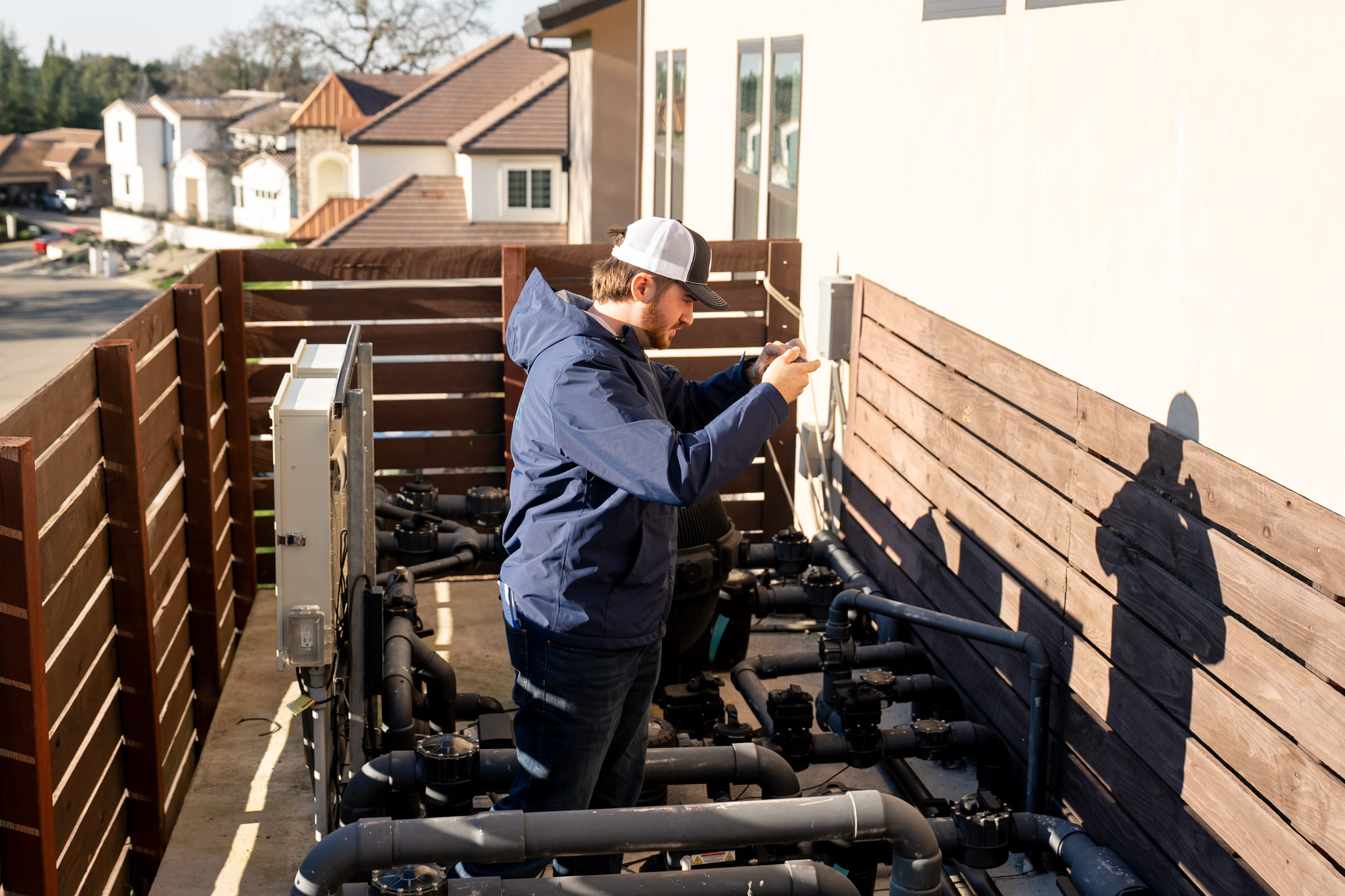
February and March put real load on a system that has been idling since fall. Almond bloom, then walnut, drifts into open water, the filter loads faster than anyone expects, and flow drops. That matters more than it sounds, because most automation decisions ride on flow. A heater will not fire without a satisfied flow switch or pressure switch, and when it refuses, the controller displays a heater fault. The homeowner calls about the automation. The actual problem is a cartridge packed with blossom or a grid that needs breaking down. We check filter pressure and flow at the pad before anyone opens a control panel, every single time.
Spring is also when freeze protect starts misbehaving. Nights still drop into the thirties through March while afternoons run warm, so the pump kicks on and off at odd hours and the homeowner assumes the schedule is broken. Two causes account for nearly all of it. Either the air temperature sensor is mounted somewhere it reads wrong, bolted to a wall that catches afternoon sun or tucked behind equipment where heat pools, or a freeze setpoint got raised years ago and nobody remembers doing it. A sensor reading badly off will run a pump all night in April for no reason at all and show up on the power bill in May.
What we typically find on a spring service call:
Heat runs hard from May through October, and the equipment pad takes it worse than the pool does. Long runtimes mean relays cycle more often, and mechanical relay contacts pit and eventually stop passing current. The classic symptom is a controller that reports everything correctly while nothing happens outside. The screen says the cleaner pump or the heater is on, the coil side has control voltage, and there is no load voltage coming out. That is a relay, and it is a clean replacement once the diagnosis is confirmed with a meter instead of assumed. We check the coil side and the load side separately, and we check the panel for heat damage while we are in there, because a scorched terminal or a discolored trace next to the relay socket means the connection was loose long before the relay failed.
Heat is also hard on communication. Variable speed pumps talk to the controller over a low voltage data cable, and that cable often shares conduit with line voltage or lies exposed to the sun for years. Once the jacket goes brittle and the conductors chafe, the pump falls back to its onboard default speed and ignores every schedule sent to it. The pool looks like it is running fine, but the automation has lost the ability to change anything, and no amount of tapping the app will fix it. Reterminating or rerunning that cable solves what looks like a dead controller.
App connectivity fails more in summer than any other season, and the reason has nothing to do with temperature. People change routers, change Wi-Fi passwords, or switch internet providers, and the automation gateway sitting in a metal enclosure well away from the house was already living on a marginal signal. It cannot authenticate, so it goes dark in the app while the local panel keeps working perfectly. Reconnecting it usually means addressing signal strength honestly rather than repeatedly re-pairing a device that cannot hear the access point.


August and September are the hardest stretch of the year on this equipment. Harvest dust drifts a long way and settles into pool water as a fine grit that loads a filter very differently than leaves do. Pressure climbs, flow falls, and the system starts throwing the same flow related faults we see during bloom, except now with a heater demand on late summer evenings stacked on top. Salt systems are the tell. A chlorinator reporting low output at the end of August is very often reporting low flow, not a dying cell, and replacing the cell without cleaning the filter fixes nothing. Before we condemn a cell we check filter pressure, verify the flow switch, and pull the cell to look at the plates, since a cell with clean plates and a low output reading is a flow problem or a wiring problem every time.
Water chemistry plays into this too. Much of Modesto is on treated irrigation district surface water, which is moderately soft and easy on equipment. Outlying properties still pull hard well water, and those pools scale. Scale builds on salt cell plates and coats temperature sensors, and a coated sensor lags badly, which makes the heater short cycle or the freeze logic trip late. When a system out toward the edge of town has three unrelated sensor complaints at once, hardness is usually the common thread. We check a suspect sensor against a thermometer in the same water before replacing it, because a lagging sensor and a failed sensor call for different work.
By late October leaf drop overwhelms skimmers, the cleaner circuit loses suction, and debris works into diverter valves where actuators have to fight it. An actuator straining against a jammed diverter will strip its gear set or trip its internal limits, and the panel reports a valve error that has nothing wrong with the electronics. Pulling the valve lid and clearing the diverter is the repair. Replacing the actuator without doing that just breaks the new one. Once the valve turns freely by hand we reset the actuator stops so it lands square on pool and spa instead of splitting flow between them.
Tule fog and cold wet nights make freeze protection the one function that genuinely has to work from December through February. Unattended pools are where this bites, because nobody notices a failed freeze cycle until there is damage. We test it rather than trust the display, forcing a freeze cycle to confirm the pump actually starts, the valves rotate to the programmed position, and the setpoint matches the sensor reading. Winter is also the sensible window for firmware updates, which sometimes restore app features that broke after a manufacturer server change, and it is when we sort out schedules that drifted through daylight saving time.
Winter is when the honest replacement conversation happens. A board is worth repairing when one section failed, the chassis and transformer are sound, and parts are still available for that generation. A full retrofit makes sense when relays, the power center, and the communication side are all going at once, when the manufacturer no longer supports the platform, or when someone wants reliable app control on a system that was never designed for it. Every call for automation system troubleshooting in Modesto ends with proving what failed before anything gets replaced. We meter the board, verify sensors against a thermometer, move actuators by hand, and confirm flow at the pad. Most visits end with a sensor, an actuator, or a relay, and when a board truly is finished, we say so and lay out both options plainly.
Related services in Modesto: Automation & Control Systems in Modesto and Pool Heater Repair in Modesto.