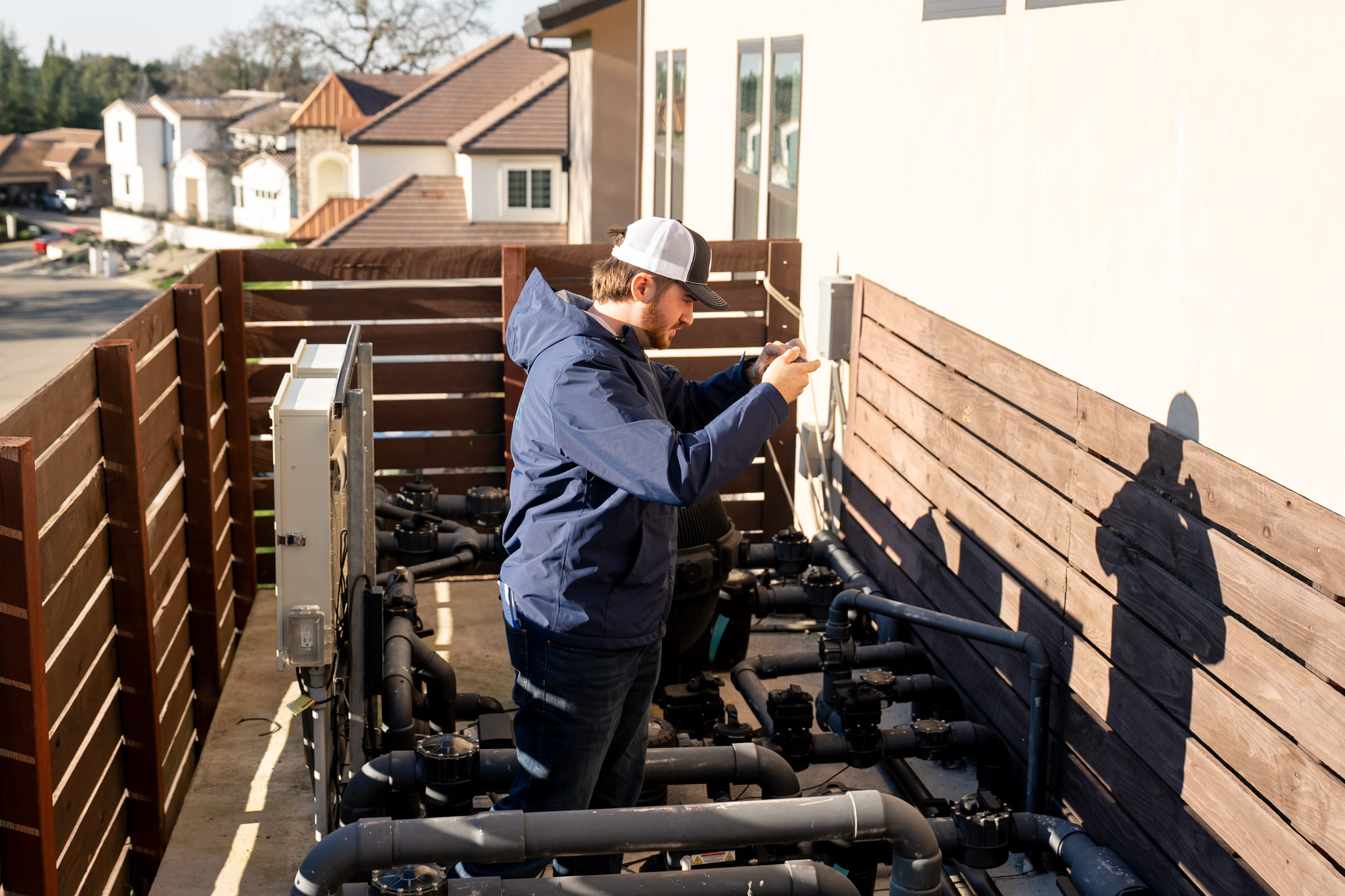
A pool heater in Modesto lives on the same calendar as the orchards around it. Almond bloom in February and March coats everything in a fine yellow film, the shakers roll through in August and September and put dust in the air for weeks, and the mature street trees in the older parts of town drop leaves onto equipment pads through November. A gas heater or a heat pump sitting in that air is pulling combustion air or condenser air through it every time it runs, and most of the failures we get called on trace back to something that started as a housekeeping problem months earlier.
The work itself is straightforward mechanical diagnosis. Ignition failures, pressure switch faults, cracked or fouled igniters, scaled heat exchangers, high limit trips, control board error codes, and on heat pumps, refrigerant charge and airflow problems. What changes from house to house is the water and the pool itself. Homes served by Modesto Irrigation District get treated Tuolumne River surface water, which is moderately soft and easier on a heat exchanger. Properties on the outskirts running well water are dealing with hardness that plates the tubes and slowly chokes flow. Older plaster and gunite pools near Graceada Park and along the McHenry corridor often have gas runs and plumbing that were sized decades ago, while newer builds on the east side of Modesto come with low NOx heaters and automation that reports faults but does not always report them accurately.
Nevergreen Pools handles pool heater repair in Modesto in partnership with Vintage Pool Service, a longtime Central Valley company working out of its shop on East Yosemite Avenue in Manteca. That combination puts a tech on the pad who already knows which heaters went into these yards, which parts are still available, and which model is not worth another repair bill.
Spring in Modesto: Bloom Pollen and the First Real Startup
February and March bring the almond and peach bloom, and for a few weeks the air in Stanislaus County carries a pollen load heavy enough to see on a car hood. That pollen settles on the combustion air intake, on the burner tray, and on the flame sensor. A gas heater that shut down clean in November will often refuse to light in April, and the fault is rarely the part a homeowner suspects. Nine times out of ten it is a dirty flame rod that no longer proves flame, a spider or wasp nest built in the burner venturi during the quiet months, or an igniter that has cracked and now draws current without reaching temperature.
Spring is also when a scaled heat exchanger announces itself. Through the winter the heater sat idle and whatever mineral was on the tubes hardened. On the first long heating cycle the water cannot carry heat away fast enough, the exchanger overheats, and the high limit switch trips. Homeowners read that as the heater shutting itself off for no reason. On a well water property outside the Modesto city limits that is usually real scale, and the exchanger has to come apart to be cleaned or replaced. Inside town on Modesto Irrigation District water it is more often a flow problem, a loaded filter, a partly closed valve, or a variable speed pump programmed to run the heat cycle at too low an RPM to satisfy the pressure switch.
Summer: Harvest Dust and Heat Pump Season
From May through October the ambient air does most of the heating work and the calls change character. Heat pumps carry the load in this stretch because they are efficient when the air is warm, and Modesto gives them plenty of warm air. Their weakness is airflow. The evaporator coil is a large fin surface sitting outdoors, and when the shakers hit the almonds in August and September that coil packs with dust and orchard debris in a matter of weeks. A packed coil raises head pressure, drops output, and eventually trips the unit on a high pressure fault. Half the summer heat pump calls in Modesto are solved with a proper coil wash and a fin comb rather than any parts at all.
Real refrigerant problems present differently, and the difference matters before anyone starts talking about a compressor:
- Low charge from a slow leak: long run times, weak temperature rise across the unit, frost on the suction line on cooler mornings.
- Restricted metering device: the unit runs but output never climbs and the coil frosts unevenly.
- Failed reversing valve on a heat and cool model: the unit runs steadily and the pool gets colder instead of warmer.
- Failed capacitor or contactor: the fan spins, the compressor hums or clicks, and nothing else happens.
Gas heaters do not get a summer break either. The same harvest dust that loads a heat pump coil gets pulled into a combustion chamber and settles on the burners, which produces uneven flame, sooting, and the kind of nuisance lockout that clears on a reset and comes right back a week later.
Fall and Winter: Leaf Drop, Fog, and Hard Starts
The mature street trees in the older parts of Modesto drop heavily from late October into December, and leaf litter is harder on equipment than most people expect. Leaves in the skimmer and pump basket starve the pump, flow falls below what the pressure switch needs, and the heater short cycles or refuses to fire at all. Leaves piled against the cabinet block the vent and the combustion air path. If the pool sits under a big tree, the most useful thing a homeowner can do before winter is keep the baskets empty and the pad clear.
Cold nights and winter fog are when marginal components finally quit. A hot surface igniter that was weak in October will not reach temperature on a forty degree morning. A gas valve with a tired solenoid opens late or not at all. A pressure switch with a corroded diaphragm reports low water pressure that is not actually low. Condensation inside the control compartment during a long run of tule fog corrodes terminals and throws error codes that come and go with the weather, which is why intermittent faults reported in December usually turn out to be wiring and connections rather than the board itself.
When Repair Beats Replacement
Age and parts availability decide it. A gas heater under about eight years old with a healthy heat exchanger is almost always worth repairing, because the expensive part is intact and everything else, igniters, valves, switches, sensors, and boards, is replaceable. Past twelve years the math changes fast. Exchangers on older units corrode from the inside, manufacturers discontinue control boards, and a repair that would have been reasonable at year six becomes a hunt for a board that has not been built in three years. On heat pumps, a sealed system failure such as a dead compressor on a unit past ten years is usually the end of the line, while board, fan motor, and capacitor failures are worth fixing at nearly any age.
The other factor is what a repair does not fix. Replacing a scaled heat exchanger on a well water property without addressing water chemistry only resets the clock on the same failure, which is a real consideration outside the core of Modesto where the well water runs hard. When we quote pool heater repair in Modesto we say plainly which repairs are durable and which are stopgaps, so nobody spends good money twice on the same unit.
Related services in Modesto: Heater & Heat Pump Installation in Modesto and Automation Troubleshooting in Modesto.