Modesto sits on the Tuolumne River with almond, walnut, and peach orchards running in every direction, and that farmland sets the rhythm of the swim season here. Air temperatures climb fast in May and stay hot through October, but the water in an unheated pool lags well behind the air. April and early May afternoons feel like swimming weather until you actually get in. October does the same thing in reverse. A properly sized heater or heat pump closes that gap on both ends and turns a three month pool into a seven or eight month pool.
There are two ways to add heat, and they are not interchangeable. A gas heater burns natural gas or propane and produces heat on demand, raising water temperature quickly for a weekend or an evening. An electric heat pump pulls warmth out of the surrounding air and moves it into the water. It works slowly and steadily, costs far less per degree, and performs unusually well in Modesto because it has hot valley air to draw from for half the year. Choosing between them, or running both, depends on how you actually use the pool rather than on which unit looks better on paper.
Nevergreen Pools handles heater & heat pump installation in Modesto in partnership with Vintage Pool Service, a longtime Central Valley company operating from East Yosemite Avenue in Manteca. That combination means the sizing, the gas work, and the electrical planning are done by people who have put equipment on both the older plaster and gunite pools near Graceada Park and the newer builds on the east side of town.
Sizing Comes Before Anything Else
The first number that matters is gallons. A rectangular pool sixteen by thirty two with an average depth of five feet holds close to nineteen thousand gallons, and every gallon weighs a little over eight pounds. It takes roughly one BTU to raise one pound of water one degree, so lifting that pool twenty degrees takes somewhere near three million BTUs of delivered heat. A four hundred thousand BTU gas heater running at eighty four percent efficiency puts out about three hundred thirty six thousand BTUs an hour, which means most of a day to come up from cold and about an hour to recover a few degrees lost overnight. Undersize the unit and it runs constantly without ever catching up. Oversize it and you pay for capacity the gas meter cannot actually feed.
Heat pumps are rated differently. Instead of burning fuel they move heat, and their efficiency is described by COP, the ratio of heat delivered to electricity consumed. A good unit returns four or five units of heat for every unit of power at eighty degree air, which is why they suit Modesto so well from late April through September. That number falls as the air cools. By the time the fog settles in December, a heat pump is working hard for very little. Heat pumps also raise water slowly, usually a degree or two an hour on a covered pool, so they are a set it and forget it tool rather than a Saturday morning tool.
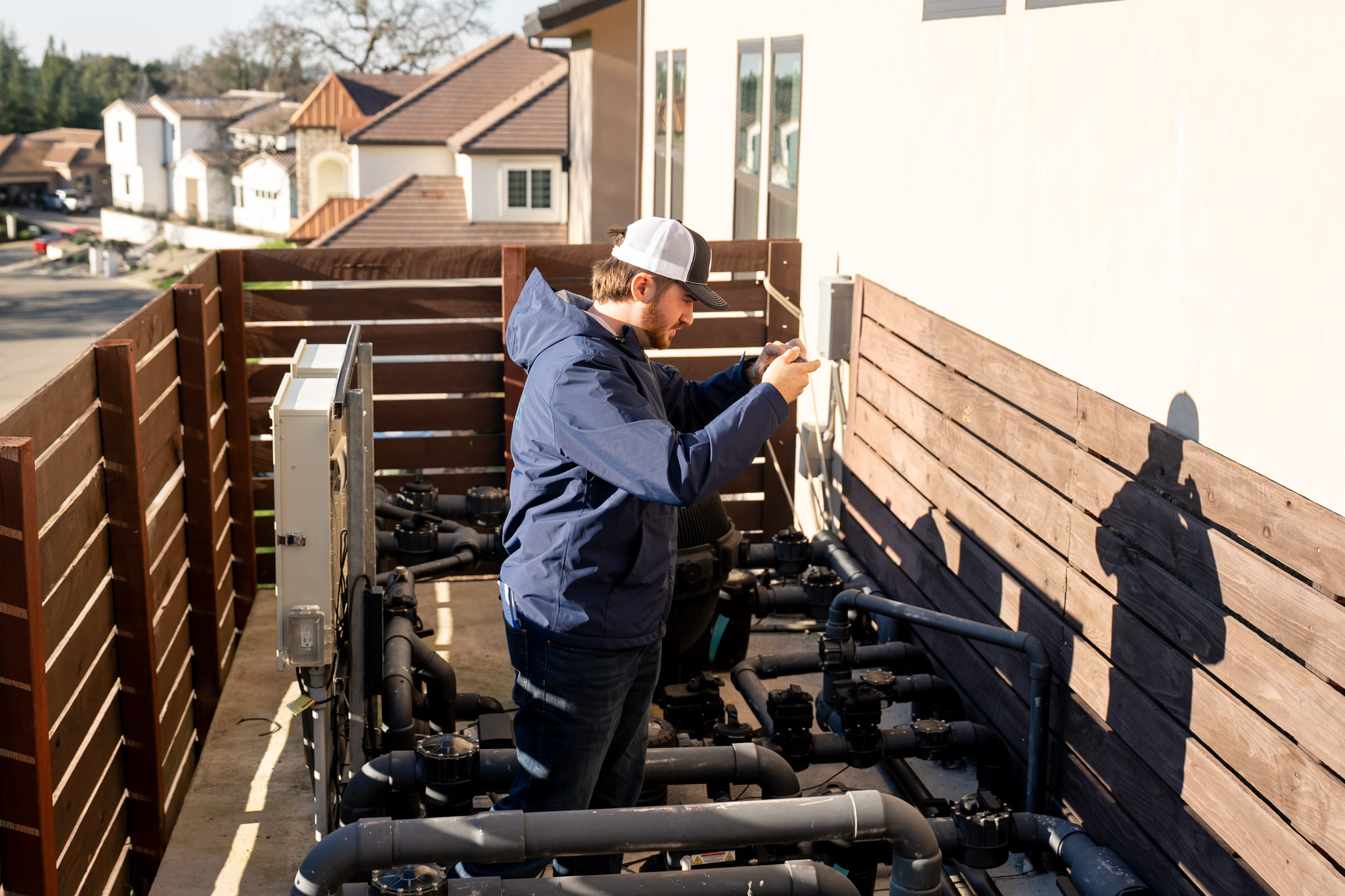
Before quoting anything, we walk the equipment pad and the gas and electrical service. The list is short, but nothing on it is optional:
- Volume and target temperature. Gallons, average depth, and how warm you actually want the water, since every extra degree costs real money to hold.
- Exposure. Wind across an open lot, shade from mature trees, and whether the pool has a cover, which changes heat loss more than any other single factor.
- Gas capacity. Meter size, existing line diameter, and total run length from the meter to the pad.
- Electrical capacity. Available panel space, distance to the pad, and whether the existing bonding grid is intact.
- Pad layout. Room for clearances, room for airflow, and enough straight pipe to plumb a bypass correctly.
Gas, Air, and Water Have to Line Up
Most failed heater installs in Modesto are not equipment failures, they are supply failures. A four hundred thousand BTU heater needs a gas line sized for its demand and for its distance. A half inch line that fed an old one hundred seventy five thousand BTU unit will starve a modern heater, and starved heaters soot up, trip on flame sensing, and burn through parts. Propane systems need their own orifice set and a regulator sized for the load, which comes up often on properties out past the orchards where natural gas does not reach. Venting is the other half of the gas side. Outdoor top vented heaters need clearance from windows, doors, overhangs, and anything that moves air, and that clearance is a code requirement, not a suggestion.
Heat pumps have the same problem in a different form. They need open air. Set one in a tight fence corner or under a low eave and it will recycle its own chilled discharge air, lose capacity, and ice its coil in cool weather. On the water side, both types get a bypass so full pump flow is not forced through the heat exchanger and so the unit can be isolated for service without draining the system. Order on the pad matters too. The heater goes after the filter and ahead of the chlorinator or salt cell, so concentrated sanitizer never sits against copper. Electrically, a heat pump wants its own two hundred forty volt circuit with the correct breaker and conductor size, bonded to the pool's equipotential grid like every other piece of metal out there.
Heating a Modesto Pool Season by Season
The orchards set the calendar around here, and heating equipment feels every part of it. Bloom comes in February, and by March and April the pollen is on everything. On a heat pump, that pollen lands in the evaporator coil, packs into the fins, and chokes the airflow the unit depends on. A coil that cannot breathe loses efficiency quietly, and most owners never notice until the power bill climbs. Spring is also when gas heaters get their first real call of the year, which is when we find the rodent nests and spider webs that built up in burner trays over a wet winter. A spring startup on a Modesto pool is half heating and half cleaning.
Summer is the easy stretch. From May through October the air runs hot, and a heat pump pulling from ninety five degree air is doing the best work it will do all year, often holding a pool in the mid eighties for less than it costs to run the filter pump a few hours longer. Many owners barely touch the heater in July. What summer does bring is dust. When the shakers move through the almonds in August and September, everything within a few miles of an orchard takes a fine coat of it, and that dust goes straight into filter media and heat pump coils. Rinsing a coil twice during harvest keeps a unit performing the way it did in June.
Fall is the season heating equipment actually earns its keep, and the season most people forget to plan for. October and November afternoons still reach eighty degrees while the water slides down into the sixties. It is also when the mature street trees along the older parts of town and the McHenry corridor drop everything at once. Leaves fill skimmer baskets, flow falls off, and a heater that loses flow will trip its pressure switch and shut down. Owners read that as a broken heater when it is really a full basket. Fall is the best window of the year to schedule an install, because crews are not backed up the way they are in May.
Winter changes the tool. Tule fog and forty degree mornings put a heat pump well outside its efficient range, so gas is what gets a pool warm in January. Water chemistry matters more than people expect through the cold months. The treated Tuolumne River water that Modesto Irrigation District delivers to much of the city is on the soft side, and water low in calcium is aggressive toward the copper in a heat exchanger. Properties running hard well water outside the city have the opposite problem, with scale building on the tubes until the heater short cycles on high limit. Balanced water is the cheapest heater repair there is.
Good heater & heat pump installation in Modesto comes down to this: honest sizing, gas and electrical work done to the actual load, a pad laid out so the equipment can breathe, and a plan that accounts for pollen in April, harvest dust in September, and leaves in November. Get those right and the equipment runs quietly for a decade. Get them wrong and you spend that decade chasing the same shutdown.
Related services in Modesto: Pool Heater Repair in Modesto and Automation & Control Systems in Modesto.