Professional Pool Service
Sanitizer Systems (UV & Chlorination) in Modesto
UV, ozone, salt and tablet sanitizer systems installed in Modesto, CA. Sized to your pool's gallons and flow, and plumbed after the filter and heater.
Professional Pool Service
UV, ozone, salt and tablet sanitizer systems installed in Modesto, CA. Sized to your pool's gallons and flow, and plumbed after the filter and heater.
A pool in Modesto does not face the same sanitizer load in March that it faces in September. Stanislaus County is orchard country, and the almond, walnut, and peach blocks that ring the city put something different in the water every season. Bloom pollen in spring, shaker dust in late summer, and heavy leaf drop from the mature street trees near Graceada Park and along the McHenry corridor in fall. Every one of those is organic material, and organic material is what your sanitizer spends its budget on.
Sanitizer system installation covers UV sterilizers, ozone generators, salt chlorine generators, in-line tablet chlorinators, and combination units that pair UV or ozone with a chlorine source. The goal is not to eliminate chlorine. It is to lower how much of it a pool has to burn to stay clear, and to cut the chloramine smell that comes from chlorine binding with sweat, sunscreen, pollen, and leaf tannin. UV and ozone break those combined compounds apart as water passes through, which means the free chlorine you carry stays available for the pool instead of getting used up on last week's debris.
Nevergreen Pools handles sanitizer systems (UV & chlorination) in Modesto in partnership with Vintage Pool Service, a longtime Central Valley company based on East Yosemite Avenue in Manteca. The equipment decisions get made by people who have opened and closed pools in this valley through hot Octobers and foggy Januaries, not by someone reading a spec sheet.
The almond bloom starts in February, and by March there is a fine film on every pool in Modesto that sits within sight of an orchard. Pollen is organic. Chlorine attacks it, binds with it, and turns into chloramine, which is the flat chemical smell people mistake for too much chlorine when it is really a sign of too little free chlorine doing too much work. At the same time the water is climbing out of the fifties and into the seventies, and demand climbs with it. This is the stretch where an owner running tablets alone starts adding a jug of liquid every week and wondering why.
A UV sterilizer or an ozone unit changes that math. Water passes the lamp or the ozone contact chamber on every turnover and the combined chloramines get destroyed, so the free chlorine you carry stays free. Most Modesto pools that add UV or ozone see chlorine consumption drop by a real margin and the smell go away entirely. A salt chlorine generator solves a different problem. It does not reduce chlorine, it makes it on site on a schedule instead of you hauling it, which holds the residual steady rather than spiking after a shock and sagging by Friday.
Most of the sanitizer systems (UV & chlorination) in Modesto that fail early fail on sizing, so before quoting anything we measure:
From May through October the sun does most of the damage. Sunlight burns free chlorine out of an unstabilized pool in hours, which is why cyanuric acid matters and why a salt pool low on stabilizer will chase its tail all summer no matter how high the output is set. When we install a generator we set run time and output against real turnover, and we check stabilizer first.
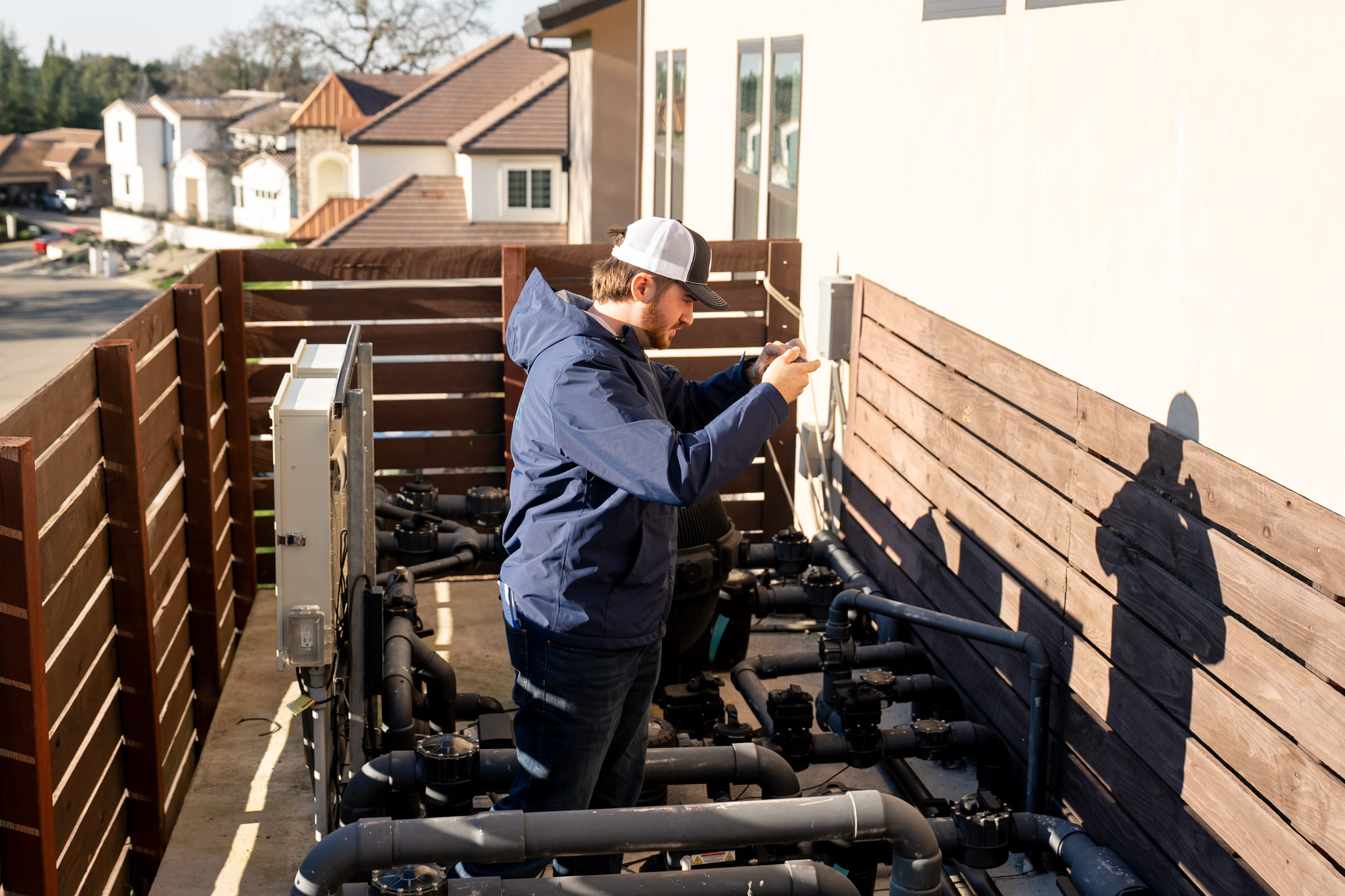
Order on the pad is not negotiable. Water leaves the pump, goes through the filter, then the heater, and the sanitizer goes last, immediately before the water returns to the pool. The filter comes first so debris never reaches a quartz sleeve or a cell plate, where a coating kills output. The heater comes before the sanitizer because concentrated chlorine leaving a cell or a tablet feeder will eat a copper heat exchanger from the inside, and that failure is expensive and slow to show itself. A check valve goes between the heater and the feeder so nothing backfeeds when the pump shuts off. On a tablet chlorinator the same rule applies with more urgency, since undissolved tablets sitting in a dead line make an acidic slurry that will find any weak fitting on the pad.


August and September are the hardest months here. When the shakers move through the almond blocks the dust travels, and pools all over Modesto pick up a gray film at the waterline and a load of fine organic material in the filter. That dust does two things to a sanitizer system. It raises demand, and it loads the filter, which drops flow. Lower flow through a UV chamber means longer contact time, which is fine, but lower flow through a salt cell can trip the flow switch and shut production off entirely without anyone noticing until the chlorine reads zero. Clean the filter during harvest and read the cell, not just the test strip.
Fall brings leaf drop from the mature trees along the older streets in town, and leaf tannin is a heavy chlorine consumer. This is the season a combination system earns its keep. UV or ozone handles the dissolved organics the leaves release, and the chlorine source only has to hold a residual behind it.
Water source matters just as much. On MID surface water, which runs moderately soft, salt cells stay reasonably clean and often go five years or better. On hard well water in the outlying areas around Modesto, calcium plates out on the cell within a season and output falls off. Those cells need a proper acid rinse at the right dilution, and they need it before scale bridges the plates. Reverse polarity helps, it does not replace inspection. Plan on a salt cell lasting roughly three to seven years depending on water and run hours. A UV lamp behaves differently. It keeps glowing long after it stops producing useful output, so it goes on a calendar, generally once a year, and the quartz sleeve gets wiped at the same time.
Modesto winters are cold and wet enough that pool chemistry slows down. Below roughly sixty degrees most salt generators cut output or stop producing altogether, which surprises owners their first winter on salt. The fix is not to crank the output. It is to carry a small tablet feed through the cold months and let the generator take back over when the water warms. Run hours can come down, but not to zero. Circulation is what keeps any sanitizer relevant.
Winter is also the right time to do the work. Nobody wants a pad torn apart in July. Cutting in new plumbing, adding a UV chamber, replacing a corroded tablet feeder, or converting a pool to salt all go smoother in January when the water is cold, algae is dormant, and there is no pressure to have the pool swimmable by the weekend. A system installed in winter is dialed in and stable before the bloom hits in February.
That is what sanitizer systems (UV & chlorination) in Modesto should look like: sized to real gallons and real flow, plumbed in the right order on the pad, and set up for the way this valley loads a pool month by month through the year.
Related services in Modesto: Salt Cell Replacement in Modesto and Chlorinators & Feeders in Modesto.