Tracy gets steady afternoon wind through most of the summer, and it puts dust in the pool every day. That material lands on the surface, sinks, and dissolves. Every bit of it consumes chlorine, feeds phosphate levels, and pushes the water in a direction your test kit will show long before your eyes do.
The fill water makes it harder. Tracy tap water is hard, with calcium and alkalinity both running high straight from the hose. Add a hot summer, a month of evaporation, and a few top offs, and the minerals stay behind while the water leaves. Now you have high calcium, drifting pH, a stabilizer level nobody has looked at since the pool was filled, and a chlorine residual that cannot keep up with the daily dust load. Water turns dull, then cloudy, then green.
Chemical treatment is the corrective visit that resets all of that. It is not a weekly service route and it is not a guess. A tech tests the water, reads the numbers, and doses to fix what the numbers actually say is wrong. Nevergreen Pools handles this work in Tracy in partnership with Vintage Pool Service, a Central Valley company that has run pools out of Manteca on East Yosemite Avenue for years and knows how the local fill water behaves.
Testing Before Anything Goes In
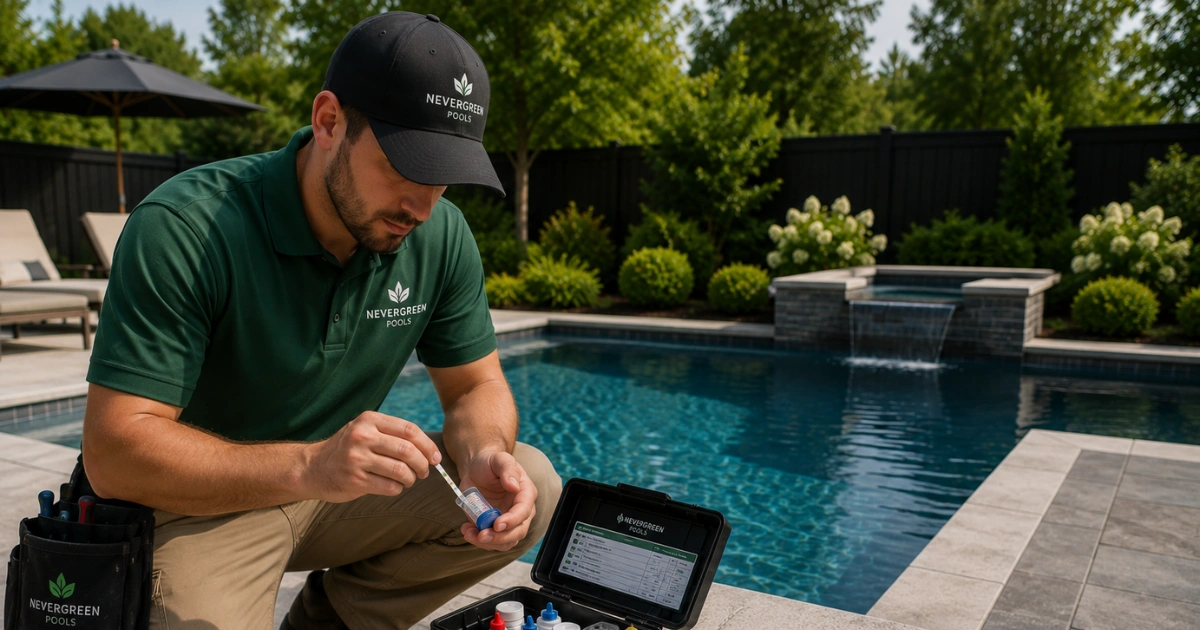
Every chemical treatment starts with a full panel on your actual water, not on an assumption about what a pool in this area usually needs. The sample gets pulled from about elbow depth and away from the returns, because surface water and water sitting right at a jet will both read wrong. Here is what gets measured before a single product comes off the truck.
- Free and total chlorine, which separates the sanitizer still working from the sanitizer already spent
- pH and total alkalinity, which control how stable everything else will be
- Calcium hardness, which in this area is usually the number driving scale
- Cyanuric acid, the stabilizer level, which almost nobody checks on their own
- Phosphates, the food supply that blown in dust keeps restocking
- Copper and iron, when there is any sign of staining or a heater history worth checking
Here is what those readings should say on a balanced pool: free chlorine 2 to 4 ppm with combined chlorine under 0.5 ppm, pH 7.4 to 7.6, total alkalinity 80 to 120 ppm, calcium hardness 200 to 400 ppm, cyanuric acid 30 to 50 ppm, and phosphates under 200 ppb. Anything outside those ranges gets dosed. Anything inside them gets left alone.
High cyanuric acid is a good example of why the panel matters. It is common on pools that have run stabilized tablets in a floater for a couple of seasons. Once stabilizer climbs past a certain point the chlorine is still in the water but works slowly, and adding more chlorine does not fix it. The answer is a partial drain and refill, not another jug. Dosing by habit misses that completely and costs you a summer.
The Corrections, In Order
Sequence matters. These chemicals do not act independently, and adding them in the wrong order wastes product and can leave the pool in worse shape than it started. Alkalinity is handled first, because it sets how far pH will move and how well it holds. Around here alkalinity usually needs to come down, which means measured muriatic acid added slowly over the deep end with circulation running, then a retest a few hours later. Dumping the full correction at once drives pH into the fives and can etch plaster before it recovers.
pH follows. Wind aerates the surface, aeration drives carbon dioxide out of the water, and losing carbon dioxide pulls pH up, so a wind exposed pool climbs faster than a sheltered one with identical chemistry. Expect to be adding acid more often than a homeowner in a still backyard would. Once pH sits back in range, the chlorine you already have starts doing its job again.
Then comes the sanitizer correction. If the pool has been running short for a couple of weeks and the water has gone dull or algae has a foothold, that is a shock calculated off the measured combined chlorine and the real gallonage, not a token bag tossed in at dusk. The filter gets cleaned or backwashed first, because pushing a shock through a loaded filter just moves debris back into the pool. The dose is held long enough to burn through the chloramines, which usually means the pump running continuously overnight.
Calcium, stabilizer, phosphates and metals get addressed last. High calcium shows up as a chalky line at the tile and a gritty feel on pebble and quartz finishes, which is most of the newer construction around town. Depending on the reading, the fix is dilution, a sequestrant to hold the minerals in solution, or both. Sequestrants break down and need re dosing every month or so through the summer to keep working. Phosphates come out with a dedicated remover, which will cloud the water for a day or two and load the filter, so it goes in after the chlorine is stable and the filter gets cleaned again once it clears. Metals get sequestered before any shock goes in, because shocking water that holds copper or iron is how a clean finish picks up a permanent stain in a single afternoon.
What to Expect When You Are Not Home
Most chemical treatments happen while the homeowner is at work. That is normal and it does not slow the job down. What we need from you ahead of time is short.
- Gate access and a heads up on any dog in the yard
- Whether the pool has automation and how to reach it, if you want the schedule adjusted
- Any history worth knowing, such as a recent fill, a heater problem, or a stain that appeared after a storm
The visit itself usually runs an hour to a few hours depending on how far out the water is. If the stabilizer or calcium numbers call for a partial drain and refill, that adds time and a second stop to retest and finish balancing once the fresh water has settled and mixed. Either way you get the before readings, what went in and why, and the after readings. You should be able to see the reasoning, not just the result.
Variable speed pumps and automation are on most newer pools here, and they matter more than people expect during a corrective treatment. Chemicals need turnover to distribute. A pump set to run four hours at a low speed to keep the power bill down will not carry a shock treatment around the whole pool, and the deep end stays untreated while the shallow end burns off. Part of the visit is running the equipment at the speed and duration the treatment actually requires, then leaving you with a schedule that fits how you use the pool the rest of the season. If the pool has a salt cell, the cell gets inspected and the output percentage set against the measured chlorine demand, since a scaled cell will read fine on the panel and still produce almost nothing.
Once the water is corrected, holding it takes less effort than most people assume. Brush the walls and steps weekly, empty the skimmer baskets more often than you would in a place with less airborne dust, run the pump long enough for a genuine full turnover in summer, and test every week or two rather than waiting for something to look wrong. We do this same work in Manteca, Stockton, and Modesto. On Tracy pools the daily dust load is what quietly drives the chemistry off course. Catch it early and the water stays easy. Wait until it goes cloudy and you are paying for the correction instead.
Related services in Tracy: Pool Rebalance in Tracy and Algae Removal in Tracy.