Professional Pool Service
Filter Cleaning in Tracy
Altamont wind and hard water load pool filters fast. Cartridge, sand, and DE filter cleaning in Tracy, CA from Nevergreen Pools. Gauge read every visit.
Professional Pool Service
Altamont wind and hard water load pool filters fast. Cartridge, sand, and DE filter cleaning in Tracy, CA from Nevergreen Pools. Gauge read every visit.
The wind off the Altamont Pass is the single biggest thing working against your filter. Most afternoons from late spring into September, air pushes down out of the hills and across the flats, and it carries fine dust off the fields and the open ground between subdivisions. That dust settles on the water, gets skimmed, and ends up in the filter. It is not leaf litter you can see and scoop out. It is grit fine enough to pack into the pleats of a cartridge or bind up a sand bed, and it arrives almost every day in summer.
The result is a filter that loads faster in Tracy than it does in a lot of the towns around it. A cartridge that might go six months somewhere sheltered will climb in pressure here in two or three. Hard water makes it worse. Calcium and alkalinity run high across San Joaquin County, and when scale builds on filter media alongside sunscreen, body oil, and pump lube, the fabric stops passing water even after you have rinsed all the visible dirt off it.
Nevergreen Pools handles filter cleaning in Tracy in partnership with Vintage Pool Service, a Central Valley company that has run routes out of East Yosemite Avenue in Manteca for years. Between the two, the work is done by techs who service pools in Tracy, Manteca, Stockton, and Modesto every week and know exactly what the wind and the water do out here.
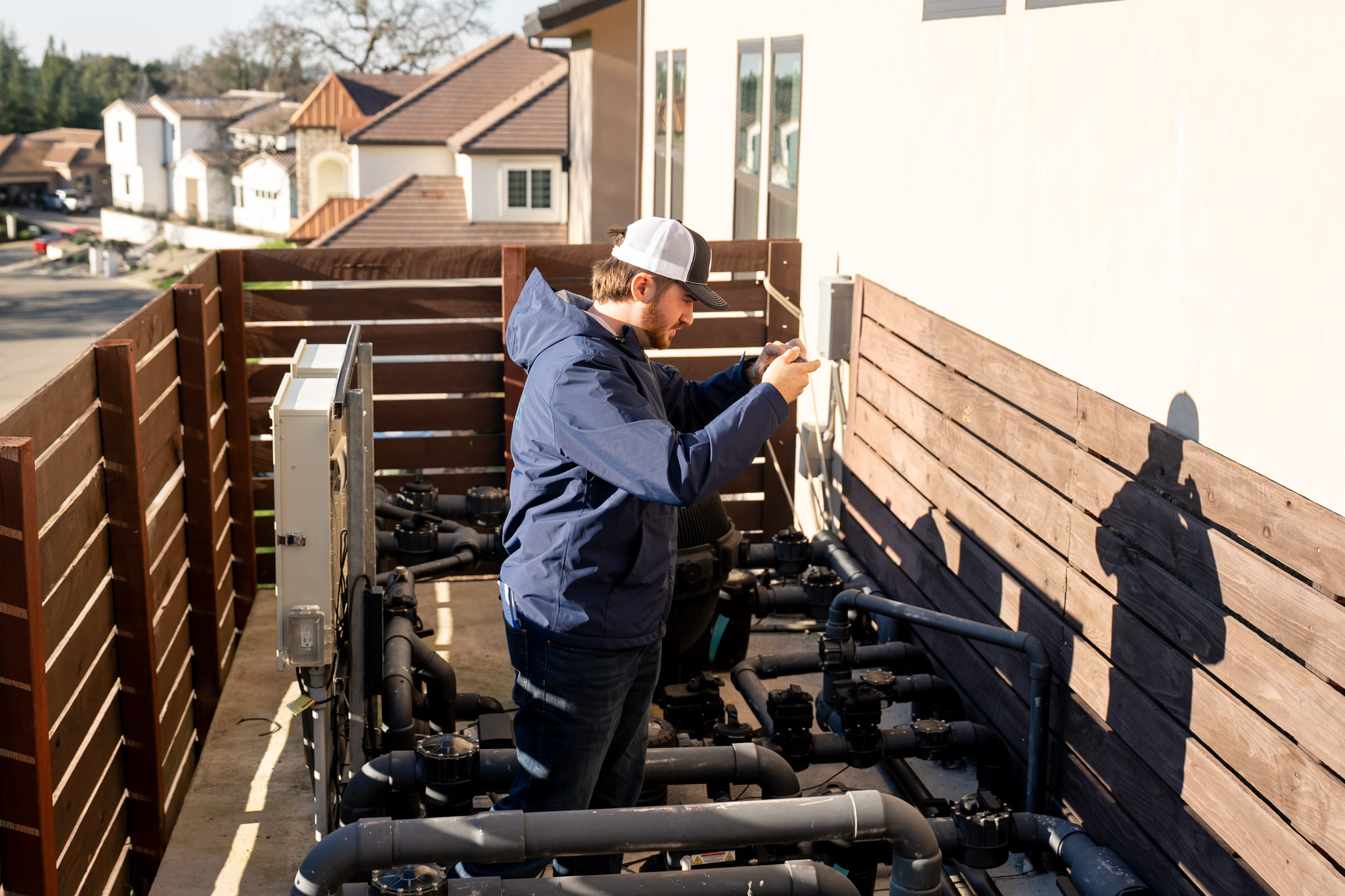
Most of this work happens midday, while you are on the other side of the pass at work, so it helps to know what actually took place at your equipment pad. The first thing a tech does is read the pressure gauge with the pump running and the returns open. That number only means something next to your clean starting pressure, which is the reading the system settled at the last time the filter was genuinely clean. When the gauge sits 8 to 10 PSI above that baseline, the filter is restricting flow and it is time. On a variable-speed pump, which most of the newer homes here run, the gauge reads low at low speed and can hide the problem entirely, so we take the reading at the same speed every visit and write it down.
From there the pump goes off, the air relief valve on top of the tank gets opened to bleed pressure, and the tank comes apart. What happens next depends on what kind of filter you have.
Reassembly matters as much as the cleaning does. The tank o-ring gets wiped, inspected for flat spots and cracks, and lubed with silicone, never petroleum. The clamp band goes on evenly and gets seated all the way around. The pump is primed, the air relief stays open until water pushes out of it, then the system runs and we take a second pressure reading. That new number becomes the clean starting pressure we measure against next time, and it goes on the service record.


In a dusty, windy town the calendar is a starting point and the gauge is the decision. As a general rule in Tracy, cartridges get a full teardown and hose every three to four months, with an extra cleaning worked in during the hottest stretch when the pool is used daily and the wind is running every evening. Sand filters get backwashed whenever pressure climbs 8 to 10 PSI over baseline, which in summer can mean every two to three weeks, and DE gets backwashed and recharged on that same trigger. Pools in Tracy that sit near open ground or a field edge load faster than pools tucked between two-story homes, so we set the schedule off what the gauge actually shows rather than off a fixed interval.
Hosing alone does not get everything. Two or three cleanings in, the media is still holding oils, sunscreen, and calcium scale that water pressure will not touch. That is when a cartridge gets a chemical soak: an overnight bath in a filter cleaner degreaser to break down the oils, and, separately, a dilute acid soak to dissolve the calcium. The two never go in the same bucket, and the elements get rinsed thoroughly in between. With the hardness in the water around here, the acid soak is not optional maintenance. It is the difference between a cartridge reaching its full service life and one that stops flowing at half of it. DE grids get the same treatment on roughly an annual basis.
Cartridges wear out. In this climate, three to five years is a reasonable life on a properly sized filter, less if the filter is undersized for the pump or has been run hard through a plaster startup. A tech should be able to show you why an element is done, not sell you a new one on a hunch. The signs are specific: pleats that stay gray or brown after a full soak, fabric that feels thin or fuzzy when you rub it between your fingers, pleats that have collapsed or spread and no longer stand square, a torn band or a cracked end cap, and pressure that climbs back to high within days of a thorough cleaning. Any one of those means the element is either passing dirt or choking flow, and replacing it costs less than running a pump against a wall of restriction month after month.
Because most of our filter cleaning in Tracy runs while nobody is home, every visit ends with a written note: pressure before, pressure after, what was cleaned, what the media looked like, and what we expect to do on the next visit. You get the same reporting whether the pool is in Tracy or over in Manteca, Stockton, or Modesto.
Related services in Tracy: Filter Repairs in Tracy and Pool Maintenance in Tracy.