Professional Pool Service
Filter Repairs (Cartridge, Sand, DE) in Tracy
Cartridge, sand, and DE filter repair in Tracy, CA. Cracked tanks, torn elements, broken laterals, bad spider gaskets, and pressure problems fixed right.
Professional Pool Service
Cartridge, sand, and DE filter repair in Tracy, CA. Cracked tanks, torn elements, broken laterals, bad spider gaskets, and pressure problems fixed right.
Tracy sits at the base of the Altamont Pass, and the wind coming over those hills is the biggest thing working against your filter. From late spring into September it picks up in the afternoon and keeps blowing well into the evening, carrying fine dust off the grasslands and the farm ground west and south of town. That grit does not stay on the surface. It sinks, the skimmer pulls it in, and it packs into whatever media you have. A filter in Tracy loads faster than the same filter in a town without that daily wind, and the parts inside wear out sooner because they spend more hours working against resistance.
Most of the newer pools around Tracy were built with pebble or quartz finishes, variable speed pumps, and automation that runs the schedule so nobody has to think about it. That is an efficient setup, and it also means the filter is the one piece on the pad quietly loading up day after day. If you drive over the pass in the morning and get home after dark, the first sign of trouble is usually a gauge you happen to look at on a Saturday, or water that will not clear no matter how much chlorine goes in. Filter repairs (cartridge, sand, DE) in Tracy almost always begin with that pressure reading, either crept up well over the clean baseline or dropped below it for no obvious reason.
Nevergreen Pools works in Tracy in partnership with Vintage Pool Service, a longtime Central Valley company running out of East Yosemite Avenue in Manteca. Between us we cover Tracy, Manteca, Stockton, and Modesto, so the diagnosis and the parts do not wait on somebody driving in from outside the area.
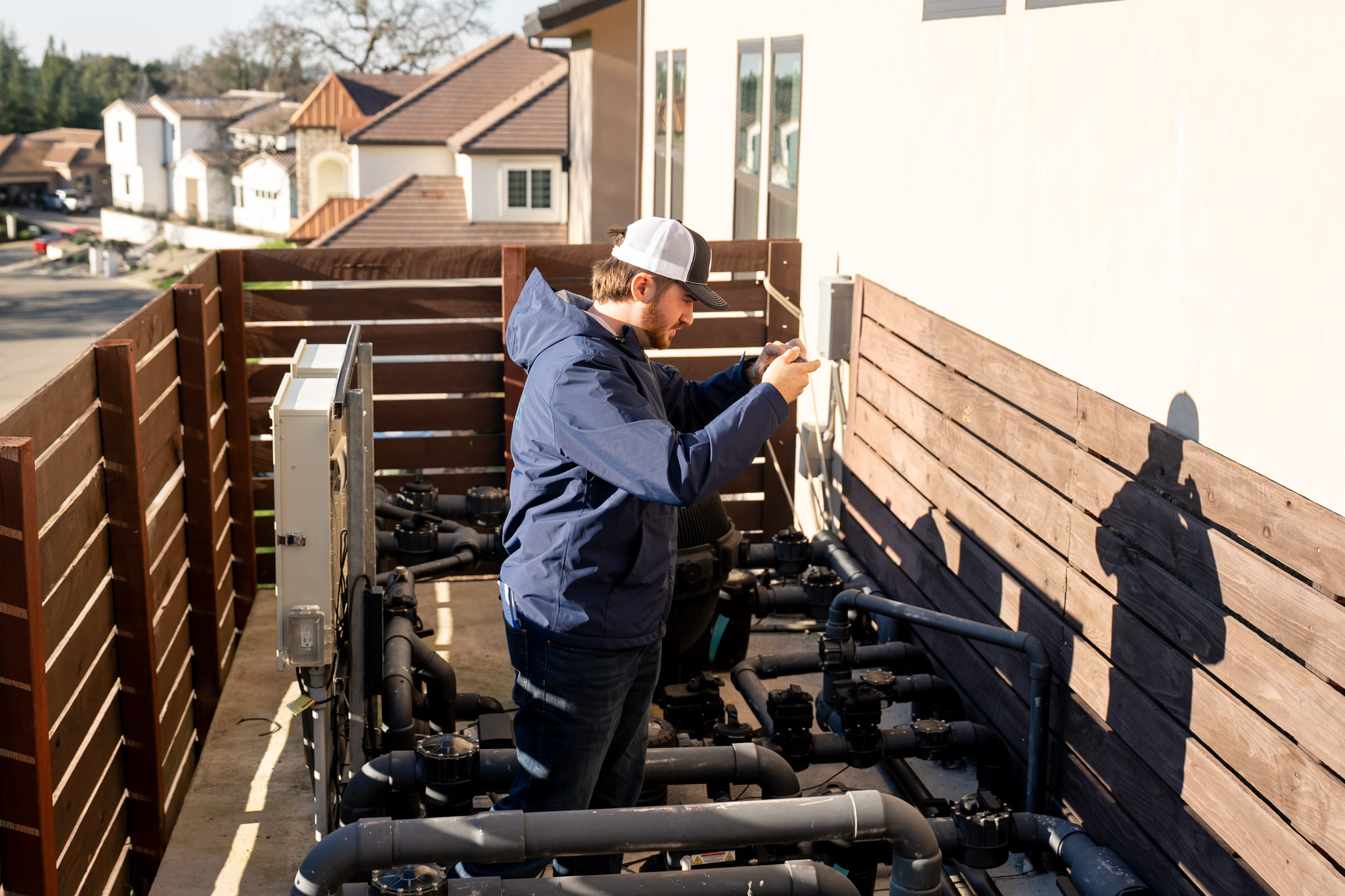
The visit starts with the filter running. Pressure only tells the truth under load, so we take a reading with the pump at full speed and again at the speed your automation normally holds it at. Clean starting pressure is the number every other reading gets compared against, and if nobody ever wrote it down, we establish it once the element or the media is clean. Eight to ten pounds over that baseline means restriction. Sitting below it usually means water is getting past the media instead of through it, which points at a tear, a crack, or a seal that is no longer sealing.
Then the tank comes apart. On a cartridge filter that means releasing the band clamp, lifting the lid, and pulling each element out to look at it in daylight rather than down inside the housing. Wind driven grit works into the pleats and grinds at the fabric from the inside, so tears show up along the pleat folds and at the end caps where the material is bonded. On a DE filter we pull the grid assembly and check the fabric, the manifold the grids seat into, and the standpipe, since DE blowing back into the pool almost always traces to one of those three. On a sand filter we look at the sand itself, which channels and cements into clumps as calcium builds up, and then at the laterals in the bottom of the tank. A cracked lateral is what sends sand back through the returns and puts a gritty pile on the floor near an eyeball fitting.
While the tank is open, we go through everything that fails alongside the media:
You get the findings and the reason behind each one before any part gets replaced. Because most homeowners in Tracy are gone during the day, we are set up to do this without anybody standing there. Give us gate access and we send photos of what came out of the tank, a note on what was replaced, and the clean pressure number to watch going forward.


A cracked tank or lid gets replaced, not patched. Filter housings are pressure vessels, and a hairline crack in a lid after a summer of Valley sun will open up the first time the system starts against a closed valve. Torn cartridges get replaced as a set so the load stays even across the elements, and we size the replacement to what the pump actually moves rather than whatever was cheapest at install. On sand filters we pull the old media, replace broken laterals, and refill with the correct grade and volume, which matters more here than most places because hard water shortens the useful life of sand. On DE systems we replace failed grids, cracked manifolds, and worn standpipe O rings, then recharge the filter with the right amount of powder for the square footage.
Valves and small parts are where most short cycling comes from. A worn spider gasket in a multiport lets water bypass straight to waste or back to the pool, so the filter never builds normal pressure and the water stays hazy. Air relief valves stick or leak, gauges freeze at one reading, and both are cheap to replace and worth doing any time the tank is already open. Air pulling in at the pump lid or a suction side union shows up at the filter as bouncing pressure and a pump that loses prime, so we track that back to the source instead of bleeding the tank and leaving.
Water in this part of San Joaquin County runs high in calcium and alkalinity. That mineral load scales the inside of a sand bed, stiffens cartridge pleats, and coats DE grids so they hold less dirt between cleanings. Combine that with grit blowing off the fields every afternoon and a filter here takes more abuse than the manufacturer had in mind. The practical result is that filters in Tracy need cleaning on a tighter interval and their internal parts have a shorter service life than the same equipment in a cooler, calmer town. Knowing that up front is the difference between replacing a torn grid for what a grid costs and replacing a pump that ran hot for weeks against a blocked filter.
Two habits keep this cheap. Write down the clean pressure after every service so you have a number to compare against, and glance at the gauge on the weekend even if you never touch anything else on the pad. When that number moves, call. Filter repairs (cartridge, sand, DE) in Tracy are straightforward, often same day work when the filter is the only thing that has failed, and they turn into a much longer job when a restricted filter has been cooking the pump and the heater all season. We schedule around commuter hours, work the pad without you home, and leave the system running and balanced before we lock the gate.
Related services in Tracy: Filter Cleaning in Tracy and Filter Installation in Tracy.