Professional Pool Service
Pool Heater Repair in Tracy
Gas heater and heat pump repair in Tracy, CA. Ignition faults, pressure switches, scaled heat exchangers and error codes fixed right by Nevergreen Pools.
Professional Pool Service
Gas heater and heat pump repair in Tracy, CA. Ignition faults, pressure switches, scaled heat exchangers and error codes fixed right by Nevergreen Pools.
Tracy sits at the base of the Altamont Pass, the first town on the valley side of the hills, and the wind that pours through that gap every afternoon is the single biggest thing separating a pool here from one in a sheltered older neighborhood. From late spring through September the breeze picks up around two or three in the afternoon and keeps blowing well past sunset, carrying fine dust off the fields and the dry grasslands with it. That grit lands in the water, sinks into the filter, and works its way into every piece of equipment on the pad that has a vent, a louver, or an open cabinet. A pool heater has all three.
The result is a heater that gets dirty faster than the manual assumes. Dust settles on the burner tray and around the igniter, coats the flame sensor, packs into the air intake screen, and builds a gray film across the heat exchanger fins where it traps moisture at night when the wind turns cool. Add hard Tracy water, which runs high in calcium and alkalinity across most of San Joaquin County, and you get scale forming inside the exchanger tubes at the same time dust is insulating the outside of them. Heat gets trapped, the unit runs hotter than it was designed to run, and the safety switches start doing their job.
Nevergreen Pools handles pool heater repair in Tracy in partnership with Vintage Pool Service, a longtime Central Valley company that has run routes out of East Yosemite Avenue in Manteca and knows the equipment sitting on these pads. Most of the pool owners we work with here commute over the pass or down the interstate and are not home when the truck arrives, so what follows is written to tell you exactly what happens while you are at work.
Gas heaters fail in a short and predictable list of ways, and the order changes depending on how the pool is used. Ignition failure is the most common call. The unit clicks, tries, and locks out. Behind that is usually a worn hot surface igniter, a dirty flame sensor that can no longer prove the flame, or a gas valve that is opening late. Wind driven dust makes the sensor problem worse, because a thin insulating layer on the rod is enough to drop the signal below what the control board will accept even when the burners are clearly lit.
Water side problems show up as a heater that will not start at all. The pressure switch is looking for flow, and if the filter is loaded with the fine grit that blows in off the fields, or the variable speed pump is set to a low speed that saves energy but does not move enough water through the heater, that switch never closes. A lot of the newer Tracy homes have automation and variable speed pumps programmed by a builder who never checked the heater minimum flow rate. Correcting the heat cycle speed fixes more no start calls out here than any part we carry on the truck.
Then there is heat itself. Scale from hard water narrows the exchanger tubes, soot and dust block airflow, and the high limit trips to protect the unit. If nobody addresses the cause, that cycle repeats until the exchanger cracks and starts leaking down into the burner tray. Things a homeowner can catch without opening anything:
Heat pumps have their own list. The evaporator coil is a large finned surface with a fan pulling air through it, which in Tracy means it pulls dust through it every single afternoon. A packed coil starves the system, refrigerant pressures move out of range, and the unit either short cycles or trips on a high pressure fault. Genuine refrigerant loss is less common than people assume, and when we do find it we chase the leak rather than topping off a sealed system that is only going to empty again.


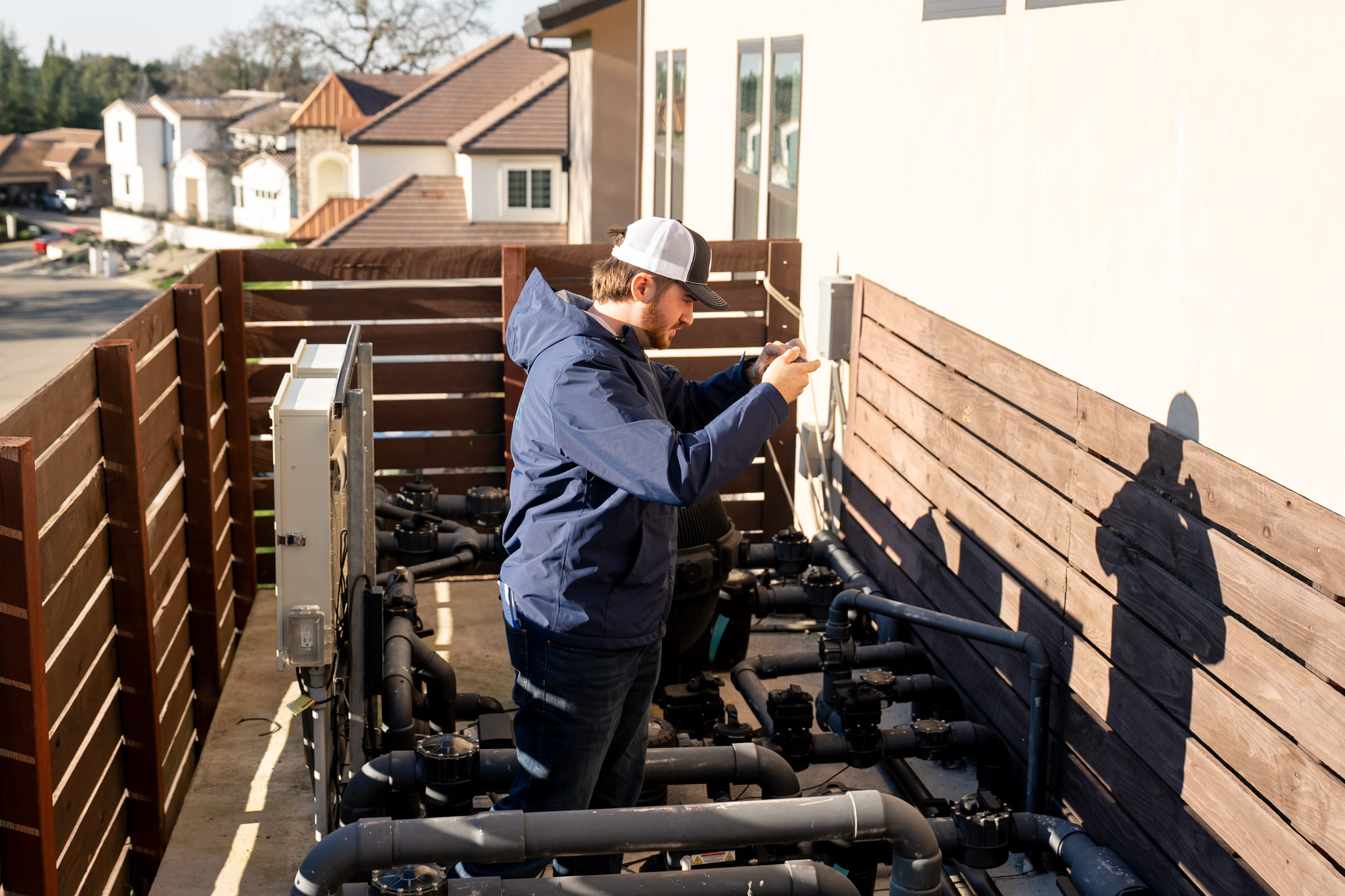
Most Tracy pool owners are over the pass or down the freeway by seven in the morning, so we run heater work as an unattended visit and keep you current by text and photo. The sequence is the same every time.
First we confirm the basics before touching the unit. Gas is on and the meter is sized for the load, the breaker is closed, the pump is turning the speed the heater needs, and the valves are actually routing water through the heater instead of past it. A real share of no heat calls end right here, especially after somebody has been in the automation panel changing schedules.
Second, we pull the codes and read the control board. Modern gas heaters and heat pumps log what tripped and in what order, which tells us whether we are chasing an ignition fault, a flow fault, or a thermal trip before we start taking things apart. Third, we open the cabinet. That means inspecting the burner tray, the igniter and flame sensor, the pressure switch and its tubing, the internal bypass, the gas valve, and the exchanger itself for scale, soot, and the white crust that says water has been weeping where it should not.
Fourth, we test under load. A heater that lights while we stand there proves very little. We run a full heat cycle, watch stack temperature and water temperature climb together, verify the flame stays proved all the way through, and confirm the unit shuts off on setpoint rather than on a limit switch. Fifth, you get photos, the codes we found, the parts we replaced, and a note on anything we saw that is going to matter a year from now. That last part is where the Tracy dust and the hard water almost always come up, because both are constant and both are manageable once you know what they are doing to the equipment.
We give a straight answer on this one. Under roughly eight years, a gas heater is almost always worth repairing. The exchanger is usually sound, and the parts that fail at that age are igniters, sensors, switches, and valves that are stocked and inexpensive next to a new unit. Between eight and twelve years the question becomes what actually failed. A control board or a gas valve on an otherwise clean heater is a repair. A cracked or heavily scaled heat exchanger at that age generally is not, because the exchanger represents a large share of what a new heater costs and the rest of the unit has aged right alongside it.
Past twelve years, parts availability starts to decide it for you. Manufacturers discontinue boards and valves for older model lines, and waiting three weeks on a part for a heater that has another failure coming is a poor trade. Heat pumps follow a similar curve, with compressor failure being the point where replacement wins almost every time. Whatever we recommend on pool heater repair in Tracy, you get the reasoning behind it, and if the honest answer is that the repair does not make sense, we tell you that before you spend anything chasing it.
Related services in Tracy: Heater & Heat Pump Installation in Tracy and Automation Troubleshooting in Tracy.