Professional Pool Service
Chlorinators and Chemical Feeders in Tracy
Chlorinator and chemical feeder repair in Tracy, CA. We clear clogged feeders, calcified lines, stuck check valves, and set feed rates on hard water.
Professional Pool Service
Chlorinator and chemical feeder repair in Tracy, CA. We clear clogged feeders, calcified lines, stuck check valves, and set feed rates on hard water.
The wind off the Altamont is the first thing that sets a Tracy pool apart from one in Manteca or Stockton. It picks up in the afternoon, holds through the evening, and pushes a steady film of road dust and field dust across the water almost every day in summer. Most homeowners read that as a skimmer basket problem. It is also a chemistry problem. Dust and fine organic grit raise chlorine demand, the sanitizer system works harder to keep up, and the part quietly carrying that extra load is the tablet chlorinator or liquid feeder sitting on the equipment pad.
Pools here are also newer than in much of the valley. The large subdivisions built out on the west and south sides of Tracy went in with pebble and quartz finishes, variable-speed pumps, and automation panels, which means the feeder is often the only piece of equipment on the pad with no sensor, no display, and no way to tell you it has stopped working. It just sits there. Combine that with hard Tracy water, where calcium and alkalinity both run high, and scale forms inside the exact passages a feeder depends on to meter product at a steady rate.
Nevergreen Pools services chlorinators and chemical feeders in Tracy in partnership with Vintage Pool Service, a longtime Central Valley company running routes out of East Yosemite Avenue in Manteca that knows what this water does to equipment. Below is what the work actually involves, step by step, written for the homeowner who leaves before the wind comes up and gets home after it dies down.
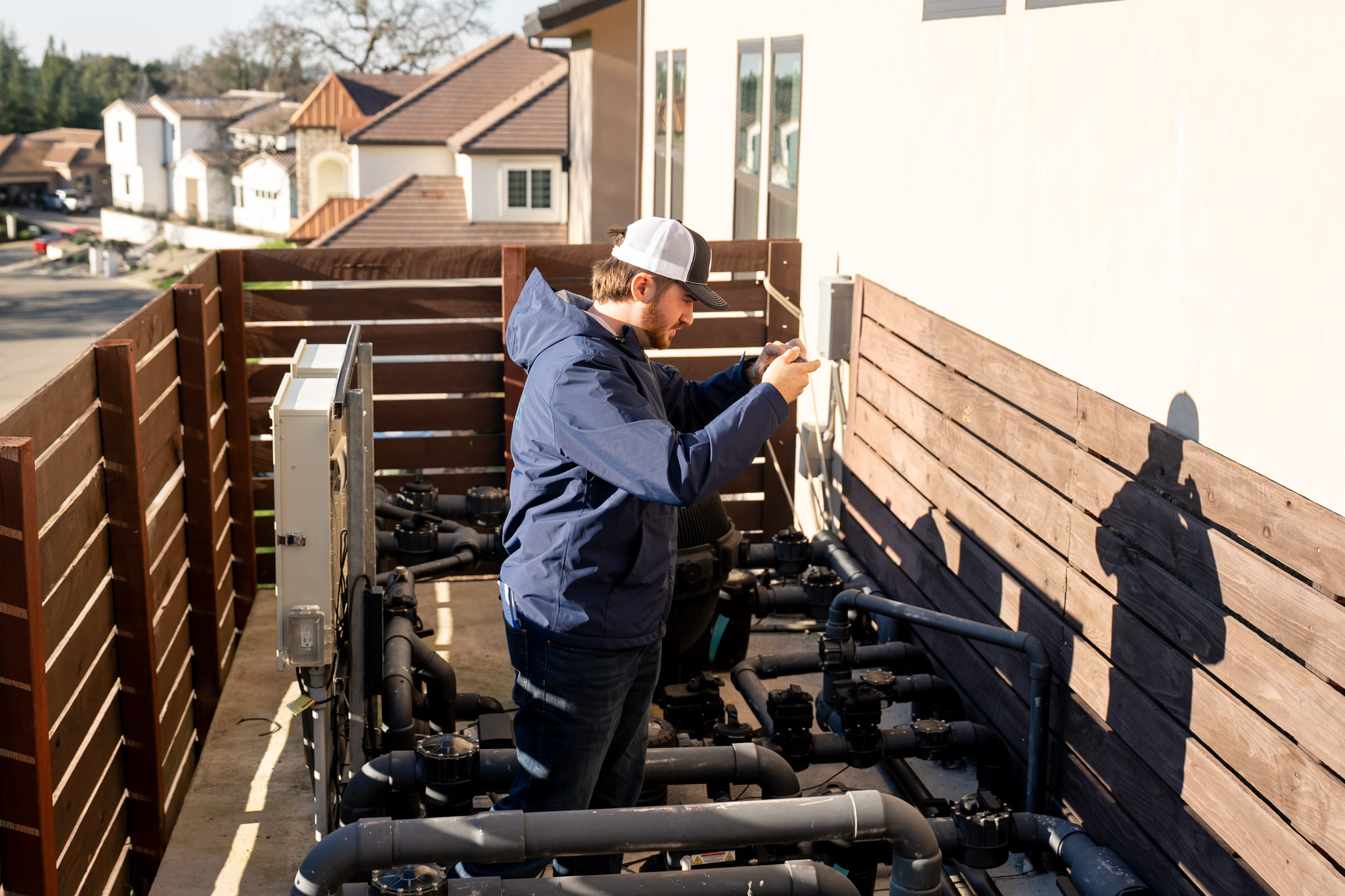
The first step is shutting the pump down and relieving pressure before anyone touches a lid. An in-line chlorinator sits in the return plumbing after the heater and holds full system pressure while the pump runs. Opening one under pressure sprays concentrated slurry and gas. Once the line is safe, the lid comes off and the inside of the body tells most of the story.
On a tablet chlorinator the failures are consistent. Tablets that sit in a damp body without flow fuse into a single block that no longer dissolves evenly, so the pool gets nothing for days and then a slug of chlorine all at once. The lid o-ring flattens and hardens, then the lid itself cracks around the threads, usually because someone cranked it down to stop a leak the o-ring was causing. The check valve on the outlet sticks open, which lets treated water back-feed toward the heater and chews up the heat exchanger from the inside. The control dial you turn from 1 to 5 works off a small metering orifice, and in this water that orifice scales down until a dial set to 3 is feeding what 1 used to feed, or nothing at all. Offline feeders, the kind mounted beside the plumbing instead of in it, add a saddle and two small feed lines to that list, and those lines are usually the first thing to calcify shut around here.
Liquid chlorine and acid feeders wear differently. A peristaltic pump squeezes flexible tubing against a roller head, and that tubing is a consumable, not a permanent part. It work-hardens, flattens, and eventually splits, and when it splits inside the head you get product where it does not belong. Injection fittings scale over at the tip. Suction tubes crack at the cap and pull air. Foot valves stop sealing, so the pump loses prime and runs dry while the display still reports that it is dosing.
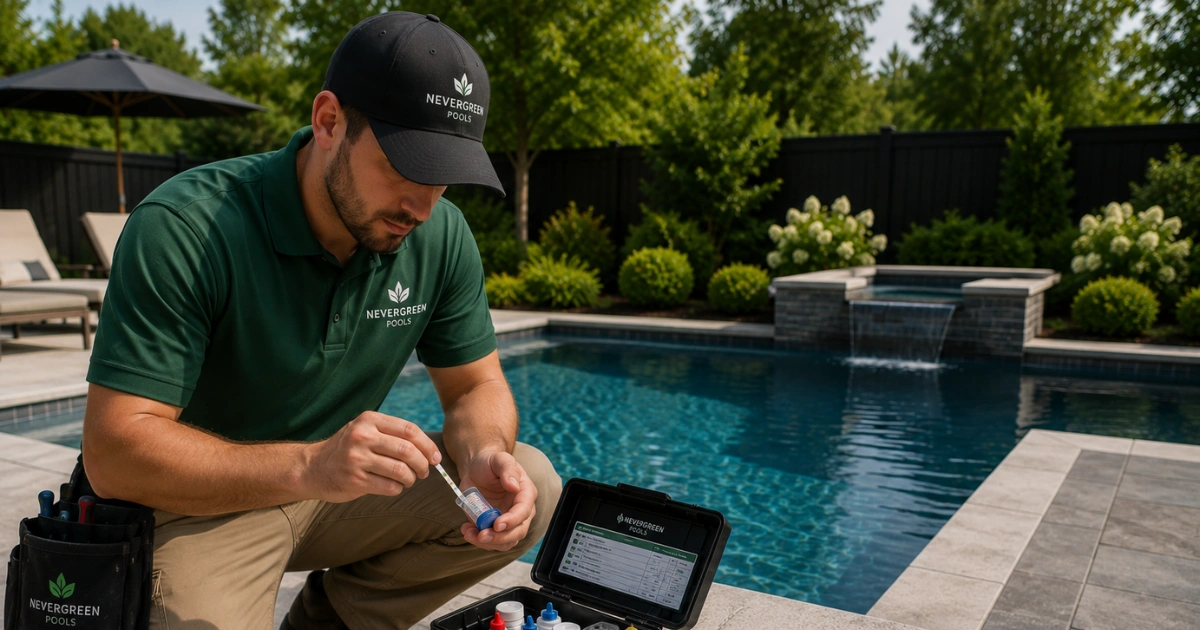
After the mechanical work, the feed rate gets set against a real test rather than a guess. We read free chlorine, pH, total alkalinity, calcium hardness, and cyanuric acid, set the feeder to match, and verify the number held. On a Tracy pool that means allowing for the dust load, because a pool that runs clean in April will pull noticeably more chlorine in July when the wind is up every single afternoon.


The tempting fix for a weak feeder is to turn the dial up. Over-feeding has real costs. Trichlor tablets, the most common type on pads in this area, are acidic, so every tablet that dissolves pushes pH down. Hard Tracy water buffers that for a while through its alkalinity, and then it gives up and the pH swings get sharp. Low pH is corrosive to heat exchangers, pump seals, and the pebble or quartz surface itself, and it makes the water uncomfortable long before it looks wrong.
Trichlor also carries cyanuric acid, the stabilizer that shields chlorine from sunlight. Stabilizer does not evaporate and it does not burn off. It accumulates every time a tablet dissolves. Once cyanuric acid climbs past a workable range, the chlorine you are paying for gets locked up and stops behaving the way the test kit suggests it should, and the only real correction is draining and replacing a portion of the water. In a hot dry summer, with wind pulling evaporation up all day, that is water you would rather not have to replace on top of what you are already adding. Setting the feed rate correctly the first time is cheaper than either repair.
Most of our customers here are gone during the day, so we do not need you home. Gate access, a text when the tech arrives, and a written summary of what was found, what was replaced, and where the dial ended up is usually all it takes. If a feeder needs a part that is not on the truck, you hear what it is and what it does before anything is ordered, not after the invoice.
We handle chlorinators and chemical feeders in Tracy along with Manteca, Stockton, and Modesto, so routes through San Joaquin County are already running most days of the week. Whether the pool is an older plaster build or a newer pebble pool on automation, the feeder gets the same treatment: opened safely, inspected part by part, descaled or rebuilt, and dialed in against measured water instead of a guess. That is the difference between a feeder that holds a number through a windy Tracy August and one that quietly stops working in June.
Related services in Tracy: Chemical Treatment in Tracy and Sanitizer Systems in Tracy.