Professional Pool Service
Heater & Heat Pump Installation in Tracy
Gas heater and heat pump installation in Tracy, CA. Proper BTU sizing, gas line and venting work, bypass valves, and a swim season that starts earlier.
Professional Pool Service
Gas heater and heat pump installation in Tracy, CA. Proper BTU sizing, gas line and venting work, bypass valves, and a swim season that starts earlier.
Anyone who owns a pool in Tracy learns the wind before they learn anything else about the climate here. The air comes down off the Altamont Pass most afternoons and keeps blowing well into the evening, and it carries dust and fine grit from the pass and the surrounding fields straight into the water. It also does something less obvious. Wind strips heat off a pool surface faster than almost anything else, and a Tracy pool that felt fine at four in the afternoon can drop several degrees by the time you pull into the driveway at seven. That is evaporative loss, and it is the main reason pools in this town feel cold in May and again in September even when the daytime highs are still in the eighties.
A heater is the fix, but only if it is the right heater and it is sized for your pool instead of for the one down the street. Pool volume, the temperature rise you actually want, wind exposure, whether a cover is realistic for your household, and what fuel or electrical service already exists at the equipment pad all change the answer. Newer construction across Tracy usually comes with a variable speed pump, a pebble or quartz finish, and an automation panel already on the wall, which makes some installs straightforward and others more involved than they look from the patio.
Nevergreen Pools handles heater & heat pump installation in Tracy in partnership with Vintage Pool Service, a longtime Central Valley company working out of Manteca on East Yosemite Avenue. Between the two crews we install gas heaters and electric heat pumps across Tracy, Manteca, Stockton, and Modesto, and we do the gas, venting, and electrical work that goes with them rather than handing you off to somebody else halfway through the job.
Gas heaters are rated in BTUs, and the math starts with two numbers: how many gallons your pool holds and how many degrees of temperature rise you actually want. The working rule is that it takes roughly 10 BTUs to raise one gallon by one degree in an hour. A 20,000 gallon pool that needs a 20 degree rise wants somewhere near 400,000 BTUs of output to get there in about a day. Then you adjust for the real yard. Wind exposure, which nearly every Tracy backyard has in quantity, pushes that number up, because a heater in this town is fighting evaporation the whole time it runs. A solid cover or a fence line that blocks the prevailing wind pulls it back down. Given the choice, we put in a heater with some headroom rather than one that runs wide open every evening and still never catches up.
Fuel is the next decision. Most homes here have natural gas at the meter, which makes for the simpler and less expensive install. Propane heats just as well, but a pool sized burner goes through a tank quickly, so we walk through tank capacity and refill logistics before anyone commits to it. Either way, the gas line has to be sized for the load. A 400,000 BTU heater tied into an undersized branch line will starve, short cycle, and throw fault codes, and that is one of the most common problems we find on heaters installed by somebody else. We check meter capacity and the length of the run before recommending a unit, not after it is bolted to the pad.
Electric heat pumps are the other path, and they fit this climate better than most people expect. A heat pump does not burn fuel. It pulls warmth out of the surrounding air and moves it into the water, which is why it is rated by COP, or coefficient of performance, rather than by input BTUs alone. On a hot Central Valley afternoon a good heat pump returns four or five units of heat for every unit of electricity it draws, and no gas heater comes close to that operating cost. The tradeoff is speed and timing. A heat pump raises water temperature slowly, over a day or two instead of a few hours, and its output falls off as the air cools, which in Tracy means it does its best work in the afternoon and its worst on those windy nights. It wants the pump running long enough to give it steady flow, and it wants a dedicated circuit with real capacity behind it. If the electrical panel is already loaded up, that cost belongs in the conversation from the start.
Before we quote anything, we put eyes on:


Most of the people we do this work for commute over the pass or up and down the interstate and are not home between seven in the morning and six at night. The process is built around that.
It starts with a site visit. We measure the pool, look over the equipment pad, trace the gas line back to the meter, check the electrical panel, and note how the wind moves through the yard. If you cannot be there, a gate code is enough, and you get photos of what we found along with the recommendation. That recommendation names a specific unit and size, explains why, and tells you what the second choice would have been and what it would have cost you in performance or in operating expense.
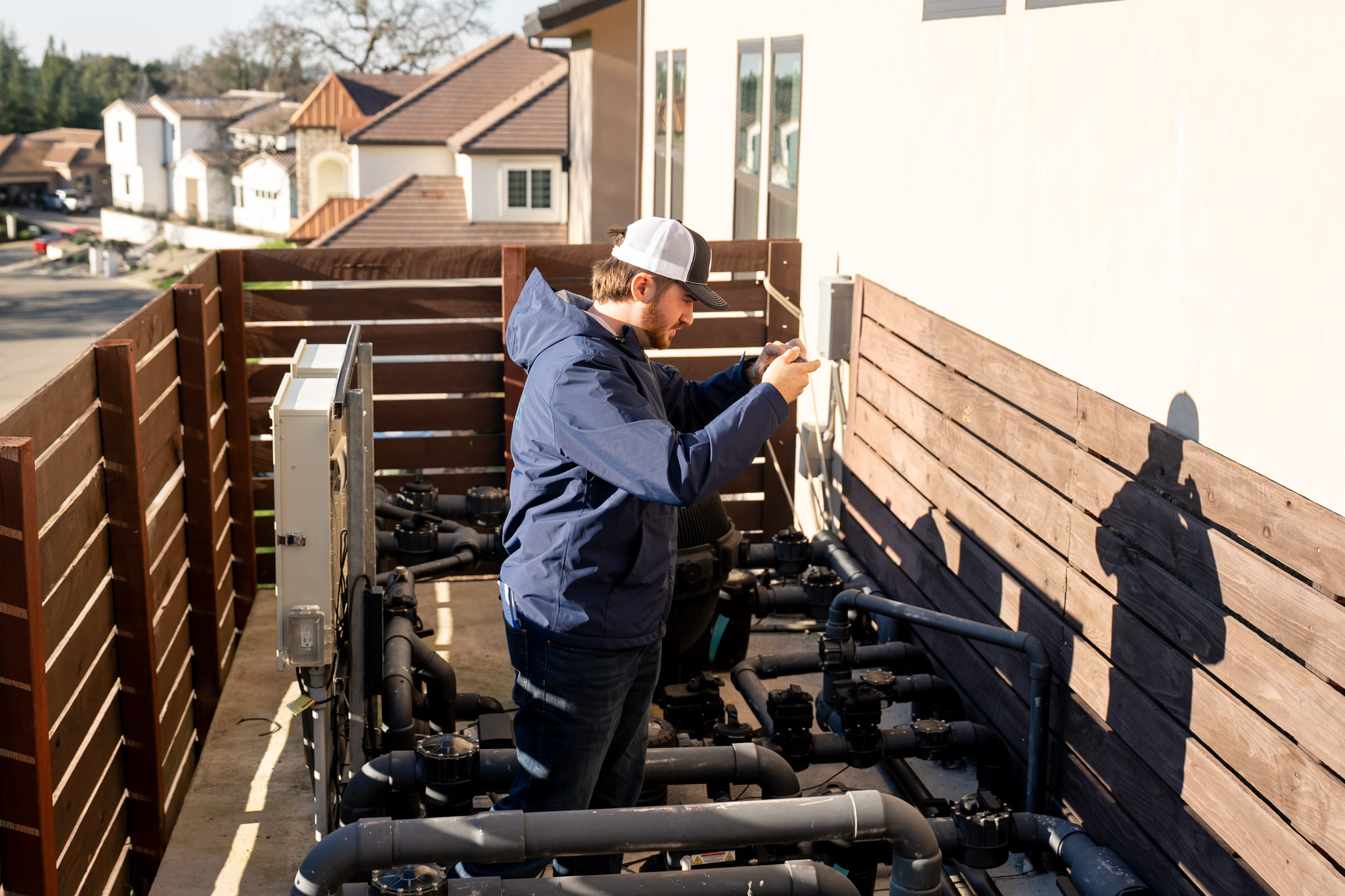
On install day the crew shuts the system down, drains the affected plumbing, and sets the new unit on the pad with the clearances the manufacturer requires. Gas heaters need room around the vent and a safe distance from windows, eaves, and anything combustible, and the venting has to be built for that unit rather than adapted from whatever was there before. Heat pumps need open air at both the intake and the discharge, because a unit crowded into a corner recirculates its own cold exhaust and quietly gives up a good share of its rated efficiency. Once the unit is set, we handle the plumbing tie in, the gas or electrical connection, and the bypass.
Bypass valves are worth understanding, because they do more than people assume. A three valve bypass lets water route around the heater instead of through it, which keeps flow off the heat exchanger when the pump is running for filtration only and gives us a clean way to isolate the unit for service without draining the system. Water in this part of the valley is hard, calcium and alkalinity both run high, and scale on a hot heat exchanger is what ends most gas heaters in Tracy long before anything mechanical wears out. Correct bypass plumbing, balanced water, and a variable speed pump set to deliver the flow rate the heater was designed for will add years to the unit.
If your pool already has an automation panel, we tie the new heater into it so the heater answers to your schedule and your phone instead of a dial on the side of the cabinet. That is the part commuters end up using most. You bring the water up to temperature before you get home on a Thursday, hold it through the weekend, and let it drop back during the week, and you never have to walk out to the pad in the dark to make that happen.
The point of heater & heat pump installation in Tracy is not to improve August. August takes care of itself. The point is April and May, when the days are warm and the wind still pulls the water back into the low sixties overnight, and October and early November, when the same thing happens in reverse. A correctly sized system turns those months into swimming months, which for most families is the difference between a pool used twelve weeks a year and one used closer to thirty.
Once the unit is running, we walk you through it in plain terms: what the display is telling you, what the common fault codes mean, what to check before you call anyone, and how to run the pump so the heater is not fighting it. We service what we install across Tracy and the surrounding towns, so if a heater acts up in the middle of October you are calling the same people who put it in.
Related services in Tracy: Pool Heater Repair in Tracy and Automation & Control Systems in Tracy.