We respond same day.
Emergency services available!
Professional Pool Service
Pool Rebalance in Tracy
Water out of range in Tracy, CA? We correct pH, alkalinity, calcium, and stabilizer with LSI testing and partial drains to protect pebble finishes.
Professional Pool Service
Water out of range in Tracy, CA? We correct pH, alkalinity, calcium, and stabilizer with LSI testing and partial drains to protect pebble finishes.
Tracy sits at the base of the Altamont Pass, and the wind that funnels down out of those hills is the single biggest reason pool water here drifts out of range. Most summer afternoons it comes up around two or three o'clock and runs well into the evening, carrying dust off the grasslands and grit off the open fields east and south of town. That material lands on the surface, sinks, and slowly pushes pH and total dissolved solids up. Add fill water that already runs high in calcium and alkalinity, and a pool that looked fine in May can be cloudy, scaling, and burning through chlorine by July.
A pool rebalance in Tracy is the correction job that follows. It is not a stop where somebody pours in a jug of acid and leaves. It is a full read of the water, a decision about what can be dosed and what has to be diluted, and a sequence that gets every number back into a range where they hold each other steady. Some of that happens on the first visit. Some of it takes two or three weeks of controlled adjustment, especially if the pool has been sitting through a stretch of heat with nobody watching it.
Most homeowners we do this work for in Tracy commute over the pass and are not home when the truck shows up, so the work is built to run without you standing there. Nevergreen Pools serves Tracy in partnership with Vintage Pool Service, a Central Valley company that has run routes out of East Yosemite Avenue in Manteca for years, and between the two crews we cover Tracy, Manteca, Stockton, and Modesto. You get a written record of what the water read, what went in, and what happens next.
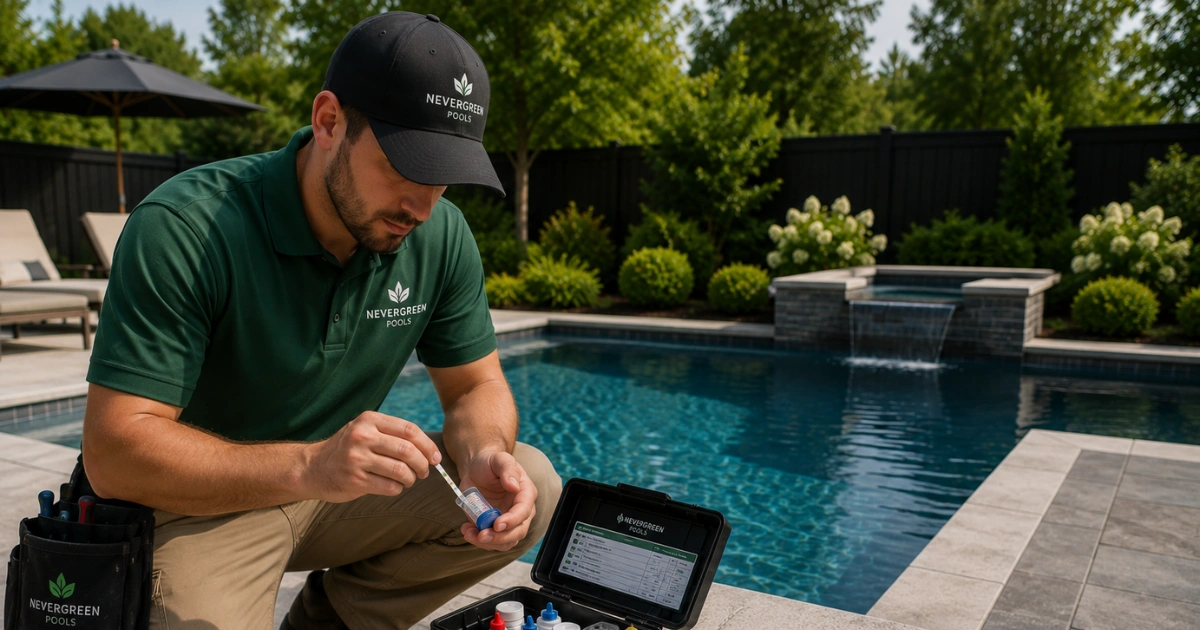
The visit starts with a full panel, not a test strip. Strips are fine for a quick chlorine glance and useless for the decisions that matter on a correction. We run pH, total alkalinity, calcium hardness, cyanuric acid, free chlorine, combined chlorine, and total dissolved solids, plus salt on a system with a chlorine generator. Then we read the pool itself: the tile line, the texture of the finish at the steps, the pump basket, the filter pressure, and the automation panel if there is one.
Those numbers only mean something together, and that is what the Langelier Saturation Index is for. It combines pH, water temperature, calcium hardness, and alkalinity into a single figure that tells you whether the water is going to deposit calcium or dissolve it. Meaningfully above zero and the water is oversaturated, so it drops scale on tile, inside the heater exchanger, and across salt cell plates. Meaningfully below zero and the water is aggressive, so it pulls calcium back out of plaster and grout, etching the finish and leaving it rough underfoot. In Tracy, with hard fill water and heavy evaporation through a windy summer, the drift is almost always toward the scaling side.
What that panel tells us is which problems can be dosed away and which ones cannot. That split decides how long the job takes and what it costs you in water.
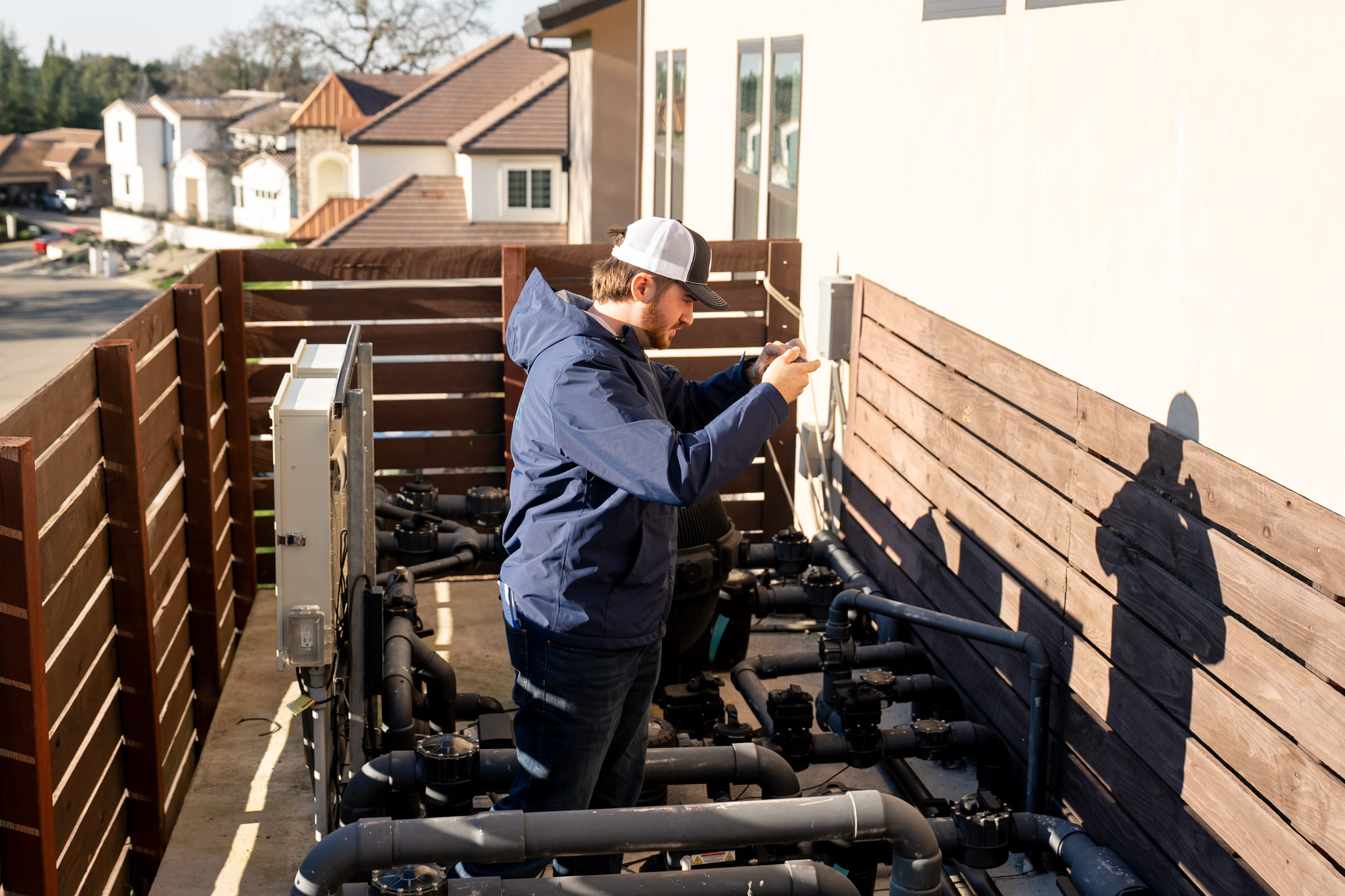

Order matters. Alkalinity comes first, because it controls how pH behaves afterward. If alkalinity is high, which is common on local fill water, we bring it down with measured acid additions and then aerate to lift pH back toward target without driving alkalinity back where it started. If it is low, it goes up with sodium bicarbonate before anything else gets touched. Only once the buffer is set do we chase pH, and then it tends to stay put instead of drifting back within a day.
Calcium hardness and cyanuric acid do not come down with chemicals. There is no product that removes them. The only real fix is dilution, which means a partial drain and refill. On a pebble or quartz pool we take out a calculated percentage rather than emptying it, both to protect the finish and the shell and because refilling with hard Tracy water only buys you so much. We size the exchange from your current reading and the hardness of the fill, drain to that line, refill, and retest. Doing that once correctly beats three half attempts across a month.
Sanitizer comes last. Once alkalinity, pH, and hardness are set and the stabilizer sits in a workable range, chlorine finally does what it is supposed to do at a normal dose. If combined chlorine is elevated we shock to break it apart, run the filter through a full turnover, and clean or backwash after. A pool rebalance in Tracy usually ends with equipment work as well, because wind blown dust loads a filter faster here than in towns with more tree cover and less open ground. High filter pressure and short run times will undo good chemistry inside a week.
You do not need to be home for any of it. Every visit leaves a log: what the water read going in, what was added, what it read on the way out, and what we expect at the next check. Correction work runs on a tighter cycle than routine service, so during an active rebalance expect us out more than once a week until the readings hold on their own. Once they do, the pool goes back onto a normal schedule.
After that, the job is holding the line against the same wind that started it. Skimmer baskets here fill with fine grit rather than leaves, so they need attention more often than people expect on a newer pool. Variable speed pumps, which most of the homes built here in the last fifteen years already have, are a real advantage. A longer low speed run through the windy part of the evening keeps the surface turning over and carries dust down to the filter instead of letting it settle on the floor overnight. We set that schedule as part of the work, along with automation setpoints if the pool has a controller. A cover helps too, but only if it actually gets used, which for a commuter usually means an automatic one.
The point of the whole exercise is a pool that stays in range between visits instead of one that gets shoved back into range every week. Stable water is cheaper to run, easier on plaster and equipment, and it turns the Altamont wind back into what it should be, which is a reason to empty a basket and nothing more.
Related services in Tracy: Chemical Treatment in Tracy and Algae Removal in Tracy.