It is the first week of April in Manteca. The air is in the low eighties, the almond bloom has blown through and left a film across the surface, and the water is sitting at 62 degrees. Everybody walks out, puts a foot in, and goes back inside. Left alone, that pool will not be comfortable until the third week of May, and the same thing happens in reverse in October, when the afternoon still hits 85 but the water has dropped out of range. Those two shoulder months on either end are the ones people give up without meaning to, and they are exactly what a properly sized heater or heat pump buys back.
Heater & heat pump installation in Manteca is not a matter of picking the biggest unit on the shelf and bolting it to the pad. The right equipment depends on how many gallons you are actually heating, how much temperature rise you need and how fast, whether natural gas runs to the equipment pad or you are on a propane tank, what the electrical panel can carry, and how the pool gets used. A household that swims every weekend from March through November needs something different from one that mainly wants the spa hot on a Friday night in January.
Nevergreen Pools serves Manteca in partnership with Vintage Pool Service, whose shop and retail store sit on East Yosemite Avenue. That local footing matters on an equipment install more than it does on almost any other job, because the crew setting the heater already knows what Manteca water and Manteca air do to it over the following ten years. The install itself is the easy part. Making the install last is the work.
Gas Heater or Heat Pump
A gas heater burns natural gas or propane and is rated in BTU input, commonly 250,000 to 400,000 for a residential pool. It makes its own heat, so it does not care whether it is 100 degrees out or 40. Sizing starts with volume and the temperature rise you want in a given number of hours. A 15,000 gallon pool with a 400,000 BTU heater and a cover will climb roughly one to two degrees an hour. Drop to a 250,000 BTU unit on that same pool and you are waiting most of a day. That is why undersizing usually shows up later as a complaint about operating cost, because the small heater never gets to shut off.
Fuel type is not a detail. Natural gas and propane use different orifices and different manifold pressures, and a unit has to be ordered or converted for the fuel it will actually see. Homes on the outskirts of Manteca, closer to the orchards and out toward Lathrop and Ripon, are more likely to be on a propane tank than a gas meter, and propane changes both the plumbing and the cost per hour of run time.
A heat pump does not burn anything. It runs on electricity and moves heat out of the outside air into the water through a refrigerant loop, which is why it is measured by COP rather than by combustion efficiency. A good unit returns five or six units of heat for every unit of electricity it draws, and it does that best when the air is warm. Manteca gives it a long window to work in, with 100 degree afternoons routine from late May into mid October. The trade is speed. A heat pump raises a whole pool a few degrees a day rather than a few degrees an hour, so it is built to run continuously and hold a temperature, not to warm a cold pool on demand. On a 40 degree tule fog morning in January it loses most of its advantage.
- Gas: fast recovery, works in any weather, higher cost per hour, best for spas and for heating on demand.
- Heat pump: low cost per degree, needs warm air and time, best for holding a pool at temperature through spring and fall.
- Both: plenty of pools with an attached spa end up with a gas heater for the spa and a heat pump carrying the pool.
Gas Lines, Venting, Electrical, and Bypass Valves
Most of the trouble on a heater install is upstream of the heater. Gas line sizing is the first thing we check. A 400,000 BTU heater needs a supply line that can actually deliver 400,000 BTU at the far end of a long run, and plenty of Manteca backyards have a half inch line that was pulled decades ago for a 150,000 BTU unit sitting fifty or sixty feet from the meter. Pressure drops over distance and through every fitting, and the calculation has to include the whole house load, furnace, range, water heater, and dryer, not just the pool. When the math does not work, the fix is upsizing the run or pulling a dedicated line, and it is far cheaper to know that before the equipment is ordered than after it is sitting on the pad.
Venting and clearances come next. Even an outdoor heater has required clearances from windows, doors, eaves, overhangs, fences, and anything combustible, and equipment pads get built tight against a side yard fence more often than not. Anything installed under a structure needs a proper flue and proper combustion air. Electrical is its own step. A gas heater still needs a control circuit, and a heat pump needs a dedicated 240 volt circuit at roughly 40 to 60 amps, which is a real conversation in an older home with a full panel.
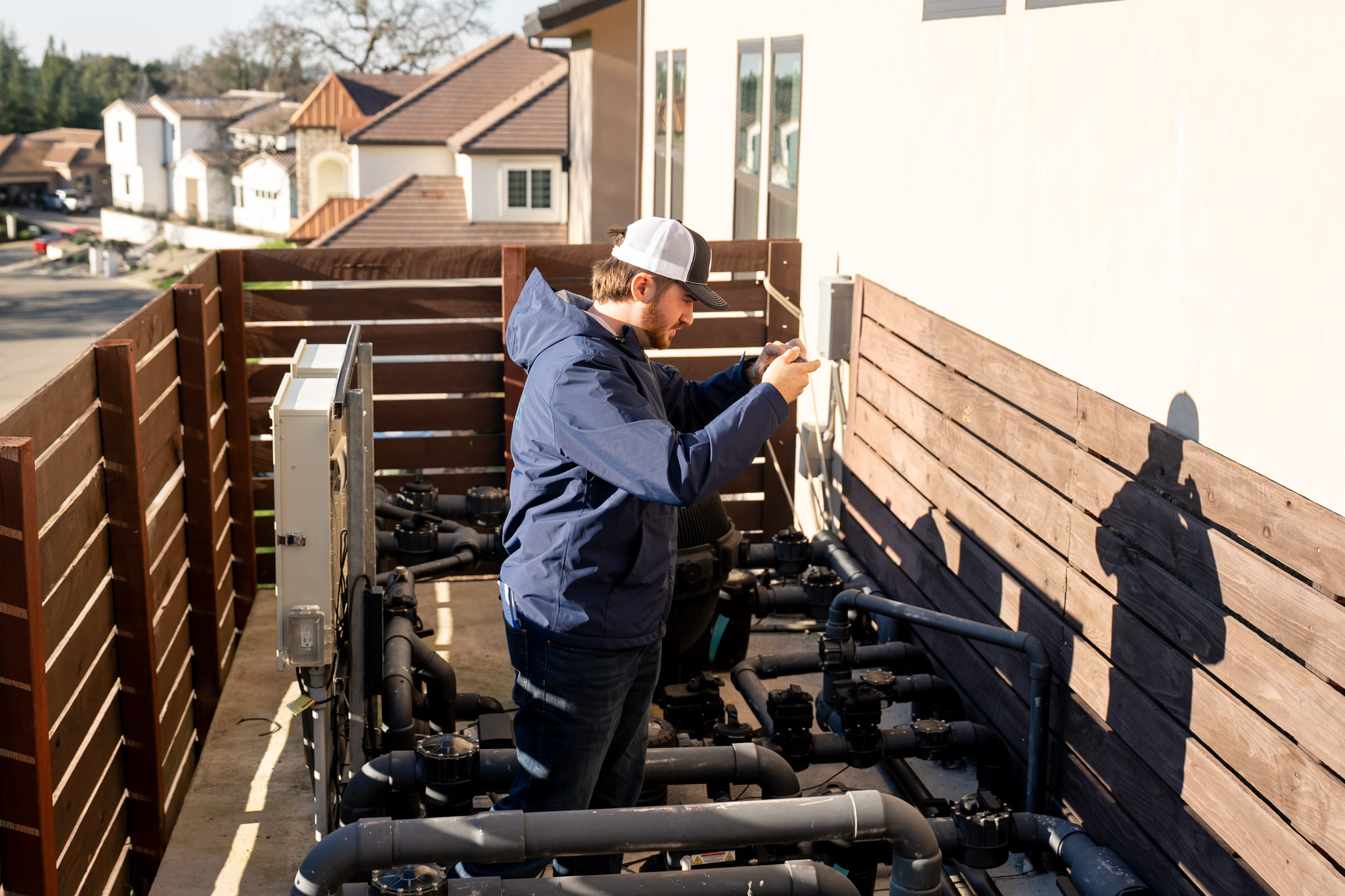
We plumb a three valve bypass on every install. It lets the heater be isolated for service without draining the system, keeps excess flow from being forced through the heat exchanger, and gives you a way to run the pump for filtering or cleaning without pushing water through the heater at all. It costs very little at install and it pays for itself the first time the unit needs service.
Hard Water, Orchard Dust, and Making the Unit Last
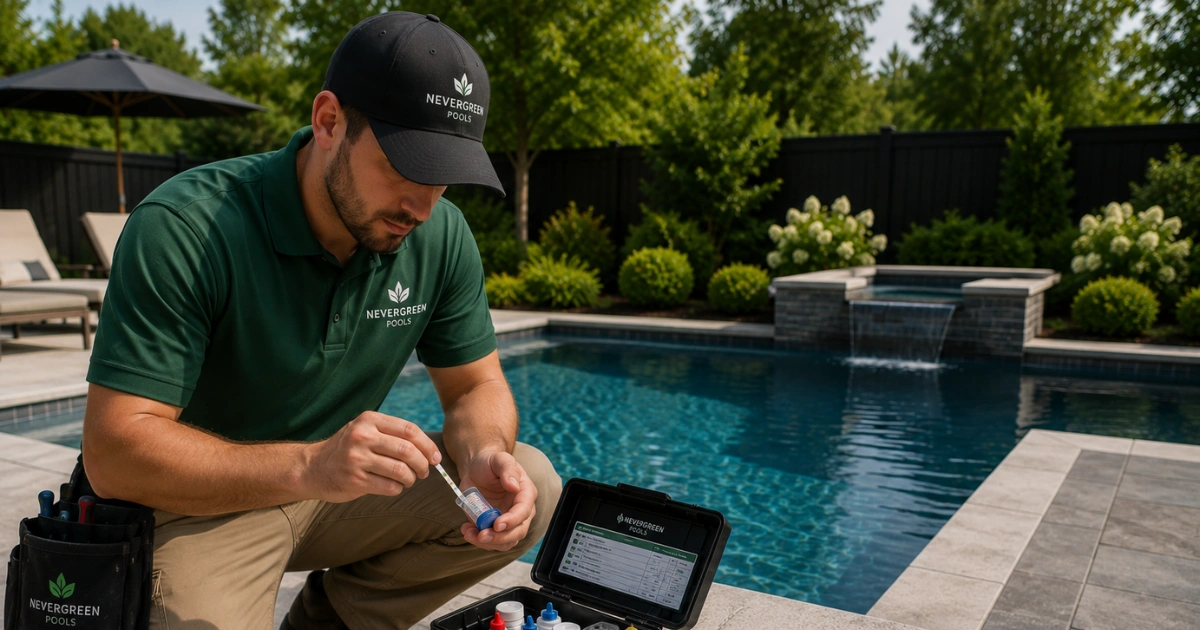
Manteca municipal water is hard. Calcium and total alkalinity both run high, which pushes pH up on its own and leaves scale on tile, on plaster, and, where nobody can see it, inside the heat exchanger. Scale on copper tubing is an insulator. The heater fires the same but delivers less heat to the water, the tubes run hotter than they were designed to run, and eventually one fails and the unit leaks. That is the single most common reason a heater in this area dies years earlier than it should. On an install we balance the water before the unit ever fires, hold alkalinity in range rather than letting it drift, and on a pool with a history of scaling we specify a cupronickel heat exchanger instead of standard copper. It costs more up front and it is the right call on this water.
Flow is the other quiet killer. Almond orchard dust, spring bloom, cottonwood, and whatever the delta breeze carries in after sundown all end up in the filter. A loaded filter starves the heater, and a starved heater either trips out on the pressure switch or runs hot enough to damage itself. The filter and the pump have to be right for the heater, not merely adequate for the pool, and that gets checked as part of the install rather than discovered after the first summer. Older plaster pools in the middle of town and newer pebble finish pools out in the subdivisions both see it.
A cover does more for heating cost than any equipment decision. Evaporation is the largest single heat loss on a pool, and Manteca nights, especially once the delta breeze comes up, pull heat off an uncovered surface fast. Every heat pump we set comes with the same instruction: run it steadily and cover the pool overnight. Heater & heat pump installation in Manteca is straightforward work when the sizing, the gas, the electrical, and the water chemistry are handled together instead of one at a time, and we do the same work in Lathrop, Ripon, and Tracy.
Related services in Manteca: Pool Heater Repair in Manteca and Automation & Control Systems in Manteca.