Professional Pool Service
Automation System Troubleshooting in Stockton
Automation faults in Stockton, CA: dead controllers, stuck valve actuators, lost app connectivity, and bad schedules diagnosed and repaired by Nevergreen.
Professional Pool Service
Automation faults in Stockton, CA: dead controllers, stuck valve actuators, lost app connectivity, and bad schedules diagnosed and repaired by Nevergreen.
Pool automation is supposed to make a pool quieter and simpler. When it fails, it does the opposite. A controller that will not wake up, a valve that hums but never turns, a heater that ignores the schedule, an app that reports the pool offline while the pump is clearly running in the yard. Automation system troubleshooting in Stockton starts with separating the three layers that can fail: the control board and its relays, the devices out at the pad, and the network path between the panel and your phone. Most homeowners assume the panel is dead. More often the panel is fine and something downstream stopped answering.
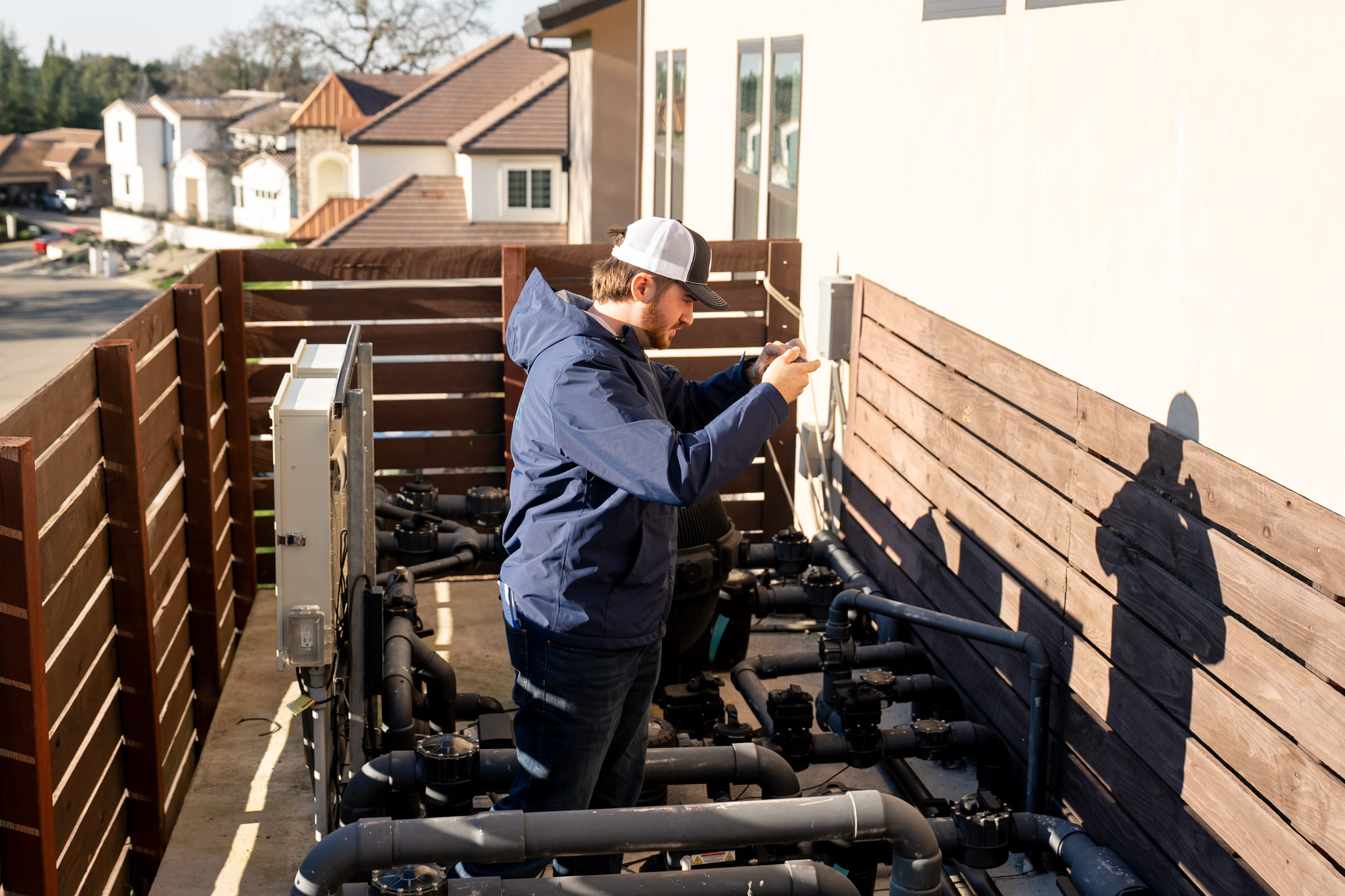
Two very different kinds of system get diagnosed under the same complaint here. On older pools, automation was usually added long after the pool was built and bolted onto equipment that has been replaced in pieces since: original galvanized plumbing, plaster resurfaced once or twice, a single speed pump swapped for a two speed at some point, and a panel wired to switch all of it with line voltage. Newer pools run variable speed pumps, actuators on both the suction and return side, and a controller that talks to the pump over a communication cable instead of cutting power to it. The symptom can read identically on both. The cause almost never does. The first thing we establish on a service call is which type of system is in front of us, because the diagnostic path splits right there and the wrong path wastes the visit.
Nevergreen Pools covers this area in partnership with Vintage Pool Service, a longtime Central Valley company running routes out of East Yosemite Avenue in Manteca, so the tech who shows up already knows how equipment pads around here were built and what has usually been changed since.
On an older pool, automation is mostly a box of mechanical relays switching line voltage. The controller decides, the relay clicks, the pump or the light gets power. When one of those relays fails you get a very specific symptom: the panel says the pump is on, the schedule is correct, the display looks normal, and nothing happens at the pad. Pull the dead front and you will often find a relay with pitted contacts or a scorch mark on the board underneath it. Relays are consumables. They carry a rated number of cycles, and a pool running two schedules a day for twenty years has burned through them.
Testing that is straightforward. We confirm line voltage into the power center, then read voltage at the relay load terminals with the circuit commanded on. Voltage in and nothing out means the relay is done. Voltage out with no equipment response moves the problem to the pad. A relay that stays energized after the circuit is commanded off has welded contacts, which is why some pumps run around the clock no matter what the schedule says. Relays are replaceable individually on most supported platforms, so a single failure is rarely a reason to condemn a panel.
Heat is the second half of that story. Summer here runs hot from June into September, and most older equipment pads sit in full sun with no shade, so the panel bakes for months at a stretch. Dust and cottonwood fluff blow in on the afternoon breeze and settle on the board, then tule fog holds moisture in that grit all winter. That combination corrodes terminal screws, backs out low voltage connections, and produces intermittent faults that come and go with the weather. A good share of automation system troubleshooting in Stockton is figuring out whether a fault is electrical, mechanical, or a connection that has worked itself loose. If your system only misbehaves on hot afternoons, or only after a stretch of fog, that pattern is a real clue and worth telling the tech.
Valve actuators on these pools tend to be older too, and they fail in a way people misread. The actuator has internal cams that tell it where to stop. When the gears strip or a cam slips, the actuator still gets power and still makes noise, but the valve stops short or runs past and slams. Homeowners hear the motor and assume automation is working. It is not. The other common one is a valve that has gone stiff. The water here is hard, and calcium builds on a stem that only moves twice a day until the valve will not turn. The actuator is healthy. It simply cannot move a valve that has scaled tight. We pull the actuator and turn the valve by hand before condemning anything, because swapping in a new actuator without freeing the valve buys a few months and then you are back where you started.
Freeze protect deserves its own note. Hard freezes are rare, but fog season drops nights into the mid thirties often enough that the feature matters, and a failed air sensor either leaves the pool unprotected or runs the pump all night for weeks. Since these pools sit unused and mostly unwatched from November through February, nobody catches it until the power bill shows up. We check the air sensor reading against actual outdoor temperature and confirm the freeze setpoint and the circuits assigned to it, since a freeze routine that only protects the pump does nothing for a spa line or a heater bypass.


Newer equipment shifts the failure modes entirely. A variable speed pump on a communication cable is not switched on and off, it is told what speed to run. If that cable is damaged, miswired, or the address set on the pump no longer matches what the controller expects, the pump falls back to its own onboard program and ignores every schedule you set. The panel shows green. The pump runs at the wrong speed at the wrong time. Nothing looks broken to a homeowner, and no amount of rebuilding the schedule fixes it. The same logic applies to a salt cell or a heater on a data connection: the controller is asking, the device is not answering, and the display only reports what it was last told. We verify the pump address at the drive, check continuity and polarity on the comm pair, and command a speed change while watching the pump respond in real time.
Lost app connectivity is the other big one, and it is usually not the pool at all. Automation gateways ride the home wifi, and the panel sits out at the pad, often on the far side of a stucco wall from the router. A router replacement, a new mesh system, an internet provider swap, or a firmware push can knock the panel off the network while the pool keeps running its last known schedule perfectly. We check signal strength at the panel before touching anything else, because chasing a control fault that is really a network fault wastes the visit. Firmware belongs in the same paragraph. Manufacturers push updates that change how the app authenticates, and a panel that has not been updated in a few years can lose remote access while local control at the keypad still works fine.
Sensors are the quiet failure on both kinds of pool. Water and air temperature sensors are simple thermistors, and when one drifts, everything downstream makes bad decisions. A water sensor reading ten degrees high keeps the heater off while the pool sits cold. One reading low runs the heater past setpoint and wastes gas. Flow and salinity sensors do the same thing to a chlorinator, and a false flow fault will lock out a system that is circulating just fine. We read sensor resistance against actual water temperature rather than trusting the number on the screen, because the screen is only repeating what a bad sensor reported.
The question that decides the cost of automation system troubleshooting in Stockton is whether the system is worth repairing at all. If the platform is still supported, parts are still made, and one relay or one actuator has failed, the repair is straightforward and the rest of the system keeps earning its keep. If the main board is obsolete, if the power center is no longer produced, or if you are on your third failure in two years on a panel that lives in full afternoon sun, a retrofit is the honest answer. That comes up more often on older pools, where automation was added to equipment that has since been replaced piece by piece and the panel is now the oldest thing on the pad. It comes up less on newer ones, where a board swap usually restores the whole system. A retrofit is also the moment to relocate a panel out of direct sun or add a shade cover, since that is what killed the last one.
Either way, you get told which one you are looking at, and why, before parts are ordered. That is the same approach on every call we run in Stockton, Lodi, Manteca, and Tracy: find the actual fault, show you the part that failed, and lay out the repair path and the replacement path with the tradeoffs of each. Automation is supposed to run the pool without you thinking about it, and when it stops doing that, the fix is diagnosis, not parts guessing.
Related services in Stockton: Automation & Control Systems in Stockton and Pool Heater Repair in Stockton.