Professional Pool Service
Chlorinators and Chemical Feeders in Stockton
Chlorinator and chemical feeder repair in Stockton, CA. We clear clogged feeders, fix check valves, replace pump tubing, and dial in safe chlorine levels.
Professional Pool Service
Chlorinator and chemical feeder repair in Stockton, CA. We clear clogged feeders, fix check valves, replace pump tubing, and dial in safe chlorine levels.
A chlorinator or chemical feeder is the quietest thing on the equipment pad until the day it stops doing its job. Then the water goes cloudy, the walls get slick, or the test kit reads zero free chlorine three days after you filled the tablet chamber. In Stockton, that same complaint comes from two very different pools. One is a mid-century tract pool in the older central and north parts of town, plaster that has been patched more than once, original galvanized plumbing still in the ground, and an offline tablet feeder that was added long after the pool was built. The other is a newer pebble pool out toward the master planned areas, variable speed pump, in-line feeder plumbed into the return, and a peristaltic acid pump running on a timer.
Both fail. They just fail differently, and the repair rarely looks the same. That is why we treat chlorinators and chemical feeders in Stockton as a diagnostic job first and a parts job second. Hard groundwater runs through much of the city, and calcium does not care how new your equipment is. It builds inside dosing lines, on check valve seats, and across the injection fitting until flow drops to a trickle, while the dial on the front still reads exactly where you left it.
Nevergreen Pools serves the area in partnership with Vintage Pool Service, a longtime Central Valley pool company working out of East Yosemite Avenue in Manteca. The practical benefit of that partnership is history. The trucks running Stockton, Lodi, and Tracy already know what equipment went on these pads over the years, which older feeders still have parts available, and which ones are worth replacing outright instead of chasing.
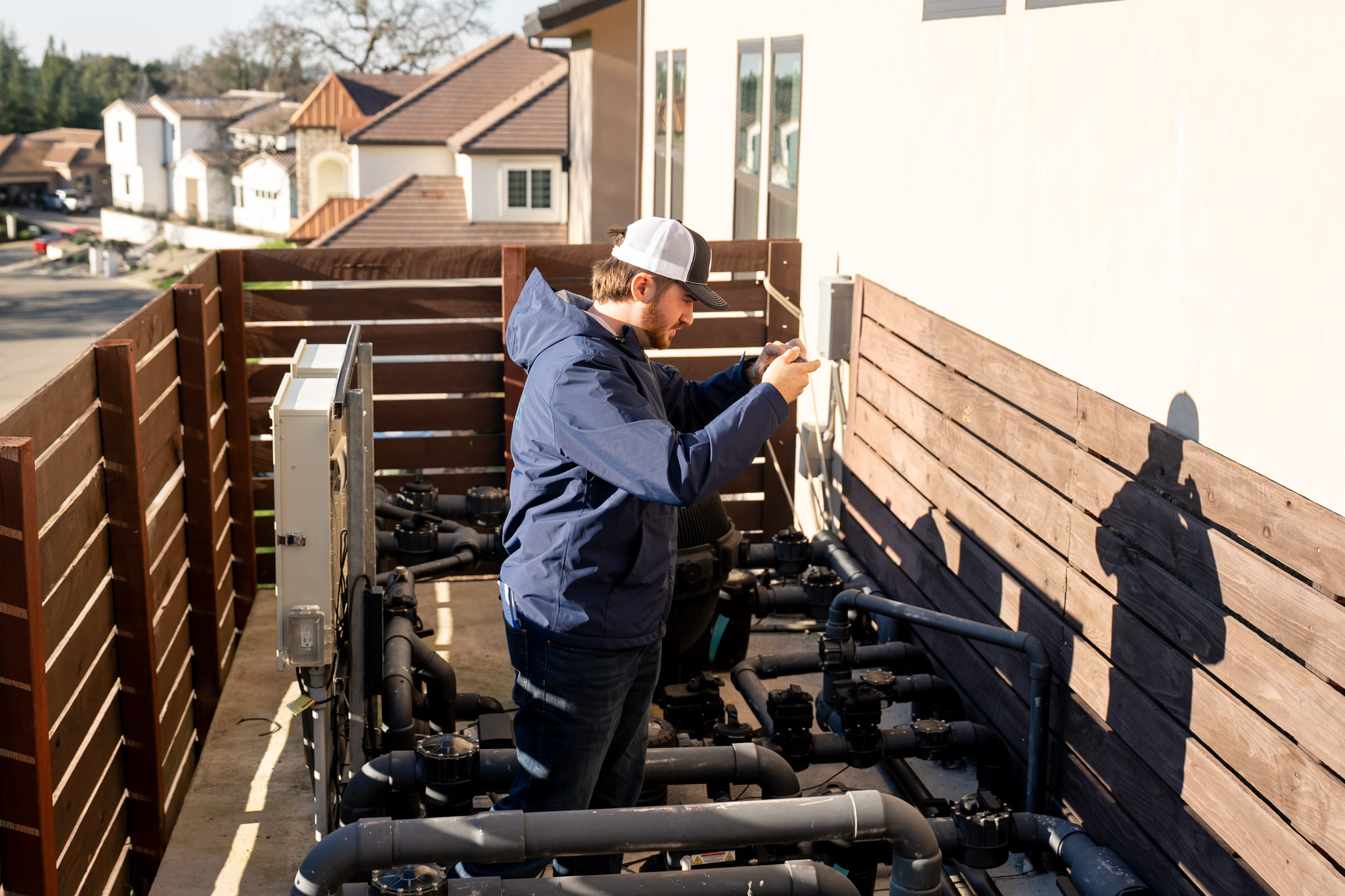
Most of the aging tract pools here run an offline erosion feeder, a white cylinder mounted beside the filter with a lid you unscrew to load trichlor tablets. Flow through it is set by a small dial or a needle valve on the feed line. Three things go wrong on these, and they usually go wrong together.
The lid cracks. Trichlor gas is aggressive and years of sun make the plastic brittle, so the threads or the lid body split and the feeder either weeps or loses its seal. A cracked lid on a feeder that also has a hardened o-ring will pull air, and once air is in the chamber the tablets stop eroding evenly and start bridging into one solid plug that no amount of dial adjustment will move.
The check valve sticks. Every offline feeder needs a working check valve to keep feeder water from pushing back toward the pump and heater. When that valve stops seating, extremely acidic water migrates into the plumbing every time the pump shuts off. On a pool with original galvanized lines still in the ground, that is how you get pinhole leaks and rust colored staining at the returns years before anyone connects the two events. We pull and inspect that valve on every older feeder we open, because it is cheap to replace and expensive to ignore.
The feed line calcifies. Stockton water is hard through most of the city, and the narrow tubing between the feeder and the return line is the first place scale closes things down. The tablets still shrink, the dial still turns, and the pool still runs low on chlorine because very little is actually getting through. Clearing or replacing that line often restores more sanitizer output than any other single repair on an older pad.


Out in the master planned parts of Stockton the equipment looks different. Pebble finish, variable speed pump, and often a liquid chlorine or acid feeder driven by a peristaltic pump instead of a tablet chamber. These are better systems when they are maintained, and they carry their own short list of failures.
Peristaltic tubing is a wear item, not a permanent part. A roller squeezes it thousands of times a day, and after a season or two it flattens, hardens, or splits. A split tube inside the pump head sprays acid across the housing and the pad, and most homeowners smell it before they see it. We replace the squeeze tube, check the roller assembly for drag, and inspect the suction and discharge fittings, since the same chemistry that killed the tube has usually been working on the connectors too.
Injection points calcify. Liquid chlorine meeting hard water right at the orifice drops calcium exactly where you least want it, and a partly blocked injector lets the pump run its full cycle while delivering half a dose. That is the failure that fools people, because the pump sounds completely normal.
Calibration is the third piece and it matters most for water quality. A feeder dialed too high does more than waste chemical. Trichlor is acidic and stabilized, so over feeding pulls pH down toward the range where plaster etches and metal parts corrode, and it steadily loads the water with cyanuric acid. Once stabilizer climbs high enough, the chlorine you are adding is locked up and slow, the pool reads under sanitized, and the natural reaction is to open the dial further. That loop is why we test stabilizer and pH before touching a dial on any call for chlorinators and chemical feeders in Stockton.
Summers run triple digits for weeks at a stretch, chlorine demand climbs hard, and a feeder set correctly in April cannot keep up by July. Delta breezes push through most summer evenings carrying cottonwood fluff, dust, and river debris onto the water, which loads the filter and drops the pressure difference an offline feeder depends on to work at all. Mature trees near the waterfront and the older streets around University of the Pacific add a heavy leaf drop in fall. Then winter arrives, tule fog settles in for months, and pools sit unused and unattended with feeders still loaded. In February we open chambers full of half dissolved tablet sludge, seized dials, and check valves cemented shut by a season of no flow.
We service tablet and liquid systems on pools of every age across Stockton and the surrounding towns, including Lodi, Manteca, and Tracy. If your feeder empties faster than it should, or the water tests low no matter how many tabs you load, the answer is almost always in the hardware and not in the chemical bill.
Related services in Stockton: Chemical Treatment in Stockton and Sanitizer Systems in Stockton.