Professional Pool Service
Sanitizer Systems (UV & Chlorination) in Stockton
UV, ozone, salt, and tablet sanitizer systems installed in Stockton, CA. Sized to your gallons and flow, plumbed in the right order on the pad.
Professional Pool Service
UV, ozone, salt, and tablet sanitizer systems installed in Stockton, CA. Sized to your gallons and flow, plumbed in the right order on the pad.
Stockton has two kinds of backyard pools, and the sanitizer that works well in one is often the wrong call in the other. In the older tract neighborhoods of central and north Stockton you find mid-century pools with plaster that has been patched more than once, small filters, and original galvanized plumbing feeding the equipment pad. In the newer master-planned parts of the city you find pebble interiors, oversized filters, and variable-speed pumps that spend most of the day turning slowly. Both sit under the same triple-digit summers, draw from the same hard water, and catch the same dust and cottonwood fluff that the delta breeze carries in every evening. What separates them is how the water behaves once you start feeding chlorine into it.
Most calls start with a complaint rather than a product. The water smells like a locker room. Eyes burn. Chlorine goes in and is gone by the next afternoon. That is almost never a chlorine shortage. It is chloramines, the spent compounds left behind after chlorine reacts with sweat, sunscreen, pollen, and organic debris. Adding more chlorine on top of them makes the smell worse. Installing sanitizer systems (uv & chlorination) in Stockton is about attacking that at the source, destroying combined chlorine instead of chasing it, and delivering fresh sanitizer at a steady rate instead of in weekly slugs.
Nevergreen Pools covers this city in partnership with Vintage Pool Service, a Central Valley company that has run routes out of East Yosemite Avenue in Manteca for years and knows how the water behaves from Lodi down through Tracy. That experience matters on equipment work, because the right sanitizer for a pool depends far less on the brochure than on what is already plumbed into the pad.
An aging plaster pool in an older Stockton tract is a chemical sponge. Plaster that has lost its finish is porous and slightly rough, and rough surfaces hold algae in a way a smooth interior never does. That pushes sanitizer demand up before a single swimmer gets in. Add hard groundwater and the calcium already in solution, and you have a pool that scales at the tile line every summer and burns through chlorine every afternoon.
Tablet chlorinators are common on these pools because they were inexpensive to install and they do work. The problem is stabilizer. Every trichlor tablet carries cyanuric acid with it, and cyanuric acid does not evaporate or burn off. It accumulates season after season until the chlorine you are paying for is locked up and sluggish. If we test a pool and the stabilizer reading is high, the honest answer is that a bigger chlorinator will not fix it. Draining and refilling, then changing how sanitizer gets fed, will.
Old galvanized plumbing changes the conversation about salt. A salt chlorine generator makes chlorine on demand and holds a steady residual, which is exactly what a high-demand plaster pool wants, but salt water is harder on metal that is already corroding from the inside. Before we quote a salt system on an older pool here, we look at:
When salt is not the right answer, a UV sterilizer paired with a correctly sized in-line chlorinator usually is. UV does not sanitize the pool. It treats water as it passes the lamp, killing what goes through and breaking apart the chloramines that cause the smell. You still carry a chlorine residual in the water. What changes is how much of it you need, and the locker room odor is generally gone within a couple of days.


Newer Stockton pools in the master-planned areas start from a better place. Pebble holds up, the filters are larger, and the equipment is already automated. The complication is the variable-speed pump. UV and ozone are flow-dependent devices. A lamp rated for a given flow provides a given contact time, and if the pump is loafing at low RPM to save power, water may be crawling past the lamp for part of the day and racing past it during heater or cleaner cycles. Sizing UV on a variable-speed pool means sizing to the actual schedule rather than to nameplate horsepower, and it often means programming a dedicated sanitize speed that runs long enough each day to turn the water over.
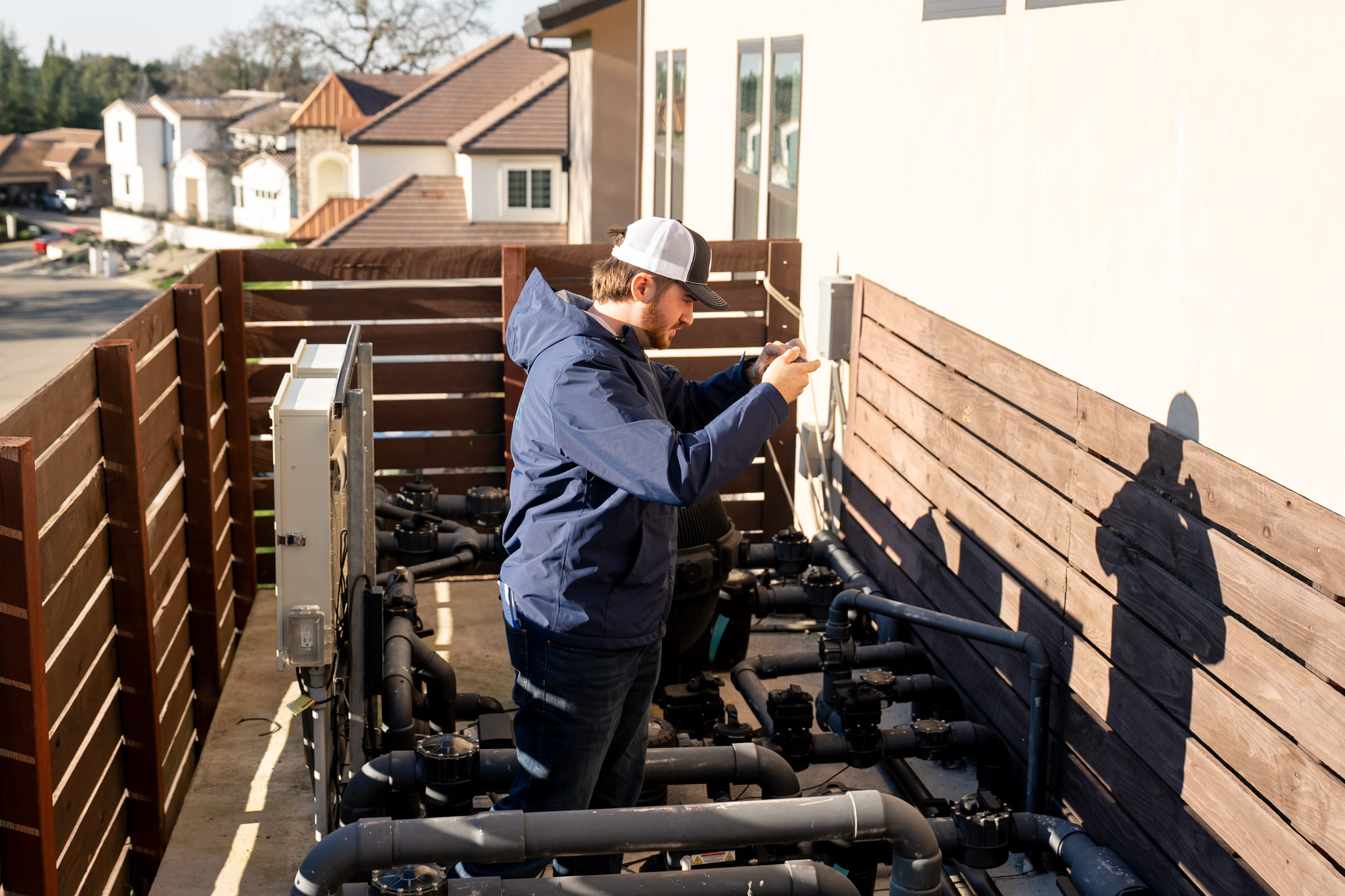
Order on the pad is not negotiable. Sanitizer equipment goes in after the filter and after the heater, at the tail end of the return line, so debris never reaches the lamp or the cell and concentrated product never sits against a heat exchanger. On a newer pool with a clean, roomy pad, we can usually do that the first time through. On an older pool we are frequently rebuilding a section of the pad to get the sequence right, and that work is worth paying for, because a chlorinator plumbed ahead of a heater will destroy the heater.
Everything gets sized to gallons and to measured flow. A salt cell rated well above the pool volume is not overkill, it is service life, because the cell runs a shorter cycle to hit the same daily output and the plates last longer for it. UV lamps lose usable output long before they go dark, so they come out on a schedule rather than on failure, generally after a year of runtime. Salt cells give several seasons and then lose plate coating, which shows up as a low salt reading on a pool that in fact has plenty of salt in it. Ozone units follow their own replacement cycle depending on whether they are corona discharge or lamp-based.
Winter is its own factor in this city. When tule fog settles in, pools sit unused and unattended for months, and a pool with no sanitizer feed running through that stretch is exactly where spring algae comes from. Salt generators throttle down as water drops toward the sixties and effectively stop producing, so a Stockton pool on salt still needs a manual chlorine plan through the cold months. We set that plan up at commissioning, along with a plan for the heavy fall leaf drop and the river and delta debris the evening breeze pushes across the surface, because the best sanitizer install in the world cannot keep up with a filter nobody has opened since October. That is the part of sanitizer systems (uv & chlorination) in Stockton that nobody puts in a sales sheet, and it is the part that decides whether the water is clear in April.
Related services in Stockton: Salt Cell Replacement in Stockton and Chlorinators & Feeders in Stockton.