Professional Pool Service
Pump Installation & Upgrades in Stockton
Variable-speed pump installation and upgrades in Stockton, CA. Proper sizing, Title 24 compliant swaps, speed programming, and leak-checked startup.
Professional Pool Service
Variable-speed pump installation and upgrades in Stockton, CA. Proper sizing, Title 24 compliant swaps, speed programming, and leak-checked startup.
Stockton has two kinds of pools, and the pump is where that difference shows up first. Across the older tracts of north and central Stockton, you find plaster pools built in the sixties and seventies, running on plumbing that has been patched more than once and, in plenty of cases, still fed by original galvanized pipe at the equipment pad. Out in the newer master-planned areas on the edge of town, you find pebble finishes, larger suction and return lines, and pads that were laid out around variable-speed equipment from the start. Both kinds of pool need a pump replaced eventually. They are not the same job.
California code drives most of this. Title 24 requires that when a filtration pump above a certain size is replaced, it goes back in as a variable-speed unit. So a homeowner who calls about a loud, failing single-speed pump is usually looking at a real equipment change rather than a like-for-like swap, and that change ripples into how the pump is sized, how it is plumbed, and how it is programmed once it is running. Done right, the pool gets quieter, the power bill drops noticeably through a triple-digit Stockton summer, and filtration actually improves, because the water turns over slowly and steadily instead of blasting through the filter for a few hours a day.
Nevergreen Pools handles pump installation & upgrades in Stockton in partnership with Vintage Pool Service, a longtime Central Valley company working out of Manteca on East Yosemite Avenue that knows what is sitting on these pads. That matters more than it sounds. Guessing at a pump for a pool nobody has looked at is how homeowners end up with an oversized motor that costs more to run and pulls harder than the plumbing can handle.
On a mid-century pool in Stockton, the pump is rarely the only thing that has aged. The suction line is often undersized by modern standards, the pad has been rebuilt piecemeal over three or four decades, and there may be a stretch of galvanized pipe upstream that has narrowed from the inside. Stockton sits on hard groundwater in much of the city, and years of calcium deposits inside old pipe and fittings cut the effective diameter down without anything looking wrong from the outside. Drop a large variable-speed pump onto that system and you have not solved the problem. The motor will run, but at higher speeds it will cavitate, whine, and pull air past tired unions, and the energy savings never show up on the bill.
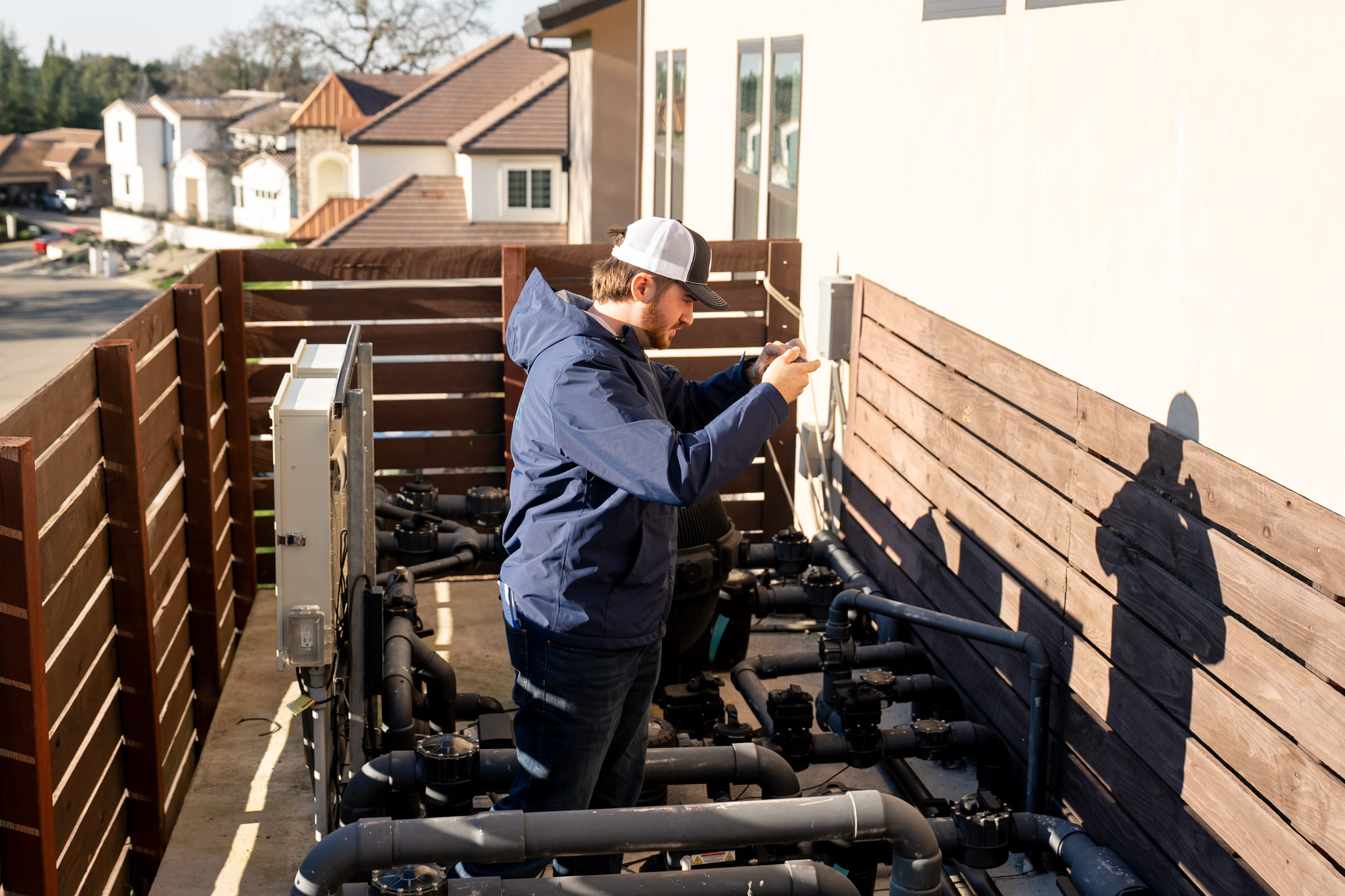
So the first part of the job on an older pool is measurement, not installation. We look at line size, run length, the number of elbows between the skimmer and the pad, the height of the pad relative to the water, and the condition of every union and o-ring we are going to disturb. Horsepower gets chosen from that, not from the label on the pump coming out. A lot of these pools were originally fitted with a one and a half or two horsepower single-speed unit because that was simply what got installed at the time, and the correct replacement is frequently a pump that moves the same water on a fraction of the electricity because it runs slow and long instead of fast and short.
The other reality on older Stockton pools is debris load. Cottonwood fluff and dust ride in on the delta breeze most summer evenings, river debris finds its way into yards closer to the water, and mature trees over these older lots drop heavily in fall. Baskets and skimmers fill faster than any factory schedule assumes. A variable-speed pump running a long, low filtration cycle handles that better than a single-speed that either runs wide open or not at all, because the water keeps moving through the day instead of sitting still while the surface loads up. We also set the install so the pot lid is easy to reach and seals without a fight. A homeowner who cannot get the lid off will not clean the basket, and a starved pump is the fastest way to kill a new motor.


Pools in the newer master-planned parts of Stockton are a different conversation. The plumbing is usually two inch or better, the pad was laid out with room to work, and the original equipment was already variable-speed. Here the pump is being replaced because the motor or the drive failed after eight or ten years, or because the homeowner wants a better unit with a cleaner interface and a longer warranty. The physical install is straightforward. The value on this kind of pool is in the sizing and the programming.
A modern pad usually has more than one demand on it. Filtration wants a low speed for many hours. A pressure-side or suction-side cleaner wants a specific higher speed to actually drive the head and cover the floor. An attached spa with jets wants near full speed on demand, and a raised waterfall or sheer descent wants its own setting somewhere in between. Heaters and salt cells have minimum flow rates they need to fire and to read correctly. All of that gets set as named speed programs on the new pump, on a schedule built around how the family actually uses the pool, rather than left on a factory default that runs too fast for too long.
Sizing still matters on these pools, just in the other direction. A newer pool with a large surface area, a long run to a detached pad, or a spa on the same system needs enough head available at the top of the speed range to run those features properly. Undersize it and the jets feel weak and the cleaner stalls halfway through a cycle. Oversize it and you are paying for capacity that sits unused every day of the year. We size from the actual turnover requirement and the highest flow feature on the system, then check that against the filter and heater already on the pad.
No pump install is finished until it has been primed and watched. We fill the pot, purge the air, and run the system while checking every joint we touched and the ones we did not. A slow suction-side leak will not drip on the concrete. It pulls air instead, and the symptom shows up as bubbles at the return or a pump that loses prime overnight. So we look at union faces, the pot lid seal, drain plugs, and diverter valves under real flow before calling it done, then read pressure at the filter to confirm the programmed speeds are producing the flow we expect.
Winter counts here too. Tule fog settles over Stockton for weeks and pools go unused and largely unattended for months. A pump programmed with a sensible cold-weather schedule, and freeze protection where the equipment supports it, keeps water moving on the handful of nights that call for it and stops burning power the rest of the time. Before we leave, we walk the homeowner through the controller in plain terms: how to change a speed, how to clear a basket, and what a normal filter pressure looks like so a rising number gets caught early. Whether it is a sixty-year-old plaster pool near the waterfront or a ten-year-old pebble pool on the newer edge of town, that is what pump installation & upgrades in Stockton should include, and it is the same standard we bring to work in Lodi, Manteca, and Tracy.
Related services in Stockton: Pool Pump Repair in Stockton and Filter Installation in Stockton.