Professional Pool Service
Automation & Control Systems in Stockton
Pentair, Hayward, and Jandy automation installed and commissioned in Stockton, CA. Retrofits for older pads, app control, and hands on homeowner training.
Professional Pool Service
Pentair, Hayward, and Jandy automation installed and commissioned in Stockton, CA. Retrofits for older pads, app control, and hands on homeowner training.
Stockton pools fall into two groups, and automation work looks different on each. Older pools in the central and north parts of the city usually have a plaster finish, a single speed pump running off a mechanical time clock, and galvanized plumbing that has been patched more than once. Newer pools usually have a pebble finish, a variable speed pump, a heater with a digital board, and equipment that left the factory already wired to accept a controller. Both can be automated. The path to get there is not the same.
That split is the first thing we look at on any quote for automation & control systems in Stockton. A Pentair IntelliCenter, a Hayward OmniLogic or OmniHub, or a Jandy iAquaLink will run pumps, heaters, lights, and valve actuators on a schedule and put all of it on your phone, but a controller is only as good as the pad it is bolted to. On a modern pad it is often a clean afternoon of work. On a pad built in the 1960s it means new actuators, a new subpanel, sometimes corrected bonding, and an honest conversation about which pieces of old equipment are worth keeping and which ones are holding the rest back.
Nevergreen Pools serves the area in partnership with Vintage Pool Service, a Central Valley company that has run routes out of East Yosemite Avenue in Manteca for years and knows what these equipment pads look like from Lodi down through Tracy. Knowing what sits behind a wall of old conduit instead of guessing at it is what keeps a one day job from turning into three.
Most older pools reach automation for one of two reasons. The mechanical time clock quits, or the homeowner is tired of walking out to the equipment in the dark to turn on the heater. The controller itself is the easy part of that job. Everything around it is what takes the day.
The first check is the pump. A single speed pump can be switched by a relay inside an EasyTouch or an OmniHub, but that only buys you on and off, and California efficiency rules push nearly every replacement toward variable speed anyway. Once a variable speed pump goes in, it talks to the controller over an RS-485 communication cable instead of a relay, and that gives you real speed steps: a low overnight circulation speed, a higher speed for skimming, full speed while the cleaner runs. Speeds are set in RPM and saved to named programs, so the schedule can drop the pump to roughly 1200 RPM for long turnover hours and step it up to 2600 or higher only when the surface needs work.
The second check is the heater. Older heaters with millivolt or basic electronic controls accept an on and off signal through a relay and nothing more, so setpoint control from the app is off the table. Heaters with a two wire communication port hand full setpoint control over to the controller, which also lets the controller enforce a cool down circulation period after the burner shuts off instead of dropping the pump at the same instant.
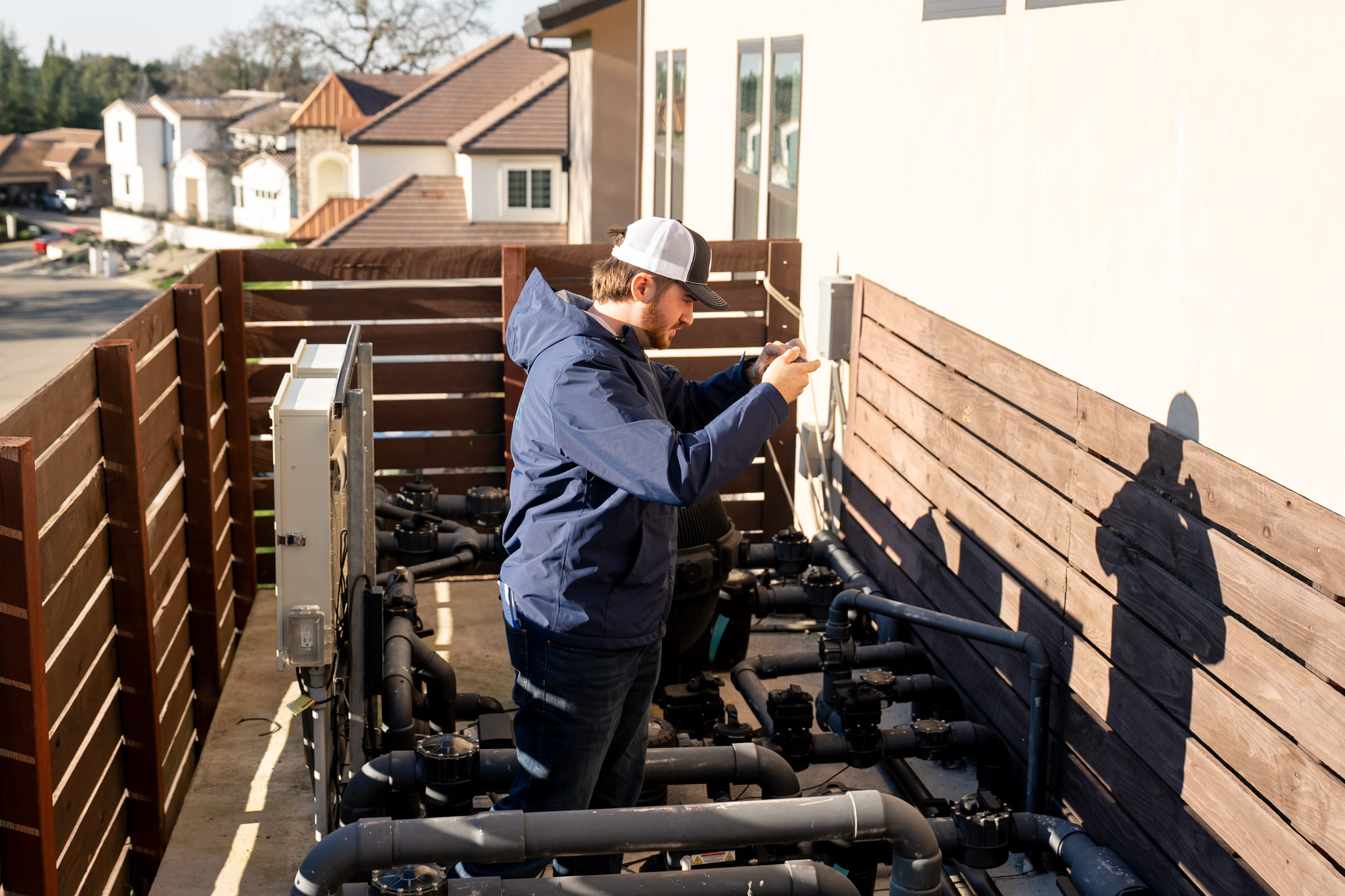
Then there is the plumbing. Older pads commonly run hard plumbed suction and return lines with hand valves that have not moved in years, plus galvanized sections narrowed by decades of scale. Motorized actuators bolt onto standard three way valve bodies, but a body with a seized diverter has to be replaced before an actuator goes anywhere near it. Add a subpanel with room for relays, low voltage runs out to the actuators and pump, bonding brought up to current standards where it is missing, and a mounting spot for the controller that is out of the afternoon sun, because Stockton runs triple digits for stretches in July and a west facing panel gets hot enough to shorten its own life.
A typical older pad retrofit includes:
That last item gets skipped more often than it should. Tule fog sits over Stockton for days at a stretch, overnight lows do drop, and the pool nobody has looked at since October is exactly the one that benefits from a controller starting the pump on its own at 36 degrees.


On newer Stockton pools the equipment already speaks the right language. A pebble pool with a variable speed pump, a modern heater, and color LED lights usually needs a controller, a communication cable, and a few hours of work. The interesting part moves from wiring to programming, and that is where local conditions decide the schedule.
Wind comes through most summer evenings and carries dust and cottonwood fluff into the water. A pool that ran its skim cycle at noon collects all of that overnight and hands you a loaded surface in the morning. Push the higher skim speed into the evening and early morning instead, and the skimmers catch that material while it is still floating, before it waterlogs and settles on the floor. Fall leaf drop earns its own seasonal program, with a longer cleaner run and a shorter heater window. Lights get their own schedule rather than sharing the pump circuit, so LED color shows can run without turning the pump on.
Hard water is the other local factor worth programming around. Stockton water runs high in calcium, and scale shows up on heater exchangers, salt cell plates, and tile lines. Controllers with pH and ORP sensing, IntelliChem on the Pentair side or Sense and Dispense on the Hayward side, read the water continuously and dose acid and sanitizer to hold a target rather than correcting after the fact. Steady pH is the single best defense against scale here, and it also flattens the swing between overchlorinated and depleted that a manual routine produces during triple digit weeks. Sensors sit in a flow cell on the return line and need the pump running to read correctly, so dosing windows get tied to circulation hours, never to a clock alone.
Installing automation & control systems in Stockton is not finished when the panel door closes. Every valve gets cycled and confirmed to rotate the correct direction. Every relay gets labeled for the thing it actually controls. Pump speeds get named for what they do instead of left as numbers. The heater setpoint is verified against a real thermometer. Salt cell output and any chemistry setpoints are checked against a full water test, not against the display. The controller goes on the home network with signal strength checked at the pad rather than at the back door, since equipment can sit a long way from the router, and an antenna extension is cheaper to install now than to retrofit later. Firmware gets updated before we leave, and the app is loaded and logged in on your phone while we are still on site.
Then comes the walkthrough. How to override a schedule for a weekend of guests, how to bring the spa up before you leave work, how to put the system into its winter program when the pool goes quiet until spring, and how to run the pump manually if the controller ever loses power. A controller nobody knows how to drive is just an expensive time clock, so the training is part of the install, not an afterthought.
Related services in Stockton: Automation Troubleshooting in Stockton and Sanitizer Systems in Stockton.