Professional Pool Service
Filter Repairs (Cartridge, Sand, DE) in Stockton
Cartridge, sand, and DE filter repair in Stockton, CA. We fix cracked tanks, torn cartridges, broken laterals, bad grids, and leaking multiport valves.
Professional Pool Service
Cartridge, sand, and DE filter repair in Stockton, CA. We fix cracked tanks, torn cartridges, broken laterals, bad grids, and leaking multiport valves.
A pool filter rarely quits all at once. It starts with a pressure gauge that climbs faster than it used to, a puff of dirt blowing back through the returns a few seconds after the pump kicks on, or a slow drip at the base of the tank that leaves a white ring on the equipment pad. By the time most Stockton homeowners pick up the phone, the filter has been signaling for weeks. The work is figuring out which part actually failed, because the symptom almost never points straight at the cause.
Stockton makes that diagnosis more interesting than it is in most towns, because the housing here covers such a wide span. In the older tracts you find plaster pools built decades ago, many still fed by original galvanized plumbing, with filters that have been patched, rebuilt, and swapped out by two or three different owners. In the newer master planned areas on the edge of the city the pools are pebble, the equipment pads are clean and square, and the filters are matched to variable speed pumps that spend most of their life at low rpm. Same city, same water out of the tap, two completely different repair conversations.
Filter repairs (cartridge, sand, DE) in Stockton usually come down to a short list of parts, and we repair rather than replace whenever the tank and the plumbing will support it. A torn cartridge, a cracked lateral, a blown spider gasket, and a failed DE manifold can all be sourced and installed without touching the rest of the equipment pad. Knowing when a repair is the right call, and when you are bolting good parts onto a dying tank, is most of the skill.
On an older tract pool, the filter is either the oldest surviving piece of the system or the newest, and neither one is comfortable. If it is original, the tank has been through thirty or more summers of triple digit heat and just as many winters sitting damp under tule fog. The plastic goes chalky and brittle, then splits at the belly band or cracks around the drain port, and the clamp band hardware is often rusted into a single piece that has to be cut off. If the filter was swapped in a hurry at some point, it was frequently undersized for the pool and tied into galvanized lines that have narrowed with scale, so it has run at a higher pressure than it should since the day it went in, and it eats elements.
Newer pools bring a different set of problems. The tanks are in good shape, but a variable speed pump running at low rpm moves water gently enough that a filter can be badly fouled and still show a reasonable gauge reading, so the failure hides for a while. When something does break on these systems it is usually inside the tank: a DE manifold cracked at a grid port, cartridges that were cleaned with a pressure washer and now have pleats blown out along one panel, or a multiport valve on a sand filter whose spider gasket has flattened and started passing water straight to waste.
The parts that actually fail are short in number and easy to name once the lid is off.


Most calls start with a number. A filter that jumps eight or ten pounds over clean pressure within a week is not simply dirty, and in Stockton the reason is often mineral rather than organic. Hard groundwater across much of the city leaves calcium on cartridge fabric and inside sand beds, and once an element is scaled it will not come clean with a hose. Sand that has sat past its useful life channels and cements into clumps, which shows up as a filter that reaches high pressure fast and then loses it just as fast after a backwash. That short cycle is the tell, and it means the media is done rather than dirty.
Debris load matters too. Delta breezes come through most summer evenings carrying dust and river debris off the water, cottonwood fluff coats the surface in late spring, and mature trees drop heavily through the fall. All of it ends up on the filter. What separates a Stockton pool from one in a drier, calmer town is that the element gets hit from both directions at once, minerals from the inside and organic load from the outside, so it wears out years before the label says it should.
Then there is winter. Tule fog settles over the city for weeks at a time and pools sit unused and unwatched. A filter left full of water through a cold snap can crack a tank or split a lid, and a system shut down wet leaves a DE grid set sitting in sludge for months. A good share of the spring repair work here is damage that happened quietly in January while nobody was looking at the equipment pad.
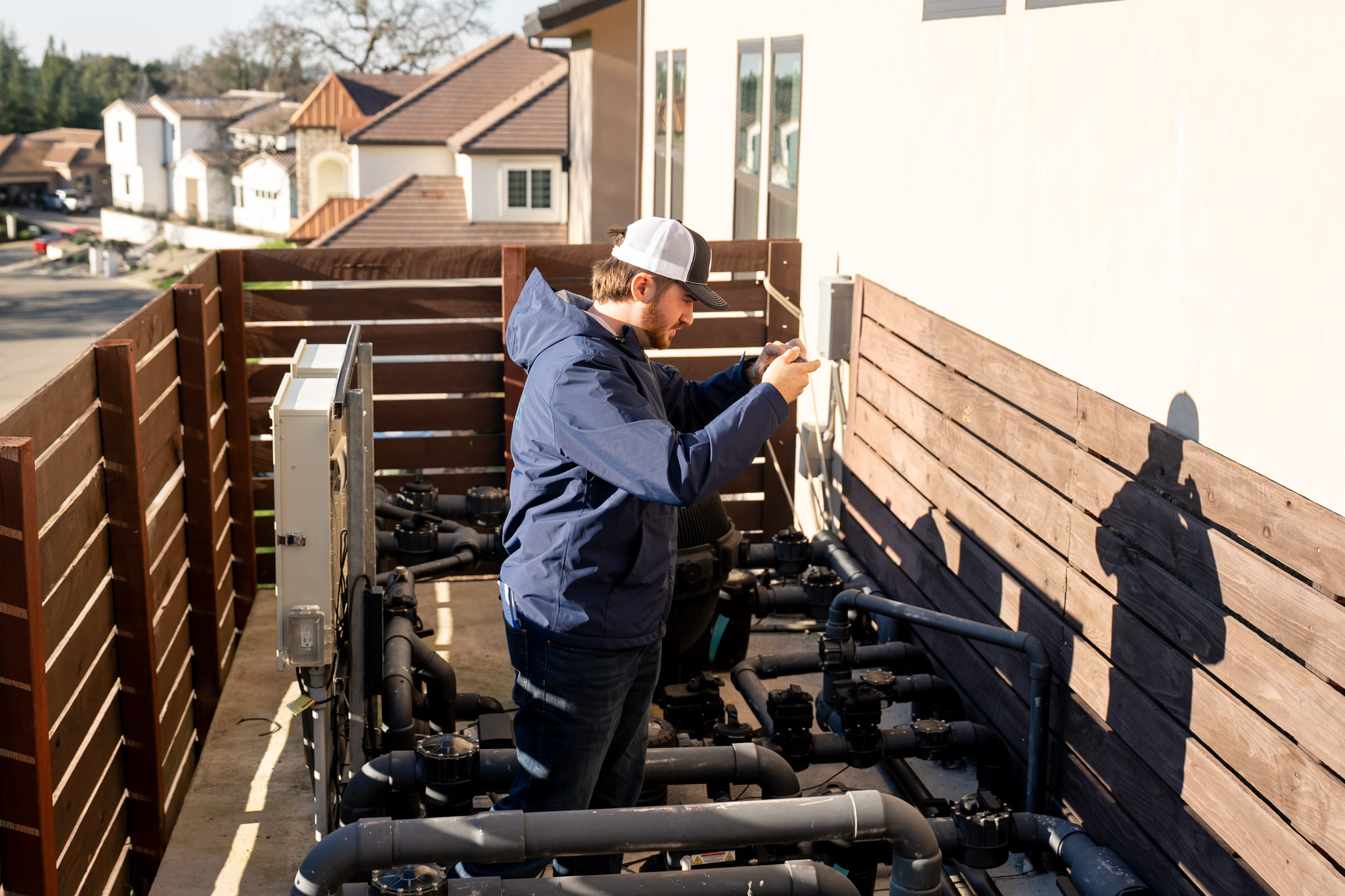
Every visit starts the same way. We read clean and dirty pressure, open the tank, and inspect the elements and the internals before quoting anything, because a cracked manifold and a scaled grid set look identical from outside the lid. If the tank is sound and the plumbing is serviceable, we repair it and put the pool back in service the same day when the parts are on the truck. If the tank is checked through and the clamp band will not seal again, we say so plainly instead of selling a gasket that fails in a month.
Nevergreen Pools is a licensed California pool company serving Stockton in partnership with Vintage Pool Service, a longtime Central Valley company working out of East Yosemite Avenue in Manteca. That pairing means the crews handling filter repairs (cartridge, sand, DE) in Stockton already know the equipment sitting on these pads, the water that runs through it, and how a filter behaves between Lodi and Tracy across a full season. Whether your pool is an older plaster tract build or a newer pebble pool with modern equipment, the fix starts with an honest look inside the tank.
Related services in Stockton: Filter Cleaning in Stockton and Filter Installation in Stockton.