We respond same day.
Emergency services available!
Professional Pool Service
Filter Cleaning in Stockton
Cartridge, sand, and DE filter cleaning in Stockton, CA. Backwashing, DE recharge, deep soaks for calcium scale and oils, and when to replace.
Professional Pool Service
Cartridge, sand, and DE filter cleaning in Stockton, CA. Backwashing, DE recharge, deep soaks for calcium scale and oils, and when to replace.
Stockton has two very different kinds of pools, and the filter usually tells you which one you are standing next to before anyone says a word. On the older side of town you find mid-century tracts with plaster that has been patched more than once and original galvanized plumbing feeding a filter that has outlived two pumps. In the newer master-planned areas you find pebble finishes, oversized tanks, and variable-speed equipment that runs long and slow. Both need the filter cleaned. They do not need it cleaned the same way, on the same schedule, or with the same amount of caution.
That is the part most homeowners miss. Good filter cleaning in Stockton starts with knowing which of those two pools you have, because what is feeding the filter matters as much as the filter itself. Stockton sits on the San Joaquin Delta, and the breeze that pushes through most summer evenings is welcome on the patio and hard on a filter. It carries field dust, cottonwood fluff in early summer, and fine river and delta debris the rest of the year. Add heavy fall leaf drop under mature trees and hard groundwater that leaves calcium behind, and a filter here works harder than the same filter would in cleaner air.
Nevergreen Pools serves the city in partnership with Vintage Pool Service, a longtime Central Valley company working out of East Yosemite Avenue in Manteca. Between the two crews we have opened tanks on both ends of town, and what follows is what actually happens at the equipment pad, not a general description of the service.
On an older Stockton tract pool the filter is often a sand tank or a small DE unit that came with the house or replaced the original in the same footprint. Sand gets backwashed. You run the valve to backwash until the sight glass clears, usually a minute or two, then rinse for twenty to thirty seconds to settle the bed before returning to filter. That sounds simple and it is, but on a house with original galvanized plumbing the backwash line is frequently the weak point. Decades of scale narrow it, flow drops, and the bed never fully clears. When the pressure falls only two pounds after a full backwash instead of returning to where it sat clean, the sand is channeled or the line is restricted, and more backwashing fixes neither one.
DE filters on those same older pools get backwashed and then recharged. Backwash, return the valve to filter, then add the correct weight of fresh DE through the skimmer with the pump running so it coats the grids evenly. Short the recharge and the grids run bare, which lets fine debris through and shortens grid life. Overdo it and you pack the tank and drive pressure up within days. Once or twice a season those filters still need to come apart so the grids can be hosed by hand and the manifold checked, because backwashing never removes the packed layer at the base of each grid.
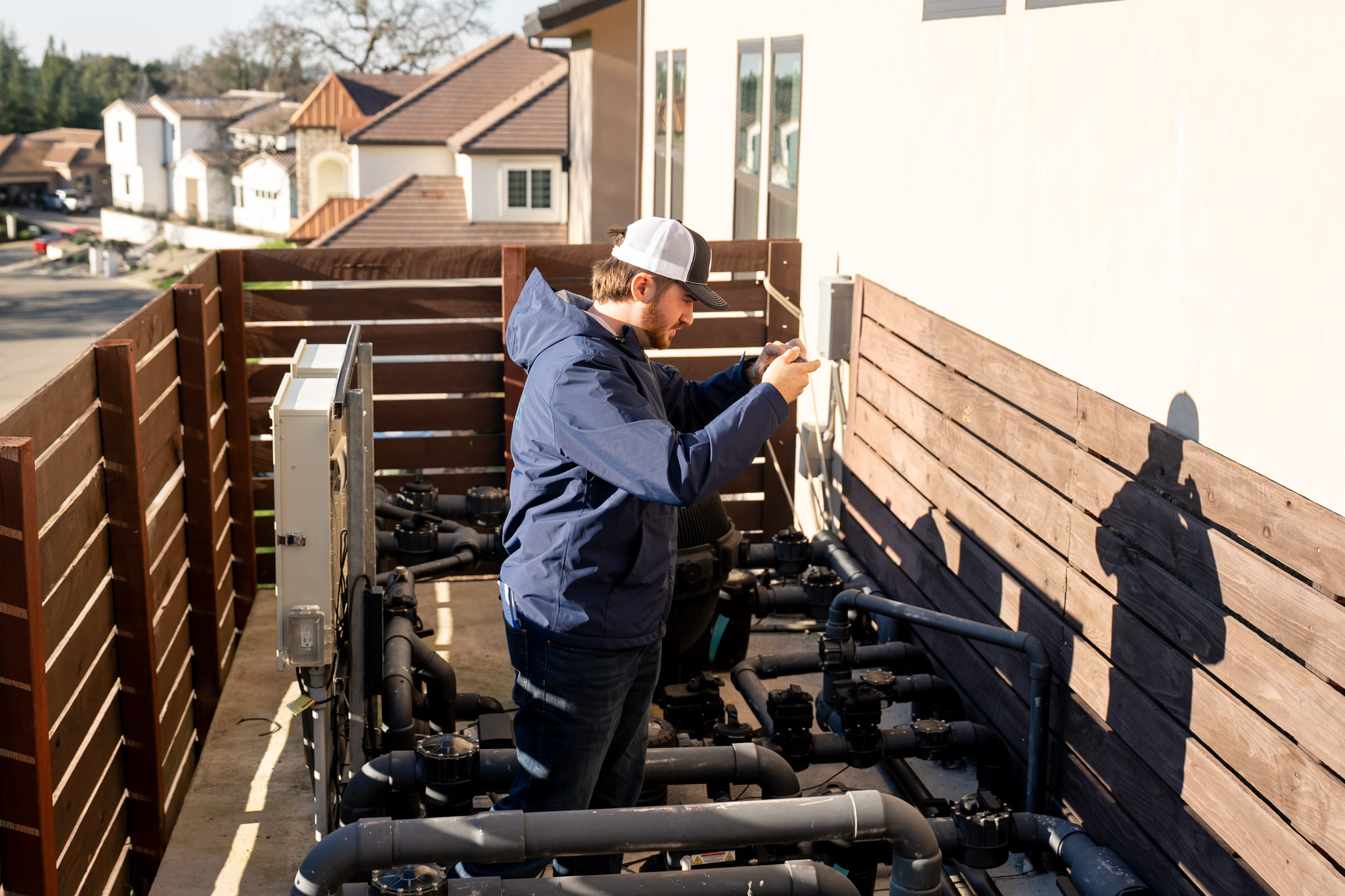
The newer pools in the master-planned parts of town are almost all cartridge. No backwash valve, no waste line, nothing running to the sewer. The tank comes apart, the elements come out, and every pleat gets opened with a hose so water reaches the bottom of the fold instead of skating across the top. That takes time. A four-element tank done properly is twenty to thirty minutes with the hose, and rushing it is the most common reason a freshly cleaned cartridge is back at high pressure a month later. Variable-speed pumps change the picture in a useful way. They run at low speed for long hours, loading the element slowly and evenly rather than in hard bursts, so cartridges often last longer but hide their condition better. Pressure creeps instead of jumping.
Whatever the filter, the gauge readings before and after are the whole point:
Hard groundwater is the other half of the Stockton story. Much of the city runs hard water with some surface blend, and calcium does not rinse off. It builds inside the pleat and through a sand bed as a hard gray film that a hose passes straight over. Sunscreen, hair product, and body oil do the same thing from the other direction, binding fine dirt into the fabric. Once either has taken hold, a hose cleaning gets you an element that looks clean and reads high on the gauge again within a week or two.
The fix is a soak. Cartridges get hosed first to knock off loose debris, then go into a chemical soak overnight or longer. Oils come out with a degreasing filter cleaner. Scale comes out with a dilute acid soak, done separately, never mixed with the degreaser, and with the element rinsed thoroughly between the two steps and again before it goes back in the tank. Get the order wrong and the acid sets the oils into the fabric instead of lifting them. We plan on at least one deep soak per season for most cartridge pools here, and two on pools carrying heavy swimmer load through triple-digit summers.
Cartridges do not last forever, and it is worth knowing when to stop cleaning one. Hold an element up and look down the pleats. If they are flattened, leaning, or waving instead of standing straight and evenly spaced, the fabric has stretched and it will not filter properly again. Check the end caps and banding for cracking or separation, and check the fabric for thin spots and fuzz, which means the fibers are breaking down. The practical test is still pressure. If a full soak and rinse no longer brings the gauge near the clean baseline, the element is finished. On a Stockton pool with hard water and a full swim season, three to five years is normal, shorter on a pool that runs heavy chlorine or gets used every day.
A realistic schedule for filter cleaning in Stockton follows the debris, not the calendar. Cottonwood arrives in late spring and early summer and can load a filter in days rather than weeks. The delta breeze lays dust across the water most summer evenings, which is steady and predictable. Fall drop under the mature trees on the older streets and near the waterfront is the heaviest single event of the year. Most pools here land on a cleaning every eight to twelve weeks in season, with the gauge getting the final say.
Winter is where this city loses filters. Tule fog settles in, the pool goes unlooked at for months, the pump runs a reduced schedule or not at all, and whatever was in the media in November is still sitting there in March, set hard. A filter cleaned before the fog closes in starts spring in usable shape. One left dirty usually needs a full soak and sometimes a fresh set of cartridges before the first warm weekend. The same pattern shows up on the pools we service in Lodi, Manteca, and Tracy, but the fog sits heavier and longer over Stockton, so the neglect runs deeper.
Related services in Stockton: Filter Repairs in Stockton and Pool Maintenance in Stockton.