Stockton has more variety in its pools than any other town in the northern San Joaquin Valley, and that variety shows up the moment you start maintaining a salt system. Drive through the older parts of the city, past the streets around the university, and you find plaster pools built in the 1960s and 1970s, some still running original galvanized plumbing, that were converted to salt sometime in the last fifteen years. Head out toward the newer master-planned areas and you find pebble interiors, variable-speed pumps, and salt cells that were part of the original build. Both are salt pools. They do not behave the same way, and they do not want the same service.
That difference is the whole job. A salt pool does not make chlorine out of nothing. The cell splits dissolved salt into chlorine, the chlorine does its work, and the salt returns to the water. What changes between an older converted pool and a newer purpose-built one is how everything around that cell reacts: the surface, the plumbing, the heater, the tile line, and the fill water itself. Hard groundwater raises the stakes on both, because calcium is the single biggest enemy of a salt cell.
Nevergreen Pools handles saltwater pool service in Stockton in partnership with Vintage Pool Service, a longtime Central Valley company running routes out of East Yosemite Avenue in Manteca that knows how these pools age from Lodi down through Tracy. The result is a route that treats a 1968 plaster conversion and a 2016 pebble pool as two separate problems, because they are.
How Salt Chemistry Drifts in Stockton Water
Salt level is the first reading, and it is the one homeowners guess at most often. Most cells want somewhere between 3000 and 3500 parts per million, and the number moves for real reasons: splash out, backwashing, filter cleaning, winter rain diluting the pool, and topping off with a hose. Run low and the cell works harder for less chlorine and wears out faster. Run high and you invite corrosion at the rails, the ladder anchors, and the heater. We test salt with a meter rather than trusting the panel readout, because a scaled cell reports a salt level lower than reality and sends people out for bags of salt they do not need.
Stabilizer is the second thing that separates salt care from traditional chlorine care. A tablet pool gets stabilizer delivered constantly whether it needs it or not, and eventually it locks up. A salt pool gets almost none, so it has to be added deliberately, and the target sits higher than most people expect, generally in the 60 to 80 range. Under a Stockton summer sun that is not optional. The cell produces chlorine as a steady trickle rather than a slug dose, and without enough stabilizer the sun burns that chlorine off faster than the cell can replace it. That is the origin of most July calls about a salt system that has supposedly quit, and the cell is usually fine.
Then there is pH. Every salt pool drifts upward. The electrolysis process itself pushes pH up, and aeration from the returns and any water features adds to it. Left alone, pH climbs past 8.0, calcium falls out of solution, and it lands on the two places you least want it: the cell plates and the tile line. In Stockton, where much of the city is on hard groundwater and the fill water already carries a heavy calcium load, that drift is faster and the consequences arrive sooner. Steady acid dosing on a weekly route, with an eye on total alkalinity so it is not driving pH right back up, is the difference between a cell that lasts five years and one that lasts two.
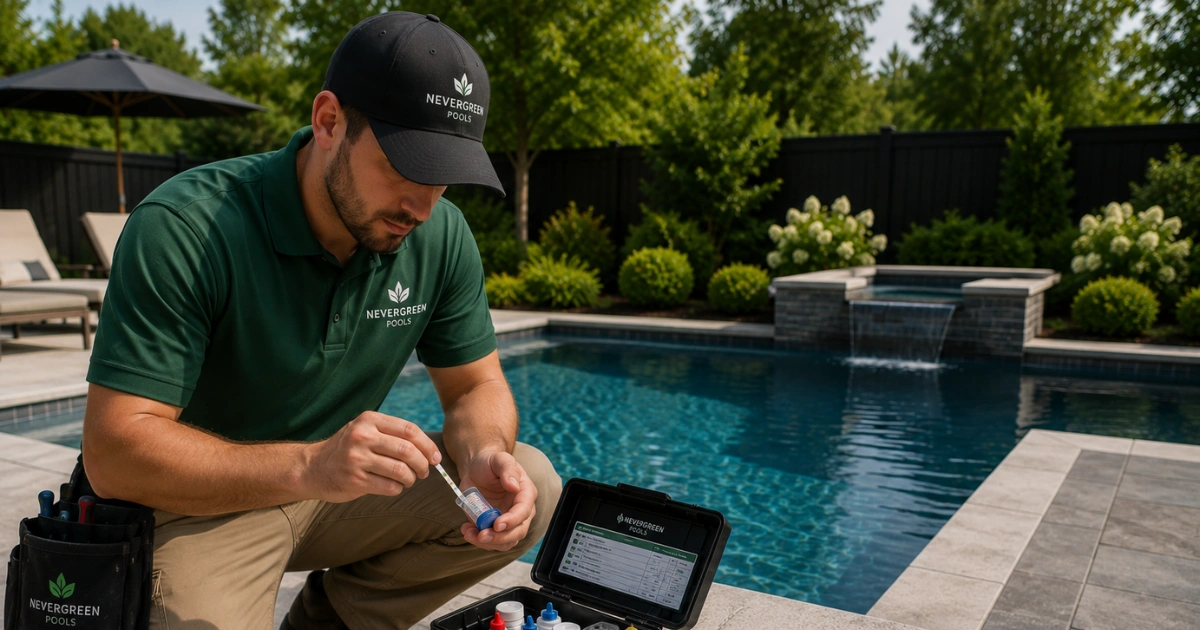
A normal saltwater pool service in Stockton visit includes:
- Salt level tested with a meter, not read off the control panel
- pH and total alkalinity corrected before they push calcium out of solution
- Stabilizer checked and held at the higher target a salt pool needs
- Calcium hardness tracked against what the fill water keeps adding
- Cell pulled and inspected on a schedule, acid washed only when the plates actually need it
- Output percentage adjusted to the season instead of left at one setting all year
Older Tract Pools and Newer Master-Planned Pools
The mid-century pools across the older parts of Stockton were not designed for salt. Most were converted long after they were built, and the conversion usually stopped at hanging a cell and a power supply on the equipment pad. The plaster is old and often etched or patched, which gives calcium more surface to grab. Original galvanized plumbing and older metal fittings do not love a chloride-rich environment, so salt running at the high end of the range matters more here than it would on a newer pool. Heaters from that era, if they were never upgraded, are worth watching closely. On these pools we hold the lower end of the salt range, keep pH tight so scale never gets a start, and inspect the cell more often, because scale builds faster on a pool with a long calcium history.
The newer pools in the master-planned parts of Stockton are a different animal. Pebble interiors tolerate chemistry swings better than aging plaster, the plumbing is PVC, and the equipment usually includes a variable-speed pump that can be programmed around what the cell needs to run. The trap on these pools is complacency. A modern system runs quietly and reports numbers on a screen, and homeowners trust the screen. Meanwhile the cell scales, the flow switch reads a false state, and the pool coasts on almost no chlorine through the hottest stretch of a Stockton summer. The equipment is better. The chemistry still needs hands on it.
Debris, Delta Breezes, and the Tule Fog Months
Stockton sits on the San Joaquin Delta, and the water is only part of what the Delta delivers. Most summer evenings a breeze pushes in and carries dust, cottonwood fluff, and river debris straight into open pools. Cottonwood is the worst of it, because it mats on the surface, gets pulled into the skimmer, and packs a filter far faster than leaves do. A loaded filter means reduced flow, and reduced flow on a salt pool means the flow switch cuts the cell off. The pool quietly stops making chlorine and nothing on the panel makes a fuss about it. On a triple-digit week that gap turns the water green in a hurry. Filter pressure gets checked every visit for exactly that reason, and cleanings get scheduled by pressure and season rather than by calendar habit.
Fall brings the second load. Mature trees along the older streets and near the waterfront drop heavily through October and November, and the pools under them need more than a surface pass. Then the tule fog settles in and the pool stops being something anyone looks at. Cold water changes the math for a salt cell in a way plenty of homeowners have never been told: below roughly 60 degrees most cells stop producing efficiently, and driving them hard in cold water shortens their life without returning much chlorine. The right move is to drop output for the season, keep circulation running enough to prevent stagnation, and carry chlorine with a supplemental source while the water is too cold for the cell to do the work. Come spring, output climbs back up as water temperature does.
That seasonal rhythm is the part most often skipped on pools left unattended all winter. A cell sitting at 80 percent output through a foggy January is wearing itself down for nothing, and a pool left uncirculated for months comes back in March with staining, scale along the tile, and a cell that needs an acid bath before it will read correctly at all. Consistent visits through the quiet months cost less than the spring recovery.
Whether the pool is a converted plaster tract pool from the 1970s or a newer pebble build on the edge of town, saltwater pool service in Stockton comes down to the same discipline: test what the panel cannot tell you, keep pH from climbing, respect what hard water does to a cell, and move the output with the season. The same care runs through Lodi, Manteca, and Tracy.
Related services in Stockton: Salt Cell Replacement in Stockton and Chemical Treatment in Stockton.