Professional Pool Service
Pool Start-Up Service in Stockton
Pool start-up service in Stockton, CA for older tract pools and newer pebble builds. Equipment check, filter clean, staged chemistry, run schedule set.
Professional Pool Service
Pool start-up service in Stockton, CA for older tract pools and newer pebble builds. Equipment check, filter clean, staged chemistry, run schedule set.
A pool start-up in Stockton is almost never the same job twice, and the reason is the housing. This city grew in waves, and the pools grew with it. In the mid-century tracts across central and north Stockton, you find plaster shells that went in decades ago, running on original galvanized plumbing, a single-speed pump, and a filter that has not been opened since the last owner lived there. Out in the newer master-planned areas on the edge of town, the pools are pebble finished, the equipment pads carry variable-speed pumps and automation, and the failure points are entirely different. The same service call on paper. A very different day of work.
That gap matters most after a pool has been closed. Stockton pools sit unused longer than people expect. Tule fog settles over San Joaquin County in December and does not really lift until late winter, and through those months nobody walks the back yard, nobody looks at the pad, and the water goes untested. By the time the delta breezes turn warm again, what is waiting is not just green water. It is a filter packed with cottonwood fluff and leaf litter, a pump that has been sitting dry or seized for months, and chemistry that has drifted far enough that dumping in shock would do more harm than good.
Nevergreen Pools handles pool start-up service in Stockton in partnership with Vintage Pool Service, a longtime Central Valley company working out of its shop on East Yosemite Avenue in Manteca. That combination matters here, because a proper start-up in Stockton is as much about knowing what the local water does to equipment as it is about following a checklist.
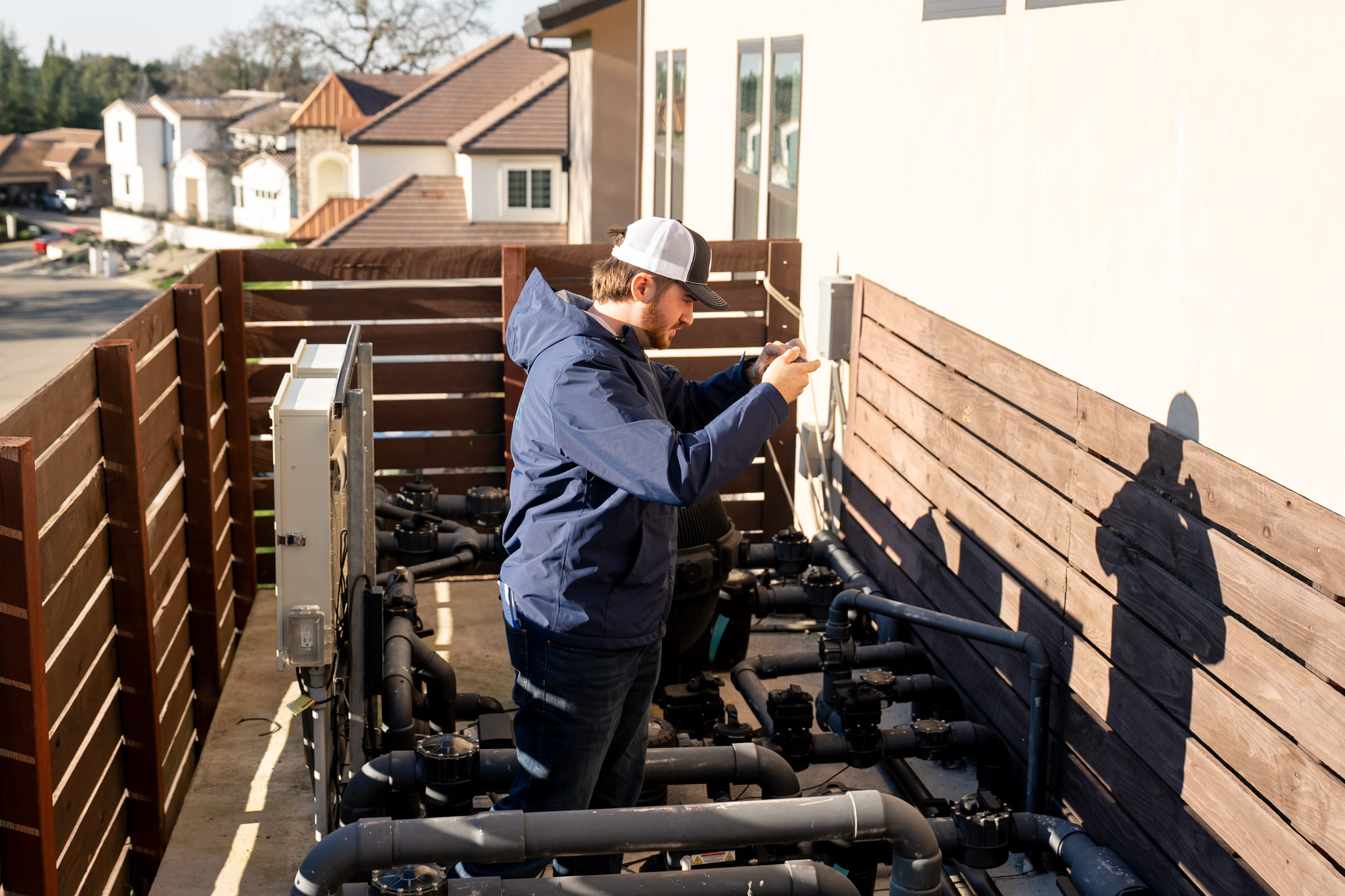
On an older Stockton pool, the start-up begins at the equipment pad and stays there a while. Galvanized and older copper lines corrode from the inside, and the scale that Stockton's hard groundwater leaves behind narrows them further, so a pump that primed fine three seasons ago may not pull now. We check suction and return lines for restriction, look at the pump basket and the lid gasket, pull the filter apart, and inspect the multiport or push-pull valve for the cracked spider gasket that quietly sends half the flow out to waste. Old plaster tells its own story. Rough patches, staining, and a chalky feel under the hand usually mean the surface has been sitting in aggressive or scaling water long enough to give up some of its own calcium, and that changes how the water gets balanced from there.
A newer pool in one of the master-planned parts of town asks different questions. Pebble finishes are tougher than plaster, but they collect calcium scale at the tile line just as readily when the fill water is hard, and a variable-speed pump that sat through the fog season often comes back with the drive faulting or the programmed schedule wiped. Salt systems are common in these builds, and a cell that ran all last summer without a cleaning is usually plated over with scale and producing a fraction of what the panel claims it is. Automation adds another layer. Valve actuators stick, heater lockouts trip, and a freeze protection setting left over from winter will fight the run schedule all season if nobody clears it.
Both kinds of pool get the same core work, in the same order:


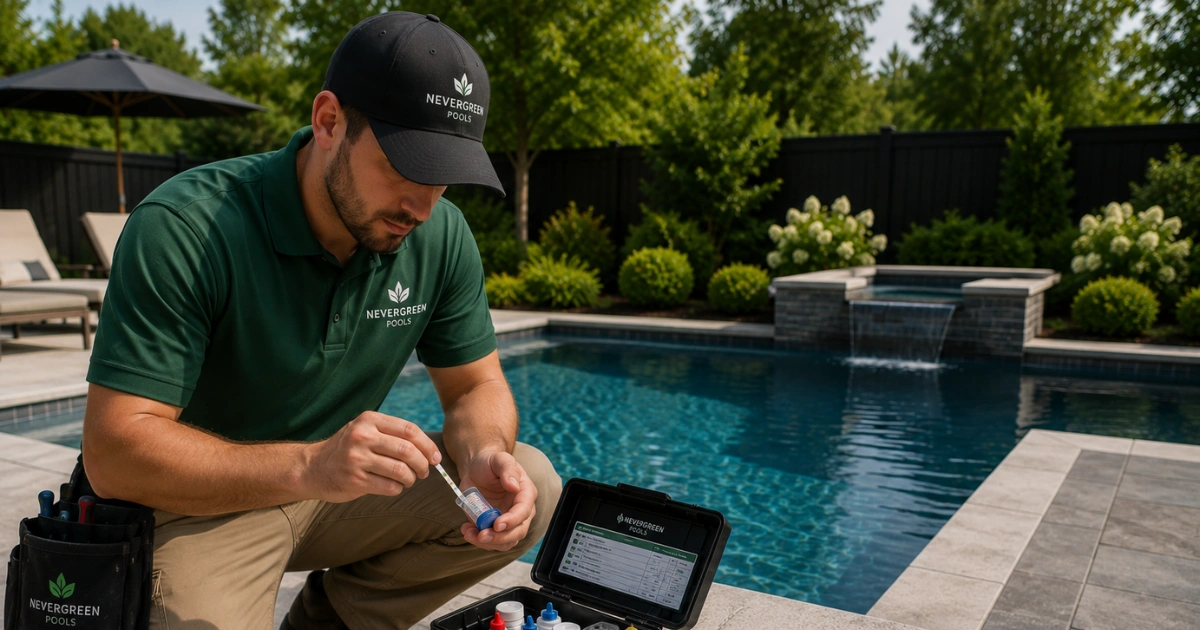
Once circulation is running and the filter is clean, the water gets tested in full, with a proper kit rather than strips. Stockton's supply is largely hard groundwater with some surface water blended in, so calcium hardness often comes back high before a single chemical is added. That one number drives most of what follows. High calcium in warm water pushes the whole balance toward scaling, which is why white crust builds at the tile line and the steps go rough on pools that have never been neglected a day in their lives. Correcting a pool like that means adjusting alkalinity and pH carefully and being honest about the fact that hardness itself only comes down by draining and replacing part of the water, not by pouring something in.
Stabilizer is the number people skip. Cyanuric acid is what keeps chlorine alive through a Stockton summer, and there is no shade to speak of once the afternoons run triple digits. Too little and the chlorine burns off by mid-afternoon. Too much, which is common on any pool that got trichlor tablets all last season, and the chlorine in the water stops behaving the way the test says it should. Either way it moves the target free chlorine level, so the reading has to come before the dosing. From there, correction happens across several days. Chlorine gets raised to a real level and held there, alkalinity gets set before pH, and the filter runs long hours and gets cleaned again as it loads up with what it pulls out of the water. Dumping the entire correction in on day one clouds the water, marks the plaster, and usually burns more chemical in the end.
The last step of any pool start-up service in Stockton is the run schedule, and it is not a default setting. Turnover depends on volume, pump type, and time of year. A single-speed pump on an older pool needs a shorter, harder run to move the water. A variable-speed unit does better on long low-speed hours, which also keeps the skimmers pulling in the evening when the delta breeze comes up and lays dust, cottonwood, and river debris across the surface. We set it, write it down, and explain what to change when the heat peaks in July and when the leaves come down under the mature trees in fall.
A freshly built or replastered pool is a different procedure, and it does not forgive shortcuts. New plaster cures underwater and gives off calcium and pH for weeks. The fill goes in without stopping so there is no ring at the water line, the pump runs continuously at first, and the surface gets brushed thoroughly and often in those early days to knock plaster dust off before it settles and hardens into permanent rough spots. pH climbs fast during that stretch and has to be checked daily and brought down in small amounts. Chlorine is introduced on a schedule that protects the green surface, salt systems stay off until the plaster has cured, and the heater stays off with them. Filters load up quickly with plaster dust and need cleaning far more often than they ever will again. Get that first month right, whether the pool is in Stockton, Lodi, or Tracy, and the finish holds for decades. Get it wrong and the mottling never fully goes away.
Related services in Stockton: Pool Maintenance in Stockton and Pool Rebalance in Stockton.