Professional Pool Service
Pool Rebalance in Stockton
Pool rebalance in Stockton, CA. We correct pH, alkalinity, calcium and stabilizer on older tract pools and newer pebble pools across San Joaquin County.
Professional Pool Service
Pool rebalance in Stockton, CA. We correct pH, alkalinity, calcium and stabilizer on older tract pools and newer pebble pools across San Joaquin County.
Water chemistry drifts in every pool, and what that drift does depends on the pool it happens in. Stockton has two very different kinds of pool sitting inside the same city, and the same correction that saves one can chew up the other. Across the older parts of town you find mid century plaster pools that have been in the ground for fifty years or more, many of them still fed by original galvanized plumbing and run by a single speed pump. Out in the newer master planned areas you find pebble finishes, variable speed equipment, and filtration that was sized properly the day it went in. Both kinds go out of range. They do not go out of range the same way, and they do not come back the same way either.
A pool rebalance in Stockton usually starts after something has already gone wrong. The pool sat through tule fog season with the cover half on and the pump running a short winter timer. A party pushed sixty people through the water in one August weekend. Someone shocked heavily, then chased the cloudiness with more chemicals for a month. By the time we get the call, pH, total alkalinity, calcium hardness, cyanuric acid, and free chlorine are all pulling in different directions, and correcting them one at a time in the wrong order just moves the problem around the pool.
Nevergreen Pools works this city in partnership with Vintage Pool Service, a Central Valley company that has run routes out of East Yosemite Avenue in Manteca for years and knows what the water here does over a full season. That history matters on a rebalance, because the fill water in much of Stockton is hard, the summers are long and hot, and evaporation concentrates everything you cannot see.
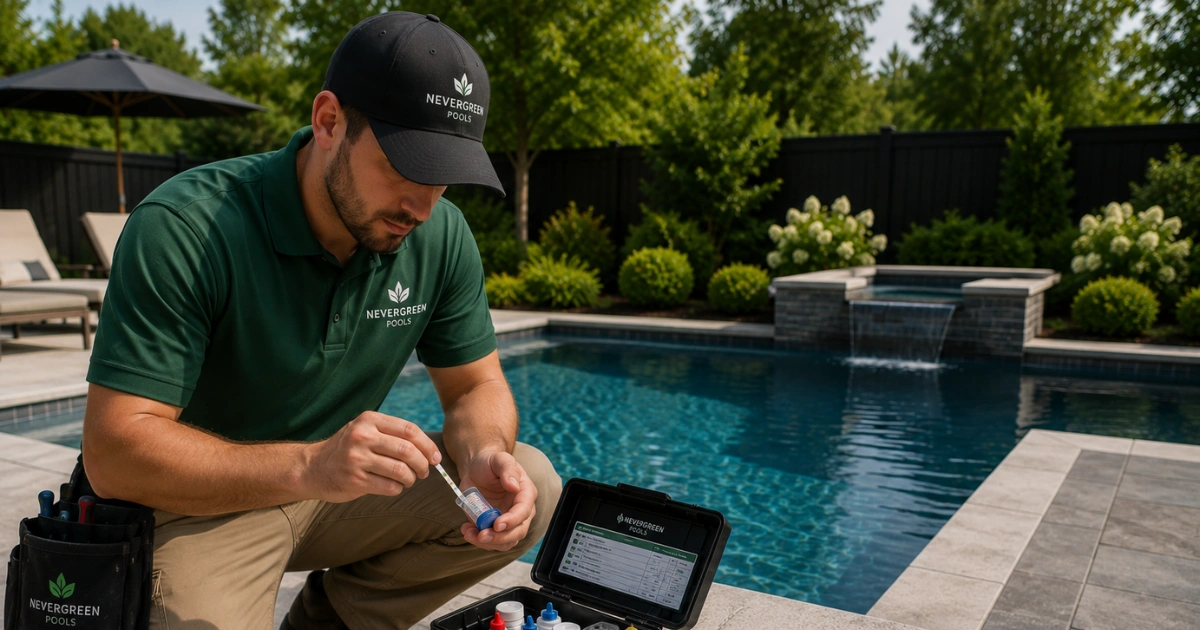
A rebalance that starts with a guess ends with a second rebalance. Every visit begins with a full panel on a fresh sample pulled elbow deep and away from the returns, because water sitting at the surface near a jet does not tell you what the pool is actually doing. We read:
Those numbers go into the Langelier Saturation Index, which is the most useful single way to describe whether water is going to build up on your pool or eat into it. The index pulls pH, temperature, calcium hardness, alkalinity, and dissolved solids into one figure. Sit near zero and the water is satisfied. Push positive and calcium comes out of solution as scale, which shows up as the crusty gray line at the tile, the rough patch on a step, the film that dulls a pebble finish. Drop negative and the water goes looking for the calcium it wants, and it takes that calcium from plaster, from grout, and from the surface of the finish itself. High pH scales. Low pH etches. Neither one announces itself on day one, which is why a pool can look fine and still be losing surface every single week.
On a fifty year old plaster pool, our first concern is almost always what low pH has already done. Old plaster is porous, and a pool that has run acidic through a long fog season comes back with a chalky, sandpapery feel and rings of exposed aggregate. Alkalinity in those pools is usually low, because acid has been added over and over to chase a pH that never held, and that low alkalinity is exactly why the pH would not hold. We bring alkalinity up first, in stages, and let it settle over several days rather than dumping the whole correction in one visit. Aging galvanized plumbing gives you another reason to be patient. Aggressive water in old metal lines mobilizes iron, and you end up with rust staining on the walls that chemistry alone will not lift back out.
The newer pebble pool tends to have the opposite problem. Pebble is tough and tolerates a lot, so owners assume the water is fine and let calcium and stabilizer climb for years without noticing. Hard Stockton fill water tops the pool off through triple digit July and August afternoons, evaporation takes the water and leaves the minerals behind, and hardness ratchets upward every summer. Add a few seasons of stabilized tablets and cyanuric acid does the same. The finish still looks great, and then the heater starts short cycling on scaled exchanger tubes and the salt cell needs an acid wash twice a season. That difference sets the order of operations on a pool rebalance in Stockton: on the old pool you are usually repairing damage from water that was too aggressive, and on the new one you are usually unwinding years of water that was too saturated. Variable speed equipment helps that newer pool in a dozen ways, but it does not change chemistry, and long low speed runs in a pool taking heavy evening debris off the delta breeze can leave corners where treated water never fully mixes.


Some numbers do not come down. There is no chemical that meaningfully lowers calcium hardness or cyanuric acid, so once either one sits far above range the only honest fix is to remove some of the water and replace it. That is a calculation, not a guess. We measure what is in the pool, measure what is in the fill water, and work out how much has to be swapped to land in range. Hard groundwater across much of Stockton means the fill itself carries calcium, so replacing half the water in a very hard pool may only get you part of the way there, and it is better to know that before the hose is running.
Stockton adds a consideration that most towns do not. The city sits on the San Joaquin Delta with an inland deepwater port, and the water table in a lot of the city is high. An empty pool shell is a boat, and hydrostatic pressure underneath it can lift the shell, crack it, or push it out of the ground outright. So we drain partially, we watch the level as we go, and we do not take a Stockton pool down to bare shell without checking the hydrostatic relief valve and the ground conditions first. Winter is usually the wrong season for that work anyway, since the same fog that keeps the pool unused keeps the ground saturated.
Getting the numbers right is a day of work. Keeping them right is a season of work, and that is where a pool rebalance in Stockton either sticks or slowly unwinds. Summer here is long, hot, and dry, so evaporation is constant and top offs are constant with it, which means hardness and stabilizer keep creeping upward no matter how well the pool is running. Delta breezes push through most summer evenings carrying dust, cottonwood fluff, and river debris, and all of that organic load pulls chlorine down. Fall brings heavy leaf drop under the mature trees in the older parts of the city, and winter fog keeps the pool covered, cold, and out of mind for months at a stretch.
So the schedule matters as much as the chemistry. We set a rebalanced pool up with a chlorine target tied to its actual stabilizer reading rather than a generic number, because a pool carrying high cyanuric acid needs more free chlorine to do the same amount of work. We recheck the saturation index seasonally rather than once, since water temperature by itself can swing the index between July and January and turn balanced water into scaling water. And we say plainly when a pool near the waterfront or under a heavy canopy needs more attention than a pool sitting in the open. Whether it is an old plaster tract pool west of the university or a newer pebble build on the edge of the city, the goal is the same: water that is chemically satisfied, so it stops taking anything off your surfaces and stops leaving anything behind. Nevergreen Pools handles that work throughout Stockton and the towns around it, including Lodi, Manteca, and Tracy.
Related services in Stockton: Chemical Treatment in Stockton and Algae Removal in Stockton.