Nevergreen Pools provides pool pump repair in Glendale, covering shaft seal leaks, worn or noisy bearings, motors that won't start because of a bad capacitor, pumps that lose prime, cracked pump housings, clogged impellers, and air leaks at the lid o-ring.
Call us if the pump is humming but not starting, if it's grinding or squealing when it runs, if water is dripping steadily from underneath the pump housing, if the pump loses prime and needs priming by hand every time you turn it on, if the motor shuts off and won't restart until it cools down, if the pump runs but the filter pressure stays low, or if the pump is pulling air and you can see bubbles coming back through the returns.
We serve Glendale in partnership with Beyond Pool Cleaning, a pool service company based nearby. Call to get a technician scheduled, or book your first visit online.
How We Diagnose It
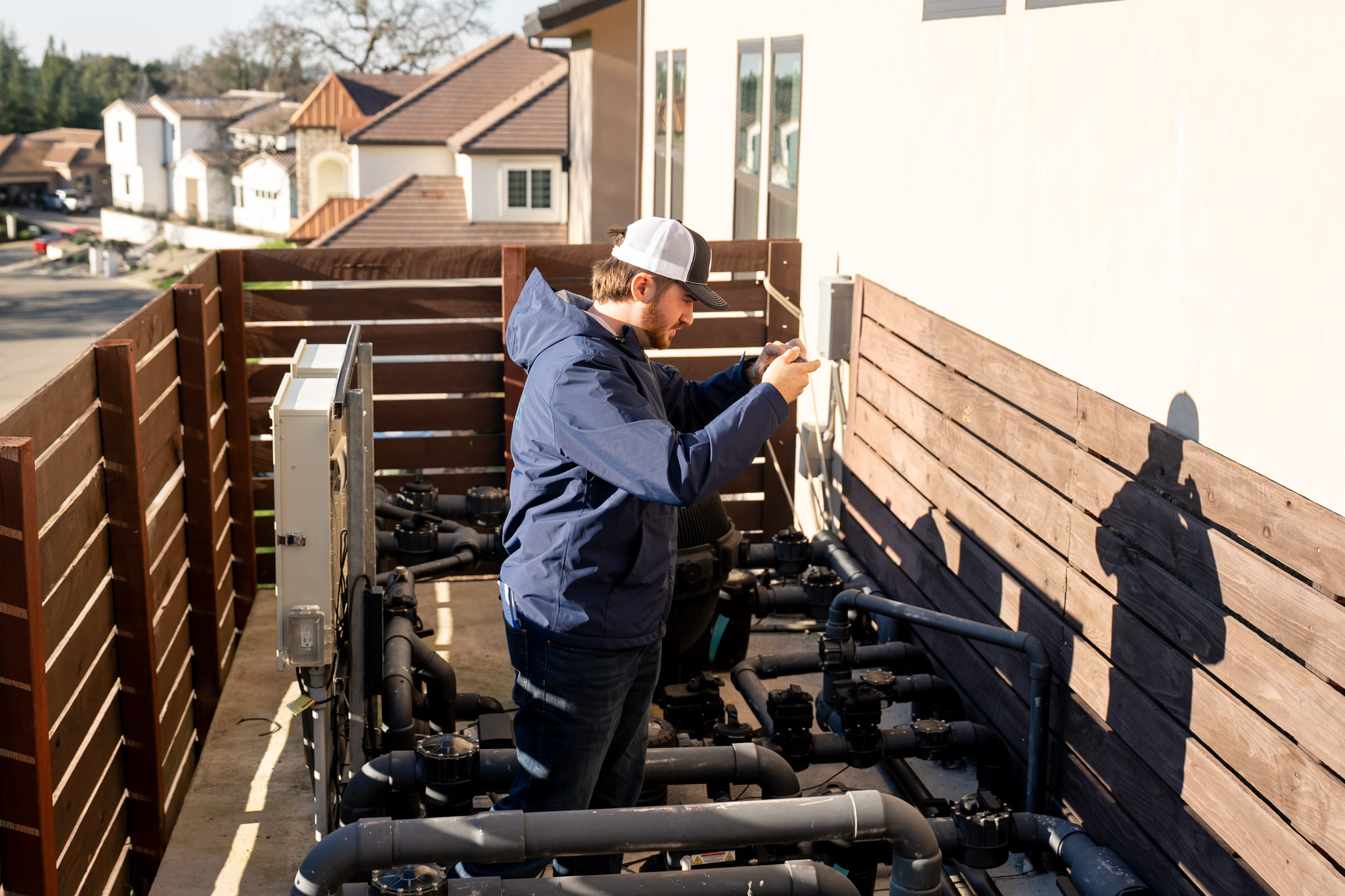
We start at the pad with the pump running, or trying to run. A pump that hums but doesn't spin almost always has a bad start capacitor, and we test it with a meter instead of swapping parts to guess our way to an answer. A pump that grinds, whines, or gets louder under load has bearings going out in the motor, and once a bearing starts singing it keeps getting louder until the motor locks up completely. We also check the shaft seal, since a slow drip forming underneath the pump housing is almost always a worn seal letting water past the shaft, and a seal left unaddressed long enough will corrode the shaft itself and take the motor with it.
If the pump won't hold prime, we check the lid o-ring and the strainer basket lid first. A dried out or cracked o-ring lets air into the suction side of the system, and a pump pulling air never fully catches no matter how many times you prime it by hand. We check the unions on either side of the pump body for hairline cracks or fittings that have loosened over time, since those leak air the same way. We also clear the skimmer and pump baskets, since mature trees in this area drop leaves and seed pods year round, and that debris packs tight enough in the impeller to choke suction and trip the pump into losing prime on its own. A cracked pump housing usually shows up as a leak at the volute where the impeller housing meets the motor, and once that housing is cracked, the fix is a new wet end rather than a patch.
- Test the start and run capacitors with a meter before replacing anything
- Check the motor bearings for play, heat, and noise under load
- Inspect the shaft seal for drips and corrosion at the motor shaft
- Check the lid o-ring, strainer basket, and pump unions for air leaks
- Inspect the pump housing and volute for cracks
- Clear and inspect the impeller so it spins freely without debris
Repair or Replace
Older pools built between the 1960s and 1980s in this area still tend to have their original plumbing and equipment at the pad, often running a single-speed pump off a mechanical timer. By now most of those motors are old enough that a bearing or capacitor repair only buys a season or two before the next part fails, so we give a straight answer on whether a motor swap makes sense or whether the whole pump is due for a variable-speed replacement. Newer pools nearby, including homes with pebble finishes and salt systems, are more likely already running variable-speed pumps, and those usually get diagnosed through the control board and programmed speeds rather than a straight motor swap.
When we do replace a pump, we check that the existing plumbing and electrical at the pad can support a variable-speed unit before we install anything, since retrofitting one onto old wiring or undersized plumbing is its own job. We size the replacement to the pool's actual volume and plumbing rather than swapping one for one with whatever failed, and we program separate speeds for filtration, cleaning, and any water features so the pool isn't running on one fixed speed around the clock. That matters in this heat, since a pool that needs more filtration hours in summer than a single-speed pump was ever sized for is part of why so many of these motors fail early in the first place.
What You Get Back
A pump that starts on the first try, runs quiet, and holds prime without you touching it. Filtration runs on schedule again, whether that's the original mechanical timer or a programmed variable-speed schedule, and you stop losing turnover time to a pump that won't cooperate. If a pump problem sits too long, a slow shaft seal leak turns into a seized motor, a small air leak at the lid turns into a pump running dry and burning itself out, and a cracked housing keeps losing water you're paying to replace. Once summer highs hit 105 to 115 and evaporation is already pulling water down fast, a pump that isn't filtering enough hours a day lets a pool turn cloudy or green in a day or two, and a water level that keeps dropping faster than heat can explain is usually a sign the seal or housing is already leaking.
Call us to get a technician out to look at the pump, or schedule your first visit online. We'll tell you straight whether it's a repair or a replacement before we start any work.
Related services in Glendale: Pool Repair in Glendale and Weekly Pool Service in Glendale.