Professional Pool Service
Heater & Heat Pump Installation in Lodi
Gas heater and heat pump installation for Lodi, CA pools. Right-sized BTUs, proper gas and electrical, and hard water protection. Swim spring to fall.
Professional Pool Service
Gas heater and heat pump installation for Lodi, CA pools. Right-sized BTUs, proper gas and electrical, and hard water protection. Swim spring to fall.
Lodi sits on hard groundwater, and that one fact shapes how a pool heater should be sized, plumbed, and run here. Water drawn from wells around the Mokelumne carries a lot of calcium, and a heater is the one piece of equipment that deliberately raises water temperature at a metal surface. Every degree of rise across the heat exchanger pushes calcium closer to falling out of solution right there on the copper. On a pool that is even slightly out of balance, scale builds inside the tubes within a season or two. Flow drops, the unit starts tripping its high limit and short cycling, and a heater that should last fifteen or twenty years starts failing in five.
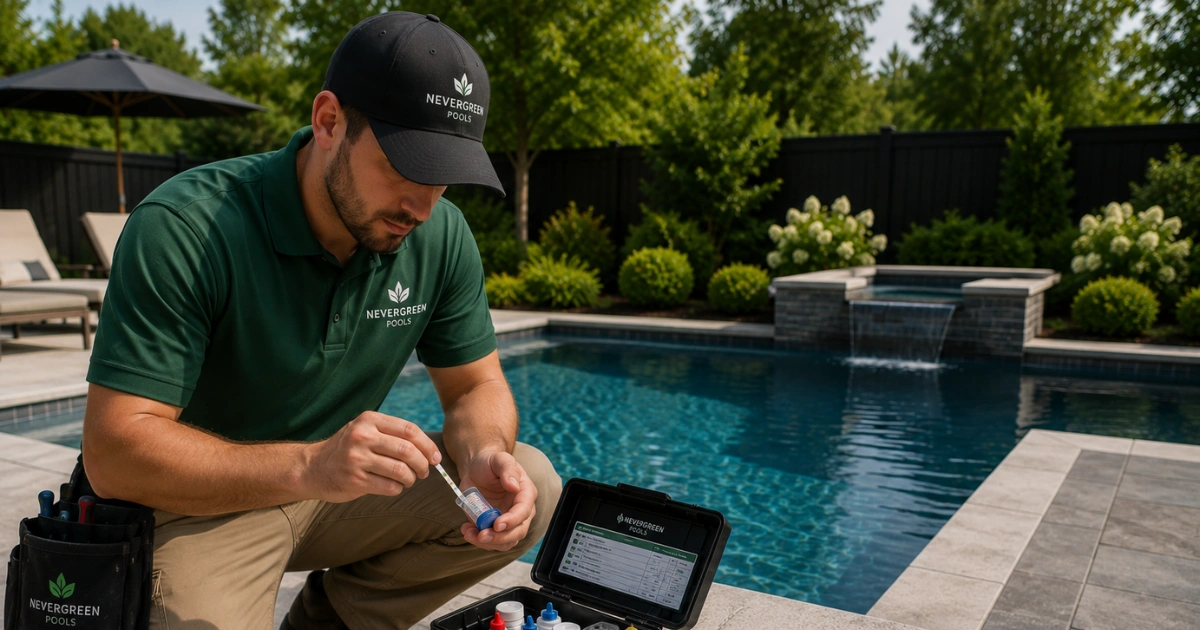
That is why heater & heat pump installation in Lodi begins with a water test and a look at the existing plaster, not with a product catalog. If the pool already shows a gray scale line at the tile or a rough patch on the steps, calcium is coming out of solution somewhere, and the next place it lands will be inside a brand new exchanger. We check calcium hardness, alkalinity, pH, and stabilizer before we quote equipment, and we talk through what the pool will need after the heater is running.
Nevergreen Pools serves Lodi in partnership with Vintage Pool Service, a longtime Central Valley company based off East Yosemite Avenue in Manteca. Between the two crews we set gas heaters and electric heat pumps across Lodi, Stockton, Manteca, and out toward Copperopolis, and we install them the same way every time: sized to the actual pool, vented to clearance, and plumbed so the next tech can service the thing without cutting pipe.
Gas is about speed. A gas heater makes its own heat by burning fuel, so it does not care whether the air outside is 100 degrees or 40. Fire it on a foggy January morning and it climbs at the same rate it would in July. That makes gas the right answer for a pool you use on short notice, for an attached spa, and for anyone who wants water warm enough to swim in through a Lodi winter. The cost of that speed is fuel. You pay for every BTU you burn, and running a large gas heater as a full time season extender adds up quickly.
A heat pump works the other way. It does not create heat, it moves heat out of the outside air into the water through a refrigerant circuit, so it delivers roughly four to six units of heat for every unit of electricity it draws. That ratio is the coefficient of performance, and it rises and falls with air temperature. Lodi summers in the high 90s and low 100s are close to ideal for a heat pump, and warm spring and fall afternoons still hold a good COP. The catch is the delta air at night. Once the temperature drops into the 50s the unit slows down hard, and a heat pump is slow to start with, moving a pool a degree or two an hour rather than heating on demand. Heat pumps reward an owner who holds a steady temperature under a cover, not one who heats from cold twice a month.
A fair number of Lodi pools end up with both, a heat pump carrying the water through spring and fall and a gas heater handling the spa on cool evenings. That combination is worth pricing before you commit to one or the other.
Sizing starts with volume and the temperature rise you want. One BTU raises one pound of water one degree, and a gallon weighs about 8.3 pounds. A 20,000 gallon pool holds roughly 166,000 pounds, so lifting it ten degrees takes about 1.66 million BTUs of delivered heat. Divide that by the heater's output and you have a heat-up time before losses. Then you add the losses back, because a pool sheds heat off its surface all night, and an open Lodi pool under a clear October sky with a breeze coming off the river gives back a lot of what you paid for.
So we measure instead of guessing. What actually goes into the number:
Undersizing is the common mistake. A heater that never quite catches up runs constantly, and constant run time on hard water is exactly what builds scale. Sizing up within reason is easier to live with, as long as the gas supply and the electrical service can feed it.


For a gas heater the first question is whether the existing gas line can carry the load. Pool heaters commonly call for 250,000 to 400,000 BTUs, and a half inch line that was fine for a barbecue will starve a 400,000 BTU unit at the end of a long run. Line size comes from the total BTU demand on the meter, the developed length of the run, and the fittings along the way. Undersized gas is not a small problem. It shows up as nuisance lockouts, sooting, and a heater that never makes its rated output. On propane, which some properties outside Lodi still run, the orifices and regulator are different and the tank has to vaporize fast enough on a cold morning to keep up.
Venting is next. An outdoor heater needs clearance above the stack and to the sides, plus set distances from doors, windows, and any air intake. Tucking a heater into a tight side yard under an eave is the shortcut that causes the most damage, because exhaust recirculates back into the intake and the unit runs rich and eats its own exchanger. Heat pumps do not vent, but they need open air on every side and overhead, since they discharge cold air out the top and will starve themselves in a fenced corner.
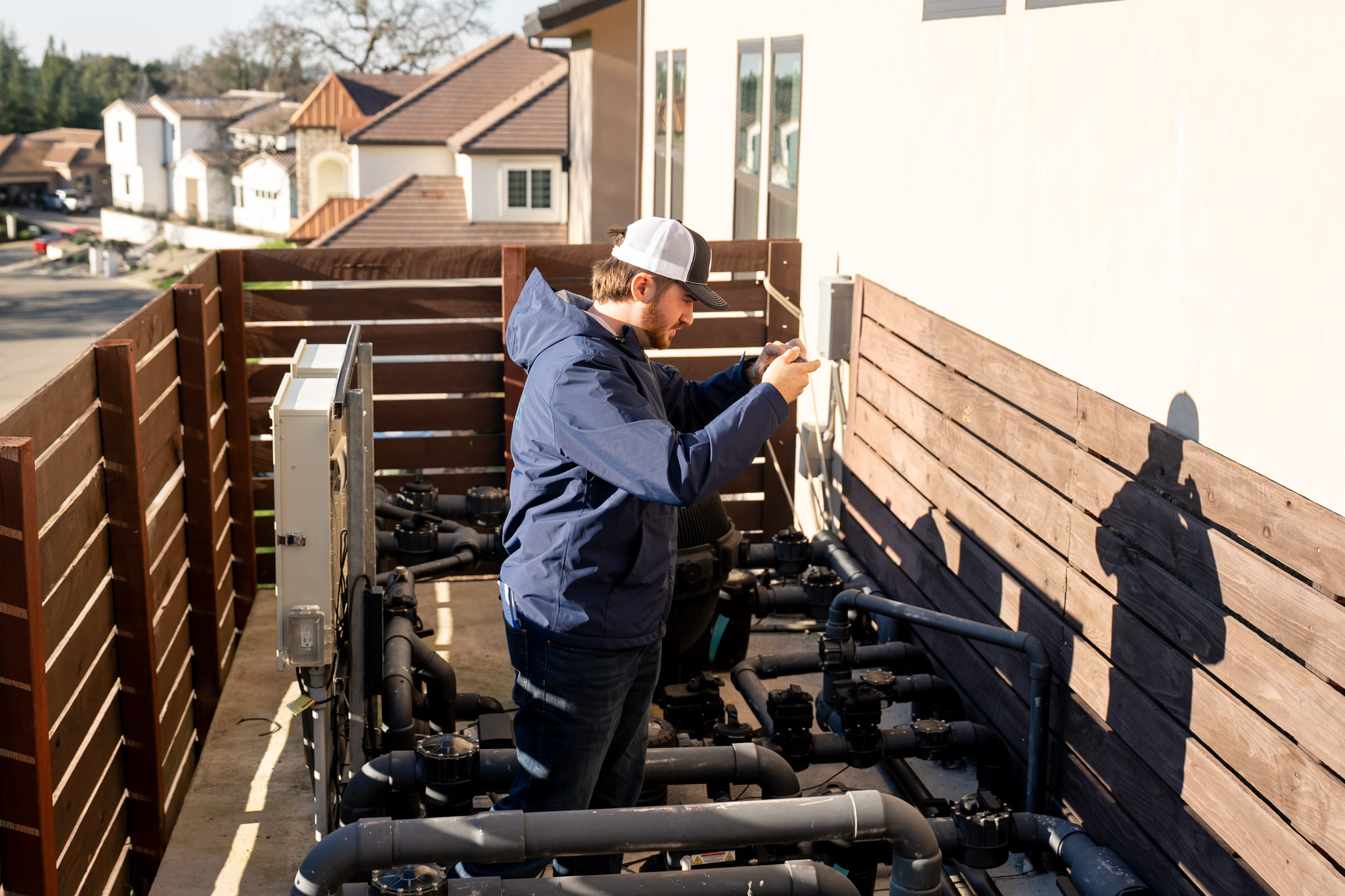
Electrical is the other half of the job. A heat pump needs a dedicated 240 volt circuit sized to the nameplate, run in conduit to a disconnect within sight of the unit, and bonded to the pool's equipotential grid. A gas heater only draws 120 volts for its controls, but it still gets bonded. We set the pad, plumb a three valve bypass so the heater can be isolated for service or an acid cleaning without shutting down circulation, and leave unions at the heater so future work does not turn into a repipe.
Balance, bypass, and flow. Keep calcium hardness, pH, and alkalinity in range so the water is not already saturated when it reaches the exchanger, and test more often in late summer when evaporation concentrates everything left behind. Keep the filter clean, because low flow means a bigger temperature rise across the exchanger and a hotter tube wall. Set the thermostat and let it hold rather than swinging the pool fifteen degrees every weekend. Iron and calcium out of Lodi groundwater will stain plaster given the opportunity, and the inside of a heat exchanger is the first place they collect.
Vineyard pollen, dust off the tilled rows, cottonwood fluff from the river, and oak and sycamore leaf drop load a filter faster here than in most places, and a loaded filter is a flow problem before it is ever a clarity problem. Watch the pressure gauge through spring and again during harvest, and clean on pressure rather than on the calendar. Done right, heater & heat pump installation in Lodi buys a season that opens in March and runs well past Halloween, with equipment still working at the end of it.
Related services in Lodi: Pool Heater Repair in Lodi and Automation & Control Systems in Lodi.