Professional Pool Service
Automation & Control Systems in Lodi
Pool automation and control system installation in Lodi, CA. Pentair, Hayward and Jandy panels wired, programmed and set up for hard Central Valley water.
Professional Pool Service
Pool automation and control system installation in Lodi, CA. Pentair, Hayward and Jandy panels wired, programmed and set up for hard Central Valley water.
Hard groundwater is the first thing we think about when we quote automation & control systems in Lodi. Well water here runs high in calcium and iron, and that mineral load shows up on every part of the pad that touches water. Salt cells scale over. Heater exchangers narrow. Flow switches and chemistry probes drift out of calibration faster than they would on softer water. An automation panel is only as honest as the sensors feeding it, so a system installed without accounting for this water starts handing you bad numbers within a season, and once that happens you stop trusting the app on your phone.
That changes how we build the job. We put probes where they can be pulled and cleaned without draining anything, we set realistic calibration intervals, and we program the controller to keep water moving through the heater and the sanitizer instead of letting it sit and deposit. Debris matters just as much. Leaf drop runs heavy through the fall, vineyard pollen and tilling dust settle on the surface all growing season, and cottonwood fluff loads the skimmer baskets in spring. A controller programmed around that reality is worth far more than one that simply turns the pump on at eight in the morning and off at four, because filtration runtime has to match the debris load actually hitting the water.
Nevergreen Pools installs, programs, and commissions automation across Lodi in partnership with Vintage Pool Service, a longtime Central Valley company working out of its shop on East Yosemite Avenue in Manteca. Between the two crews we see the same equipment pads over and over, from new construction to sixty year old pools still running their original plumbing, and that repetition is what makes a retrofit go quickly instead of turning into a discovery project.
At its core the controller is a relay board and a brain that replaces your time clock, the heater's own control panel, and the manual valve handles on the pad. A Pentair IntelliCenter or EasyTouch, a Hayward OmniLogic or OmniHub, or a Jandy iAquaLink takes over the following:
All of it lands in one app. You can drop the pump speed the night before a party, warm the spa on the drive home, or shut the heater down for a week in October when nobody is swimming. The app is the part homeowners notice first, but the schedule underneath it is what saves money. A properly programmed variable speed pump spends most of its day between 1,400 and 1,800 RPM, which moves a full turnover over eight to ten hours while drawing a fraction of the power an old single speed pump pulled at 3,450 RPM. We size that schedule to your filter and your plumbing, then set a separate higher speed step for the times the cleaner or the heater needs real flow.
Usually yes. Retrofits are most of what we do with automation & control systems in Lodi. The question is rarely the pool, it is the pad. We check whether the pump is variable speed or can be swapped for one, whether the heater has a communication port or has to be run through a relay, whether the light fixtures are color capable, and whether the subpanel has room and capacity for a load center. Pads that were sized years ago for one pump and a booster and nothing else need that sorted out before anything gets mounted on the wall.
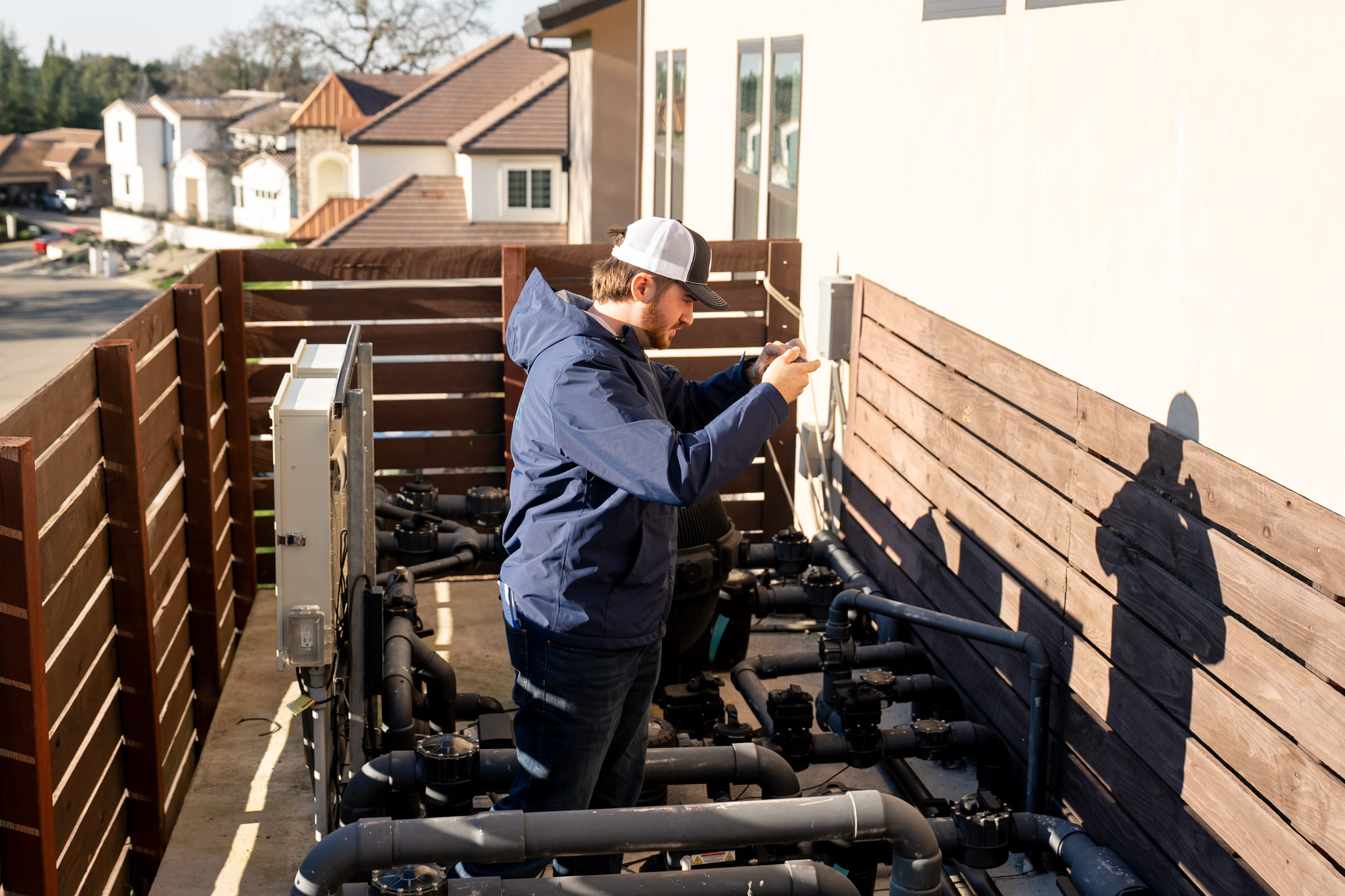
The wiring is the real work. High voltage feeds the load center, but everything smart runs on low voltage: valve actuator leads, water and air temperature sensors, and communication runs to the heater and to any wireless bridge or indoor panel. On a long pad, or where the equipment sits away from the house behind a fence line, we pull that wiring in conduit rather than tucking it under the deck, because rodents and string trimmers find anything else. Sensor leads get routed away from high voltage conductors so the readings stay clean, and the water temperature sensor goes in a tee on the suction side ahead of the heater rather than wherever is convenient, because a sensor reading heated water tells the panel a lie.


It will if nobody plans for it. pH and ORP probes read through a glass bulb and a reference junction, and calcium scale on either one slows the response or shifts the reading. On this water we regularly find probes reading a full tenth of a pH point low after a few months of neglect, which means the controller keeps feeding acid into a pool that does not need any. Iron compounds the problem, because it plates onto surfaces and stains plaster the same way it stains a probe body.
The fix is not exotic. We mount probes in a flow cell with isolation valves so they can be pulled and cleaned in a few minutes without shutting the system down, we leave you calibration solution and show you how to use it, and we set the controller's dosing limits so that even a badly drifted probe cannot dump chemical into the pool. On salt systems we set the cell cleaning reminder and walk through an acid wash, because in this water a cell that never gets cleaned loses output long before it should. Where fill water is especially hard we will talk about a softened fill line, or at minimum about tracking calcium hardness so the automation is not fighting the water on every cycle. Plan on checking probe calibration every three months here rather than the annual interval the manuals suggest.
A typical install runs one to two days. The first day is mounting and wiring: load center on the wall, actuators on the valves, sensors set, conduit run, heater tied in, and power off at the breaker for most of it. Then the panel gets addressed and every relay gets assigned to what it truly controls. That step is the one that gets rushed on cheap jobs, and it is why some pools end up with a button labeled spa that turns on a waterfall.
Commissioning is where we prove the system. We run every circuit, watch the valves rotate to their end stops and set their travel, confirm the heater fires and shuts down on the panel's command, test the flow switch and the freeze protection setting rather than assuming them, and verify each pump speed matches the job it is assigned to. Winter mornings here drop into freeze protection territory, and pools that sit unattended through the foggy months are the ones that get hurt, so that setting gets exercised before we leave and the freeze speed gets set high enough to actually move water through the plumbing. After that we sit down with you and the app, connect it to your home network, walk through the schedules we built and why they are set that way, show you how to change a set point and how to put the system into service mode for a cleaning, and leave the pad labeled. Homeowners in Lodi, Manteca, Stockton, and out toward Copperopolis get the same handoff, because a system you understand is a system you will actually use.
Related services in Lodi: Automation Troubleshooting in Lodi and Sanitizer Systems in Lodi.