Professional Pool Service
Automation System Troubleshooting in Lodi
Pool automation faults in Lodi, CA: dead controllers, stuck valve actuators, relays that will not fire, lost app connections, and bad sensors fixed right.
Professional Pool Service
Pool automation faults in Lodi, CA: dead controllers, stuck valve actuators, relays that will not fire, lost app connections, and bad sensors fixed right.
Hard groundwater is the reason a lot of automation calls in Lodi start with a symptom that looks electronic and turns out to be mechanical. Calcium and iron ride in with the fill water, build up on flow sensor paddles, coat the stems inside valve actuators, and crust the salt cell plates the controller reads to decide whether the system is healthy. The board is doing exactly what it was told to do. It is reading garbage from a sensor that scale has wrapped in a hard shell, so it throws a fault, locks out the heater, or refuses to run the schedule you set.
That matters because the fix changes depending on where the fault actually lives. Replacing a controller that is reporting accurate bad news is expensive and pointless. Scraping a flow switch, freeing a jammed valve stem, and reseating a corroded connector solves a surprising share of the problems that get labeled as a dead panel. Automation system troubleshooting in Lodi means testing the chain from the load side back to the board instead of assuming the most expensive part is the one that failed.
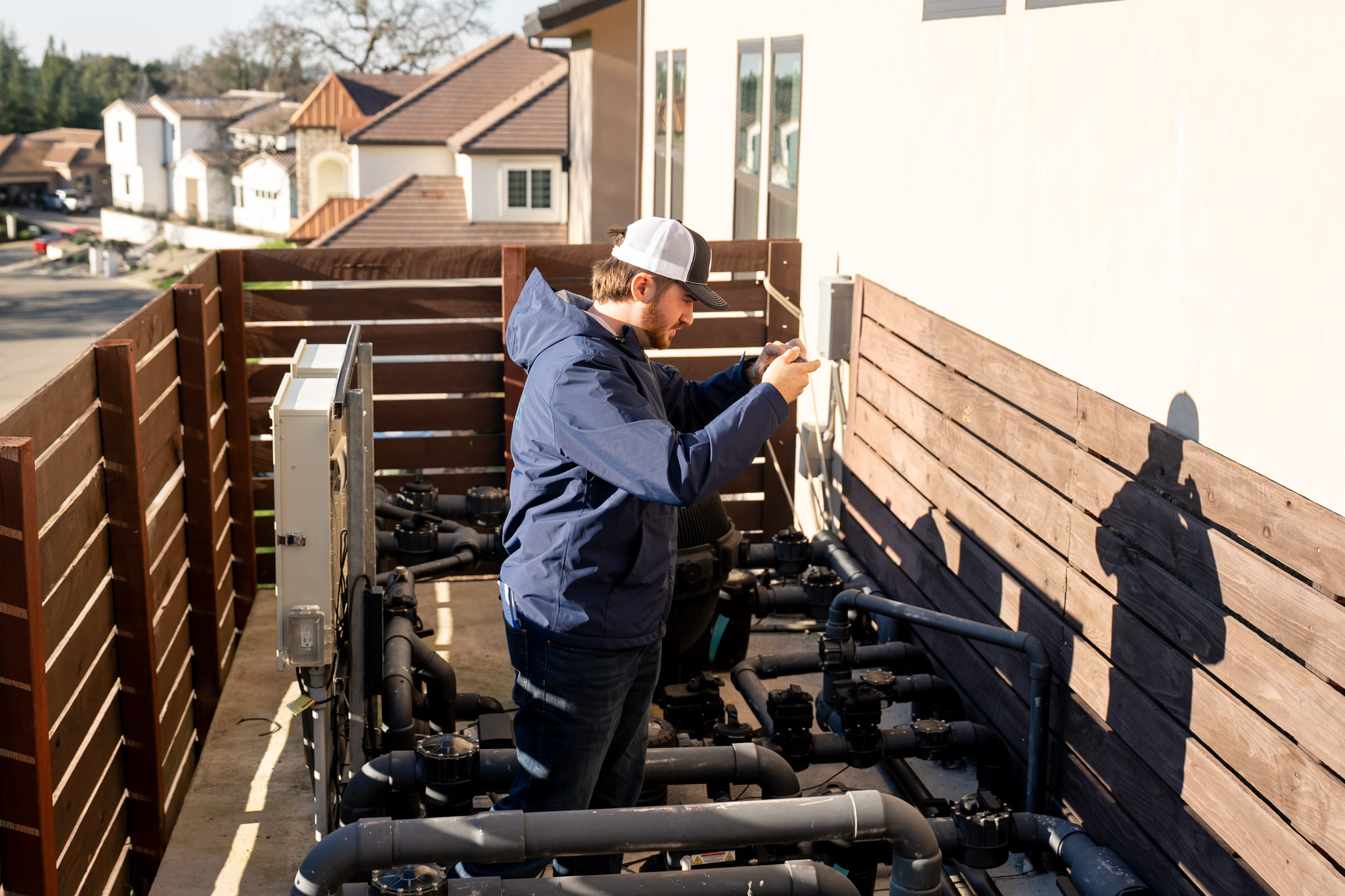
The equipment pad takes a beating on top of that. Summer afternoons run in the high 90s and low 100s, so a control panel facing west bakes all day, then the temperature drops far enough overnight to pull condensation into the enclosure. That is a heat cycle and a wet cycle every 24 hours on the same board. Winter fog keeps the pad damp for weeks at a stretch. Vineyard dust, leaf litter, and cottonwood fluff pack into panel vents, settle on relay contacts, and block antenna housings. Plenty of panels around Lodi have been outdoors fifteen years or more, and heat, moisture, and dust are what finally kill them: dried out door gaskets, corroded terminal strips, and swollen capacitors on the power supply section of the board.
Because the controller only knows what its sensors tell it. A pool automation panel reads water temperature, air temperature, flow, and on salt systems, cell current and salinity. Any one of those inputs can go bad while the pump, heater, and valves are perfectly healthy. Hard water shortens the life of every wetted sensor. A thermistor sitting in a scaled thermowell reads slow and low, so the heater runs longer than it should or the panel calls a temperature fault. A flow switch with mineral buildup on the paddle stops swinging freely and reports no flow, which locks out the heater and, on some systems, the chlorinator along with it.
Sensors get tested before they get replaced. Most pool thermistors are 10k parts, meaning roughly 10,000 ohms at 77 degrees, and they should track the manufacturer's resistance table as the temperature moves. A sensor reading open, shorted, or far off the table is bad. A sensor that reads correctly once it is pulled and the scale is knocked off the well was never the problem, and the thermowell needed cleaning.
Electrical faults look the same from the deck but test differently. Relays are mechanical devices with contacts that pit, stick, and eventually weld. When a relay does not fire, the first check is control voltage at the coil. If the coil is getting its signal and the load side stays dead, the relay is finished. If the coil is getting nothing, the problem is upstream on the board or in the low voltage wiring, which is where rodents and years of moisture in a damp enclosure leave their mark. Panels that stay wet through a long foggy stretch show it as green corrosion on terminal strips and blade connectors.
A typical diagnostic pass for automation system troubleshooting in Lodi covers:
Most of the time the panel is running fine and the link between it and your phone is what failed. Routers get replaced, the new one broadcasts a different network name, and the pool's wireless bridge never gets the new credentials. Firmware updates on the manufacturer side change how a panel authenticates to the cloud service, and a panel sitting three versions behind will not complete the handshake. Some older systems used a wireless protocol that has since been retired, so the hardware still works but nothing on the internet will talk to it.
Those cases separate quickly by walking to the panel and running everything from the keypad. If the pump, heater, lights, and valves all respond locally, the control logic is intact and the work is on the communication side: reconnect or replace the bridge, push the firmware update, or move an antenna out of a metal enclosure or away from a stucco wall it cannot see through. Most of these panels also want 2.4 GHz, not 5 GHz, so a router pushing both bands under one network name is worth checking before anything gets replaced. If the keypad is dead too, that is a power or board problem and a different conversation.


Freeze protection watches the air temperature sensor and starts circulation when the reading drops below a set point, usually somewhere around 38 degrees. Winter nights here sit close to that line for weeks at a time during fog, so the feature earns its keep. The trouble starts when the air sensor is mounted badly. A sensor in direct sun reads warm all afternoon and never protects the plumbing when it counts. A sensor clipped to a cold copper line, or tucked in shade against a north wall, reads far colder than the actual air and runs your pump for hours on nights that never came close to freezing. The same thing happens when the sensor wire gets pinched or the sensor's resistance drifts with age. The air sensor belongs in shade, out of the wind, away from hot equipment and away from bare metal plumbing.
Schedules cause similar confusion. Panels lose date and time after a power outage, and a system that thinks it is the wrong day will run the cleaner at 2 a.m. and heat the spa at noon. Battery backed clocks use a coin cell that dies after a few years, and it costs almost nothing to replace once someone thinks to look at it. Daylight saving shifts, leftover duplicate schedules from an old programming session, and a heat pump set to fight the gas heater are all common finds. Straightening out the schedule is usually the cheapest part of automation system troubleshooting in Lodi, and it fixes the complaint homeowners notice most, which is equipment running when it should be off.
That comes down to parts availability and how much of the panel is still good. A single failed relay, a burned trace, a bad transformer, or a dead sensor is a repair. Manufacturers still stock main boards for most systems installed in the last decade, and swapping a board keeps your existing actuators, sensors, wiring, and enclosure in place, which is where most of the money on that pad already sits. Older panels are the harder call. Once a manufacturer stops building the board, the only stock left is used or refurbished, and paying for a fifteen year old board with unknown history to run a pool through a full summer rarely works out.
A retrofit makes sense when the board is genuinely unavailable, when more than one major subsystem has already failed, or when the pumps and heater behind the panel are being replaced anyway. Modern panels reuse standard valve actuators and most sensor types, so the job is usually less invasive than homeowners expect: new board and enclosure guts, new keypad, updated wireless, existing conduit and actuators left alone. One thing worth knowing before you decide is that variable speed pumps talk to newer panels over a communication cable rather than a relay, which changes the wiring on the pad and is a common reason an older panel cannot drive a new pump correctly. You get told which way it is going, and why, before any parts get ordered.
Nevergreen Pools serves Lodi in partnership with Vintage Pool Service, a longtime Central Valley company working out of East Yosemite Avenue in Manteca. That crew knows the equipment on these pads because they installed and maintained a good deal of it, and they run Stockton, Manteca, and out toward Copperopolis on the same routes. If your panel is faulting, your valves are stuck, or the app went dark, the fault gets traced from the breaker to the board and you get told what actually failed.
Related services in Lodi: Automation & Control Systems in Lodi and Pool Heater Repair in Lodi.