Professional Pool Service
Filter Repairs (Cartridge, Sand, DE) in Lodi
Cartridge, sand, and DE filter repairs in Lodi, CA. We fix cracked tanks, torn elements, broken laterals, bad spider gaskets, and pressure problems.
Professional Pool Service
Cartridge, sand, and DE filter repairs in Lodi, CA. We fix cracked tanks, torn elements, broken laterals, bad spider gaskets, and pressure problems.
Hard groundwater is the reason filter trouble in Lodi usually shows up as a pressure problem long before it shows up as a leak. Water pulled from wells around this part of San Joaquin County carries a heavy calcium load, and every gallon that passes through a filter leaves a little of it behind. On cartridge pleats that mineral builds into a gray crust a garden hose will never move. In a sand filter it cements the top inch of the bed so water cuts channels through it instead of being strained. In a DE filter it blinds off the grid fabric so the powder cannot coat evenly. The filter keeps running, but it runs harder, and the parts inside start taking a beating they were never built for.
Then there is everything that lands on top of the water. Pollen off the old vine zinfandel blocks moves on the breeze in spring, tilling and harvest push fine dust across town for weeks at a stretch, and the oaks and sycamores shading the older plaster pools drop leaf litter and tannin all fall. Cottonwood fluff comes in off Lodi Lake and the Mokelumne and slips right past the skimmer basket. All of it gets chopped by the pump impeller and packed into whatever media you are running. Fine organic debris plus dissolved mineral is the combination that shortens filter life here more than heat or run time ever will.
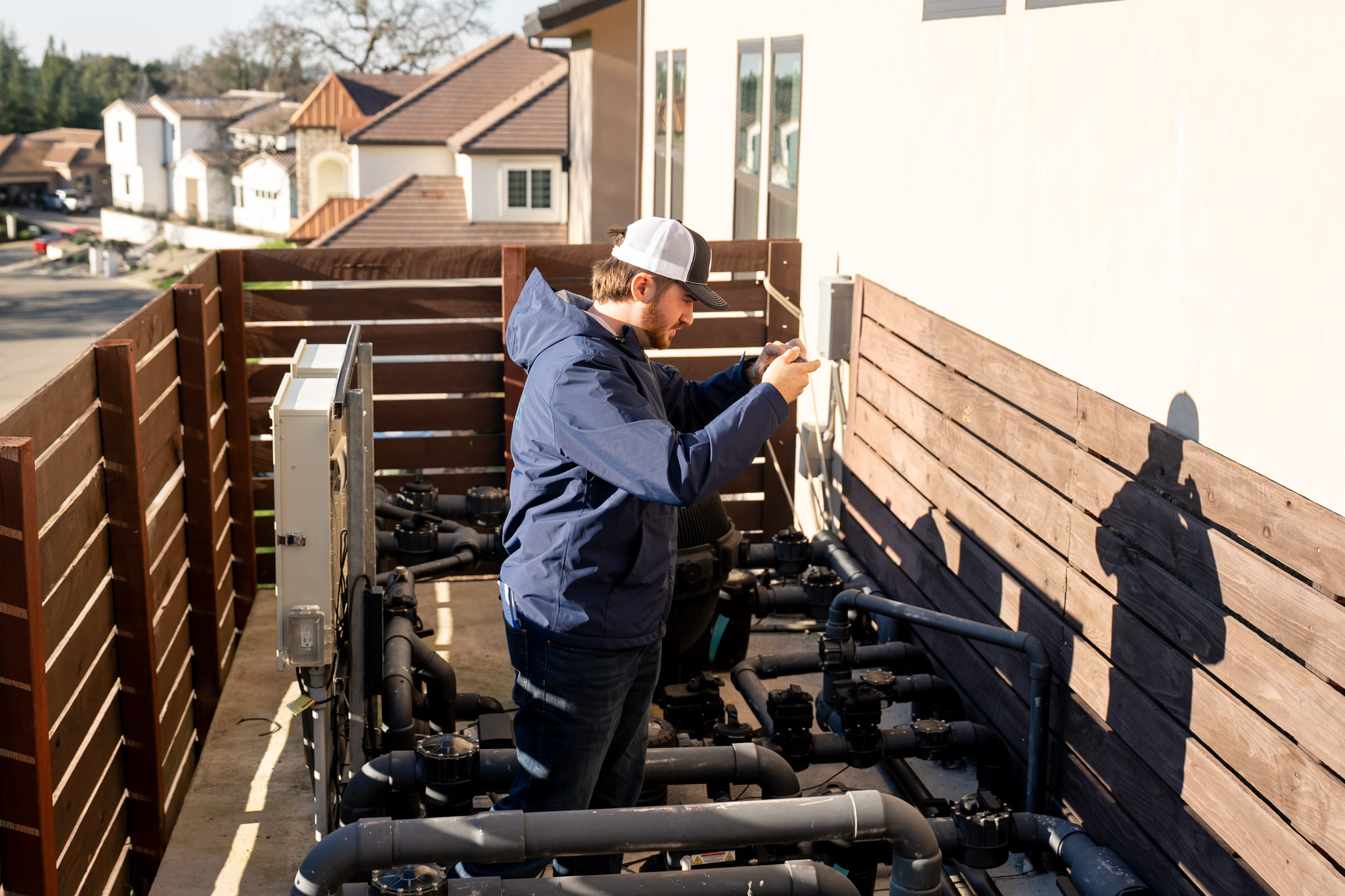
Nevergreen Pools handles filter repairs (cartridge, sand, de) in Lodi in partnership with Vintage Pool Service, a longtime Central Valley company on East Yosemite Avenue in Manteca. Between the two crews we stock grids, laterals, gaskets, clamp bands, air relief assemblies, and gauges on the truck, so most repairs get finished on the same visit instead of turning into a second trip a week later. We cover Lodi along with Stockton, Manteca, and out toward Copperopolis.
Because rinsing takes the debris off and leaves the mineral behind. A cartridge that has spent two seasons in hard Lodi water has calcium bonded down into the fibers of the pleat, and a hose only reaches the surface. The element comes out looking clean and still reads eight or ten pounds over its starting pressure the moment the pump kicks on. The fix is a soak in a proper filter cleaner or a diluted acid bath to strip the scale, or replacement if the fabric has already gone stiff. Pleats that will not flex between your fingers are finished, and no chemical brings them back.
Sand ends up in the same place by a different road. Sand does not wear out from strain, it wears out from losing its edges. Round, polished grains stop catching fine particles, and mineral cements the top layer into a crust that water simply channels through. Backwashing a channeled bed accomplishes close to nothing. We check by pulling the lid, digging a hand into the bed, and looking for clumping and mud balls near the surface. If the bed is crusted, the sand comes out, and while the tank is open the internals get inspected instead of being buttoned back up blind.
Short cycling is the related complaint. A filter that needs backwashing every three days in July is telling you one of a few things:
Straight answer on the tank: a cracked pressure vessel gets replaced. Filter tanks hold real pressure while the pump runs, and patching a crack in one is not something any honest tech will do. What we can repair is everything around it, and that covers most of what actually leaks.
Most tank cracks we find in Lodi start in one of three spots. The belly band seam on a split tank filter, where a corroded or overtightened clamp has been working on the plastic for years. The threaded port where the gauge or air relief screws in, usually from a fitting cranked in too hard. And the upper shell on filters sitting in full afternoon sun with no shade, where a decade of high 90s and low 100s leaves the plastic chalky and brittle. Lids are far more forgiving. A weeping lid is almost always a dry, flattened o-ring, and a fresh o-ring with the correct lubricant ends it.


In a sand filter, the failure points are the laterals and the standpipe down in the bottom of the tank. Laterals are the slotted fingers that collect filtered water and send it back to the pool. They turn brittle with age and split, and once one cracks you get sand in the pool, usually a small cone of it on the floor under a return. Replacing laterals means the sand has to come out anyway, so the media change gets done at the same time. A cracked standpipe does the same thing and often turns up after a hard backwash or after someone turned the multiport handle with the pump still running.
In a DE filter, the wear items are the grids and the manifold that sits on top of them. Grid fabric tears at the seams and along the top edge where it seats into the manifold, and a torn grid blows powder straight back into the pool through the returns. A cracked manifold does the same. We pull the entire element assembly, hose it down, and inspect each grid on its own, because one bad grid out of eight will keep pushing DE into the pool no matter how carefully you charge the filter. Grids also blind off from body oil and mineral over time, which reads as high pressure that a backwash and recharge will not bring down.
On both types, the small parts matter more than people expect. Pressure gauges fail low or stick, and a stuck gauge hides a real problem for months. Air relief valves get gritty and quit sealing, so air stays trapped in the top of the tank and flow drops. A gauge sitting at zero on a running system is a dead gauge, not perfect flow.
That is the spider gasket in the multiport valve. The gasket is a rubber ring seated in the underside of the valve key, and it seals off the ports you are not using. Age, chlorine, and grit flatten it or tear it, and once the seal is gone, part of your flow bleeds to waste every hour the pump runs. Signs to watch for:
The gasket itself is a straightforward replacement, and on many valves it is worth swapping the valve key and the diverter seal at the same time so the job holds. If the valve body is cracked or the ports are worn, the valve gets replaced instead. Filter problems rarely settle down on their own, and a filter running high is fighting the pump, cutting turnover, and leaving the water cloudier every week through the hottest part of the summer. If pressure is up, sand is on the floor, DE is coming back through the returns, or water will not stop running to waste, that is the point to have someone look at it. Our crews handle filter repairs (cartridge, sand, de) in Lodi year round, and a problem caught early is usually one gasket or one grid instead of an entire filter.
Related services in Lodi: Filter Cleaning in Lodi and Filter Installation in Lodi.