We respond same day.
Emergency services available!
Professional Pool Service
Filter Cleaning in Lodi
Cartridge, sand, and DE filter cleaning in Lodi, CA. Hard water scale, vineyard dust, and pressure readings handled by licensed pool technicians.
Professional Pool Service
Cartridge, sand, and DE filter cleaning in Lodi, CA. Hard water scale, vineyard dust, and pressure readings handled by licensed pool technicians.
Hard groundwater is the first thing that shapes filter cleaning in Lodi. Well water across San Joaquin County carries a heavy mineral load, and calcium hardness only climbs through the summer as high 90s afternoons evaporate water off the surface and leave the minerals behind. Those minerals do not stay in solution forever. They plate out on plaster, on tile, and on the one surface most homeowners never look at, which is the filter media itself. A cartridge that feels stiff and chalky down in the pleats is not dirty in the ordinary sense. It is scaled, and no amount of hose pressure is going to move that deposit.
Pools in Lodi also take on a debris load that a lot of towns never see. Vineyard dust rolls in when growers till the rows and again through harvest, and that fine grit floats past the skimmer basket and goes straight into the filter. Cottonwood fluff drifts off the Mokelumne River and Lodi Lake in late spring and can mat across a set of pleats in a single afternoon. Older properties in Lodi sit under mature oaks and sycamores that drop leaves and tannin all fall, while the newer construction on the edges of town has less canopy overhead and more open exposure to dust blowing off the fields. Add sunscreen and body oil from a hot weekend, and one filter is holding grease, grit, and scale all at the same time.
Nevergreen Pools serves Lodi in partnership with Vintage Pool Service, a longtime Central Valley company working out of East Yosemite Avenue in Manteca that has been cleaning these same filters for years. Between the mineral content in the water and the seasonal debris, this is not a once a year chore here. Below are the questions Lodi homeowners ask most about it.
Pressure tells you, not the calendar. Every filter has a clean starting pressure, which is the reading on the gauge right after a full cleaning with the pump primed and the air purged. Write that number on the tank with a marker. When the gauge climbs 8 to 10 psi above it, flow through the system has dropped far enough that the filter needs attention. Waiting past that point makes the pump work against restriction, cuts the flow the heater needs to fire, and lets debris pack in so hard it will not rinse back out.
In practice that works out to roughly this for most Lodi pools:
Pools that carry heavy swim loads all summer, or that sit directly under an oak, land at the short end of every one of those ranges.
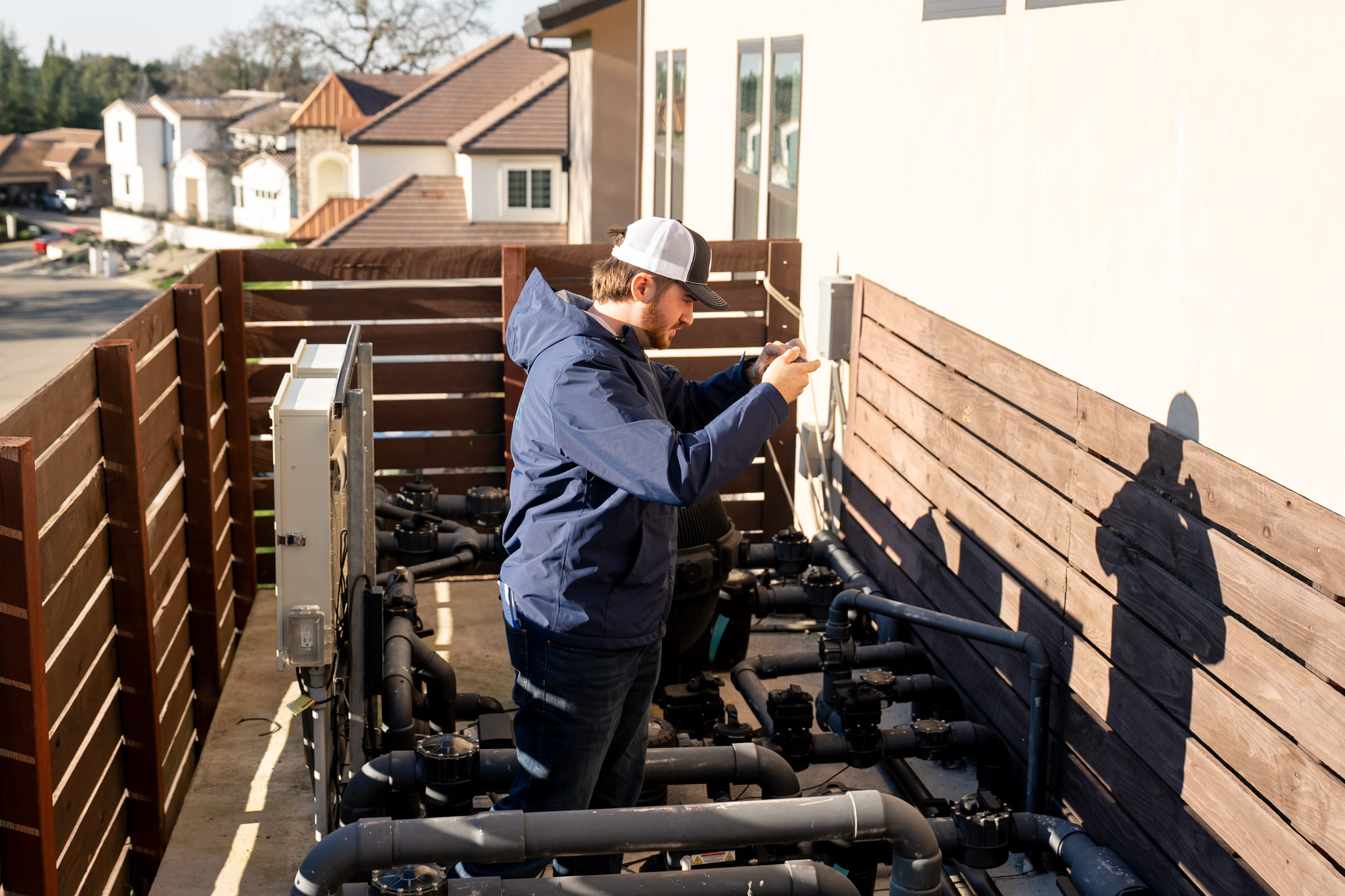
The gauge reading gets noted first, because the difference between the dirty pressure and the pressure after reassembly is the only real measure of whether the cleaning worked. Then the pump goes off, the air relief valve opens to bleed pressure out of the tank, the band clamp comes off, and the cartridges come out.
Rinsing is done with a fan nozzle, not a needle jet. A jet drives grit deeper into the fabric and can cut the fibers. The right technique is top to bottom, held at an angle so the spray gets down the side wall of each pleat and lifts the packed material out instead of pushing it through. Every pleat gets worked individually. On a large four element cartridge set that is slow work, and rushing it is the reason a lot of filters read dirty again a week later.
Rinsing alone does not remove what is bound to the fabric. Oils from sunscreen and lotion glue fine dust into a gray film, and the calcium in Lodi water bonds to that film and hardens. So the cartridges go into a degreaser soak first, usually overnight, then get rinsed clean. Only after the oils are gone does an acid soak follow, well diluted, and always acid poured into water rather than the other way around. Running the acid first sets the oils into the fabric permanently, which is the most common way a homeowner ruins a good cartridge. After the acid the elements get rinsed until the water runs clear, then go back in with a lubricated tank o-ring, the air purged, and the new clean pressure written down.
Backwashing moves loose debris and nothing else. On a sand filter, run the backwash until the sight glass runs clear, usually two to three minutes, then rinse for thirty seconds to reseat the bed before returning the valve to filter. What backwashing will not fix is a bed that has started to cement. Hard water builds calcium between the grains, water finds an easy path through the hardened mass, and unfiltered water channels straight back to the pool while the gauge still reads normal. That calls for a sand filter cleaner poured through the skimmer and left to sit, done once a year around here, and eventually for fresh media. Sand lasts five to seven years in most places and closer to the short end of that in Lodi.
DE filters need the powder replaced every time, not just rinsed. After a backwash, a full measured dose of DE goes in slowly through the skimmer as a slurry so it coats the grids evenly. Short doses leave bare fabric, and bare fabric loads up with dirt that will not come off later. Bumping a bump style filter between cleanings redistributes the cake and buys some time, but it is not a substitute for a teardown. Twice a year the grids come out, get hosed pleat by pleat, and go through the same degreaser and acid soak a cartridge gets. That teardown is also the only time anyone gets a look at a torn grid or a cracked manifold, which is what is going on when DE keeps blowing back into the pool.
The clearest sign is a cleaning that no longer lowers the pressure. If a cartridge has been degreased, acid soaked, rinsed, and reinstalled and the gauge still sits high, the media is permanently blinded and money spent cleaning it again is wasted. Fabric that stays gray after a proper soak, pleats that feel hard instead of pliable, end caps pulling loose from the fabric, broken support bands, or thin spots you can see light through all mean the same thing. Cartridges generally give two to three seasons. Between the mineral load and the dust, filter cleaning in Lodi tends to put them at the two year mark rather than three, and a worn element is cheaper to replace than to keep fighting.
Running a packed or worn out filter is not a small thing. Restricted flow raises pump amperage, shortens motor life, trips heater pressure switches, and starves the chlorinator so sanitizer falls off exactly when the water is warmest and the bather load is highest. Cleaning on pressure instead of habit, using the soaks in the right order, and replacing media when it is finished keeps the system moving water the way it was built to. That is the whole job, and on a Lodi pool it is worth doing on schedule.
Related services in Lodi: Filter Repairs in Lodi and Pool Maintenance in Lodi.