The groundwater under Lodi is hard, and that single fact changes how a salt pool has to be maintained here. Every time you top off after a hot week, you are adding calcium to the pool along with the water. Salt chlorine generators concentrate that problem, because the cell splits salt into chlorine at the plates and drives the pH up as it runs. High pH plus high calcium is exactly the condition that lays down scale, first as a gray film on the cell plates, then as a chalky line on the tile at the waterline. A pool that gets ignored for a season in Lodi usually does not fail because of algae. It fails because the cell is buried in calcium and stops producing.
That is the part most homeowners do not hear when they buy a salt system. The equipment is easier to live with day to day, but it is not maintenance free, and in this part of San Joaquin County it needs a tech who is actually testing salt and calcium instead of dropping a tab in the skimmer and moving on. Our saltwater pool service in Lodi is built around that reality: regular cell inspection, water balance aimed at protecting both the plaster and the cell, and adjustments through the year as the water swings from foggy winter mornings to afternoons in the low 100s.
Nevergreen Pools works in Lodi in partnership with Vintage Pool Service, a longtime Central Valley company running routes out of East Yosemite Avenue in Manteca. Between the two crews we cover Lodi, Stockton, Manteca, and out toward Copperopolis, so the tech standing at your equipment pad already knows what this valley water does instead of learning it on your gear.
Why does my salt cell scale up so fast in Lodi?
Two things stack on top of each other. The first is the water coming out of the tap. Lodi groundwater carries a lot of calcium, and some of it carries iron as well, which is why older plaster around town picks up rust colored staining near the fill line. Summers here run into the high 90s and low 100s, so a pool can lose a quarter inch or more a day to evaporation. The water leaves, the calcium stays behind, and you replace what evaporated with more hard water. Calcium hardness climbs all season long.
The second reason is the cell itself. As the plates generate chlorine, the water passing across them turns strongly alkaline right at the plate surface. That local pH spike is far higher than anything your test kit reads out in the middle of the pool, and calcium falls out of solution as scale exactly where the water is most alkaline. So the plates get coated before you ever see a line on the tile. A scaled cell produces less chlorine, the pool starts running short, and the panel eventually throws a low salt or inspect cell warning even though the salt level is fine.
What that means for the work on a Lodi route:
- Test calcium hardness and total alkalinity every visit, not just chlorine and pH, so we can see hardness climbing before it turns into scale.
- Keep pH pulled down into the low 7s with acid, because a salt system pushes it upward continuously.
- Pull and inspect the cell on a set schedule, and soak it in a dilute acid solution only when there is real buildup, since every acid bath takes a little coating off the plates.
- Brush and treat the waterline tile before scale hardens into something that needs to be blasted off.
- Recommend a partial drain and refill when hardness gets too high to manage with chemistry alone.
How is a salt pool different from a regular chlorine pool?
The chlorine is the same chlorine. A salt system just manufactures it on site instead of you buying it in a bucket. What changes is everything around it. Salt level has to sit inside the window your particular unit wants, usually somewhere around 3,000 to 3,500 parts per million, and salt is only lost to splash out, backwashing, leaks, and rain overflow. It does not evaporate. So when salt reads low, either fresh water went in or pool water went out, and both are worth tracking down rather than pouring in more bags twice a season.
Stabilizer runs higher on a salt pool than on a traditional one. Cyanuric acid shields chlorine from being burned off by sun, and because a cell makes chlorine at a slow steady rate instead of in one large weekly dose, that shielding matters more. We hold a higher stabilizer target on salt pools than we would on a tab fed pool, then keep it there, because too much locks the chlorine up and too little means the cell cannot keep ahead of a July afternoon. Then there is pH. On a chlorine pool, pH drifts wherever the fill water and the swimmers push it. On a salt pool it climbs, week after week, and answering that drift on every visit is what protects the plaster and the cell at the same time.
Does anything change between summer and winter?
Yes, and this is where a lot of Lodi salt pools get away from their owners. A cell produces less chlorine as the water cools, and most units stop producing entirely once water drops below roughly 60 degrees. Through the foggy stretch of winter the pool needs less chlorine anyway, so we cut the output percentage and the pump run time back instead of letting the system grind away at a setting made for August. In spring we bring output back up before the water warms enough to grow anything, because chasing algae after it starts costs a lot more than staying ahead of it.
Debris load moves on the same calendar, and it does not care what kind of sanitizer you run. Oaks and sycamores over the older homes near downtown drop steadily through fall, cottonwood fluff comes off the Mokelumne and Lodi Lake in early summer and mats up skimmer baskets, and vineyard dust and pollen blow in during tilling and again at harvest. All of that organic material pulls chlorine down. A cell that kept up fine in June can fall behind in September at the exact same setting, which is why output gets adjusted to what the water is doing rather than set once and forgotten.
What happens on a regular service visit?
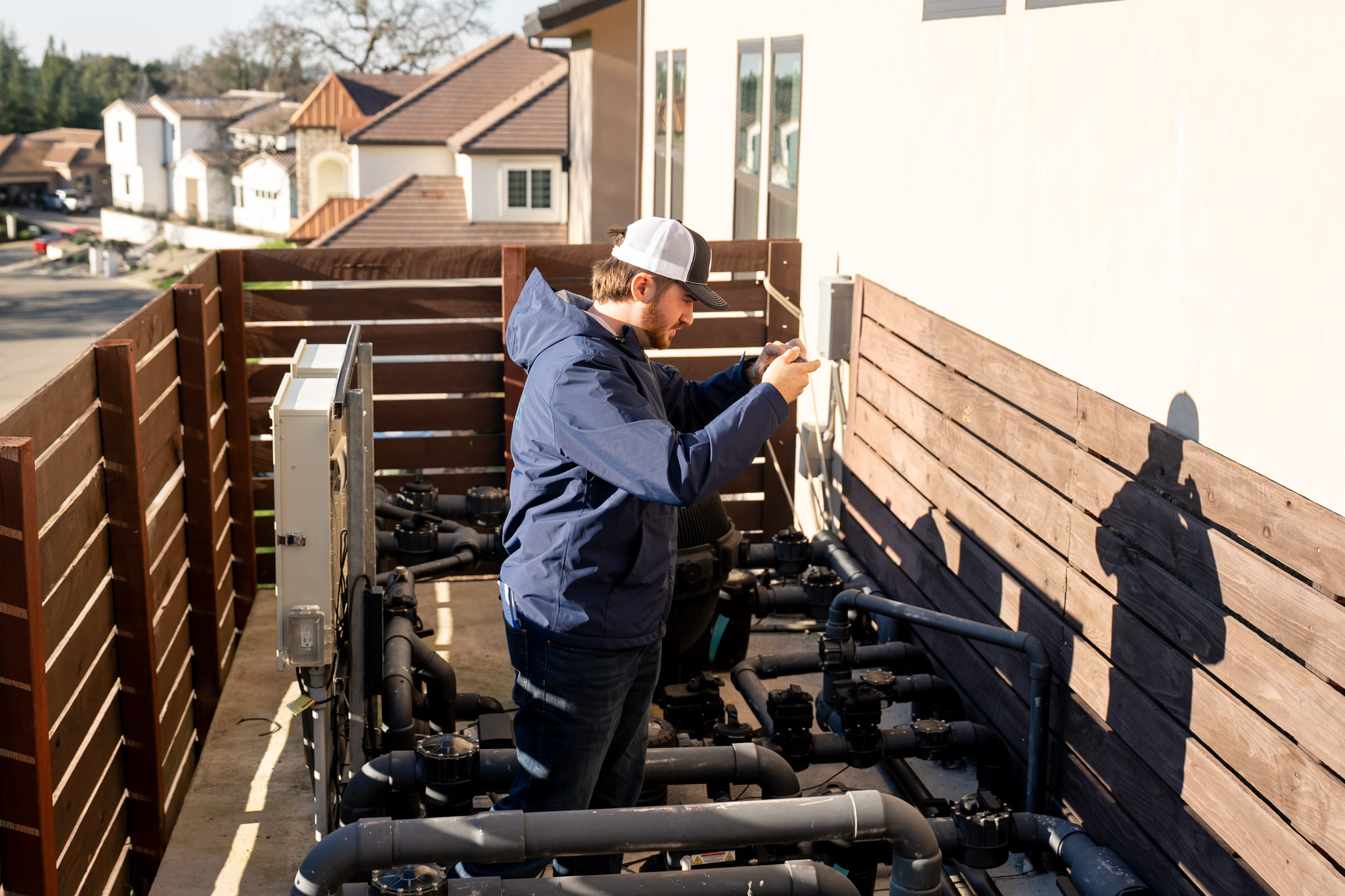
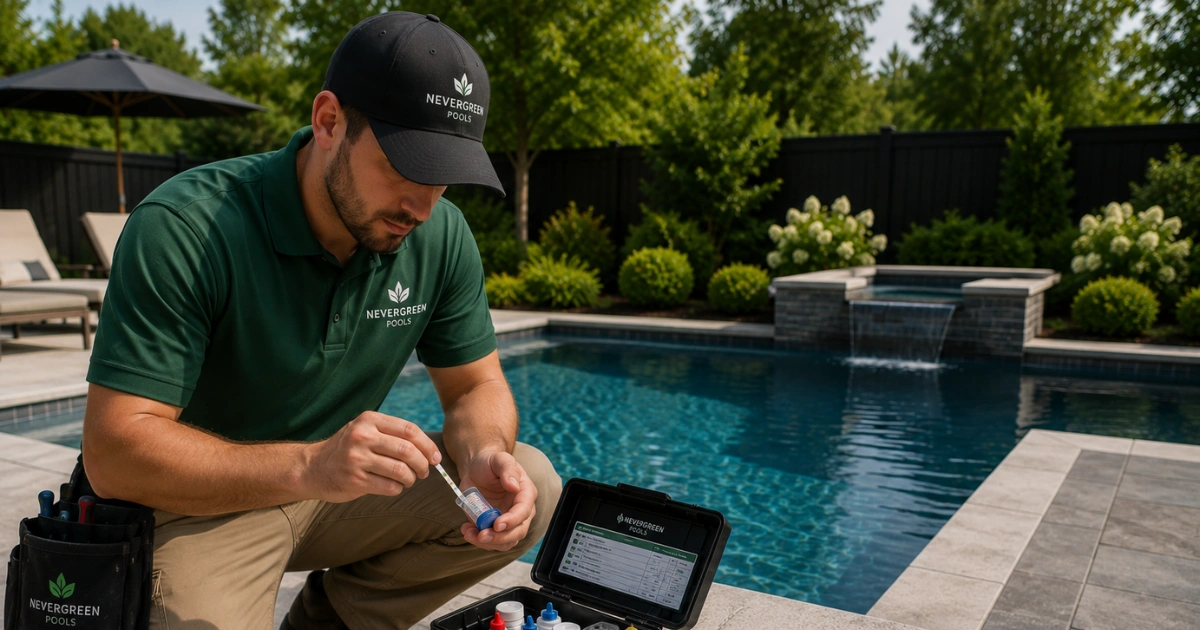
A standard stop on our saltwater pool service in Lodi covers the water and the equipment together. We test free chlorine, pH, total alkalinity, stabilizer, calcium hardness, and salt, then dose to correct the drift we actually measured that day. We brush walls and steps, net the surface, empty the skimmer and pump baskets, and vacuum when the load calls for it. At the pad we check filter pressure, look at the cell for buildup between full inspections, and read the panel for output percentage and fault codes. If something is heading toward a failure, like a cell losing output as it ages out or a filter due for a full teardown cleaning, you hear about it before it becomes a green pool.
We work Lodi year round, from newer construction on the edge of town to established properties with plaster pools sitting under mature trees closer to the river. If your salt system is throwing codes, your water has gone cloudy, or you just want a dependable tech on the route every week, we can look the pool over and tell you plainly where it stands.
Related services in Lodi: Salt Cell Replacement in Lodi and Chemical Treatment in Lodi.