Hard groundwater is the first thing to account for on almost any pool in Lodi. The supply here carries a heavy mineral load, and calcium does not evaporate. Through a stretch of high 90s and low 100s in July and August, a pool can lose an inch or more of water a day, and every top off puts more calcium and more dissolved solids into a smaller volume. That is why a pool rebalance in Lodi usually starts with a calcium hardness and cyanuric acid reading rather than with chlorine. Chlorine is the symptom. The minerals underneath it are the cause.
The second factor is load. Older homes around downtown Lodi sit under mature oaks and sycamores, and plaster pools under that canopy take a steady feed of leaves and tannin through fall. Tilling and harvest in the vineyards around town push fine dust and pollen across the water for weeks at a time, and the breeze off Lodi Lake and the Mokelumne carries cottonwood fluff and river debris. All of that is organic material. It consumes chlorine, drags pH around, and leaves a pool that tests low on sanitizer no matter how much you add.
Nevergreen Pools works here in partnership with Vintage Pool Service, a Central Valley company operating out of East Yosemite Avenue in Manteca that has been on these pools for decades. Between the two crews we run the same route through Lodi, Stockton, Manteca, and Copperopolis, and we know how the water behaves before the test kit comes out of the truck.
Why does my water keep drifting out of range?
Three things push it. The first is aeration. Waterfalls, spa spillways, returns aimed up, and a hot afternoon all drive carbon dioxide out of the water, and pH climbs on its own with nothing added. The second is total alkalinity, which is the buffer that decides how fast that climb happens. Alkalinity too low and pH swings hard from one week to the next off a small dose of acid or a heavy swim day. Alkalinity too high and pH parks in the 8s and refuses to come down without repeated acid doses. The third is stabilizer. Every chlorine tab that dissolves adds cyanuric acid, and cyanuric acid does not burn off. Run tabs all season and you can be at 100 ppm or higher by September, at which point your chlorine is still present on the test but chemically slow, and the water goes dull and green while the reading looks acceptable.
On top of that, calcium hardness in Lodi climbs with every fill. Put high calcium and high pH together and you get scale: a rough white band at the tile line, cloudy water that will not clear with filtration, and eventually deposits inside the heater that cut efficiency and shorten the life of the exchanger. Push pH the other direction, below about 7.2, and the water goes hungry. It pulls calcium back out of the plaster, etching the surface, roughing up steps and the shallow shelf, and leaving grout lines standing proud of the tile.
What does a pool rebalance in Lodi actually involve?
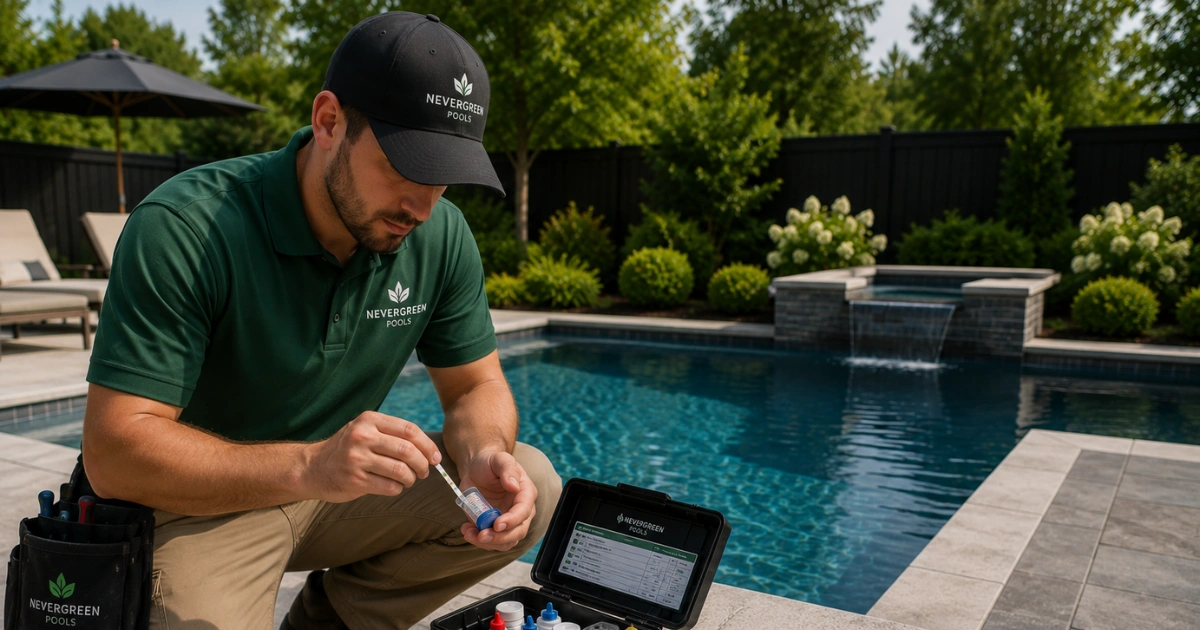
It starts with a full panel, not a strip. We test and record:
- pH, target 7.4 to 7.6, the number everything else moves around
- Total alkalinity, generally 80 to 120 ppm, set lower when the pool is on a salt system
- Calcium hardness, which on Lodi fill water often sits well above the 200 to 400 ppm range a plaster pool wants
- Cyanuric acid, 30 to 50 ppm on a chlorine pool, and the number that most often forces a bigger decision
- Free and total chlorine, read against the stabilizer level rather than as a standalone target
Those numbers get run through the Langelier Saturation Index, which combines pH, alkalinity, calcium, temperature, and dissolved solids into one figure that tells you whether the water is scaling, etching, or sitting neutral. That index matters more here than it would in a soft water town, because Lodi water starts with the calcium leg already loaded. It also explains why the same pool behaves differently at 102 degrees in August than it does on a foggy January morning. Warm water scales more readily at identical chemistry, so a pool that held steady all winter can start laying down deposits in midsummer without a single new chemical going in.
Why drain part of the pool instead of just adding chemicals?
Because two of those numbers only move one direction. Nothing removes cyanuric acid from the water, and there is no practical way to strip calcium hardness out of a residential pool. Both are corrected by dilution, which means swapping a measured portion of the water for fresh. If stabilizer reads 120 ppm and you want it near 40, that is roughly a two thirds exchange. If calcium is at 700 ppm against fill water at 200, the math lands in the same neighborhood. We calculate the percentage off the actual volume, drain to a marked line, refill, and retest instead of guessing. A partial drain done deliberately costs less and takes less time than a season of chasing chlorine that was never going to hold.
What we do not do is empty a plaster pool and walk away from it. Groundwater in the valley sits high enough in the wet months that an empty shell can lift or crack, and bare plaster left dry in the sun will craze. Drains happen in stages with the refill scheduled tight behind them, and where the fill water carries iron we treat the new water as it comes in, because iron that oxidizes on contact with chlorine is what leaves those brown streaks running down the plaster.
How long does it take, and what keeps it in range afterward?
Sequence matters more than speed. Alkalinity is set first, because pH will not hold until the buffer is right. Calcium and stabilizer come into line through the drain and refill. Then pH gets walked into place with acid in measured doses over a day or two rather than dumped in at once, which protects the plaster and keeps you from overshooting into the low 7s. Chlorine goes last, matched to the stabilizer level rather than to a generic target. A neglected pool with algae and a swing in more than one direction is usually a three to five day job with a return visit to retest, not a single afternoon.
Holding it there afterward is mostly about managing load. Skim and net through the oak and sycamore drop, rinse or backwash the filter once the vineyard dust settles in, and watch the autofill, because a leaking fill valve quietly adds calcium around the clock. Weekly service covers the rest, and the pools we carry on route in Lodi rarely need a second correction, because the drift gets caught at 20 ppm instead of 200.
Related services in Lodi: Chemical Treatment in Lodi and Algae Removal in Lodi.