Professional Pool Service
Chemical Treatment in Lodi
Corrective pool chemical treatment in Lodi, CA. We test first, then fix pH, alkalinity, hardness, stabilizer and phosphates on hard Valley water.
Professional Pool Service
Corrective pool chemical treatment in Lodi, CA. We test first, then fix pH, alkalinity, hardness, stabilizer and phosphates on hard Valley water.
Water in Lodi comes out of the ground hard. Every inch you add off the hose brings calcium with it, and often a trace of iron. That matters more than most homeowners expect, because chemistry problems here almost never start with the chlorine. They start with a calcium hardness number that has climbed past 500 parts per million after a few summers of evaporation and refill, or an alkalinity reading that will not let the pH sit still. Chlorine gets blamed because chlorine is the thing people can smell and taste.
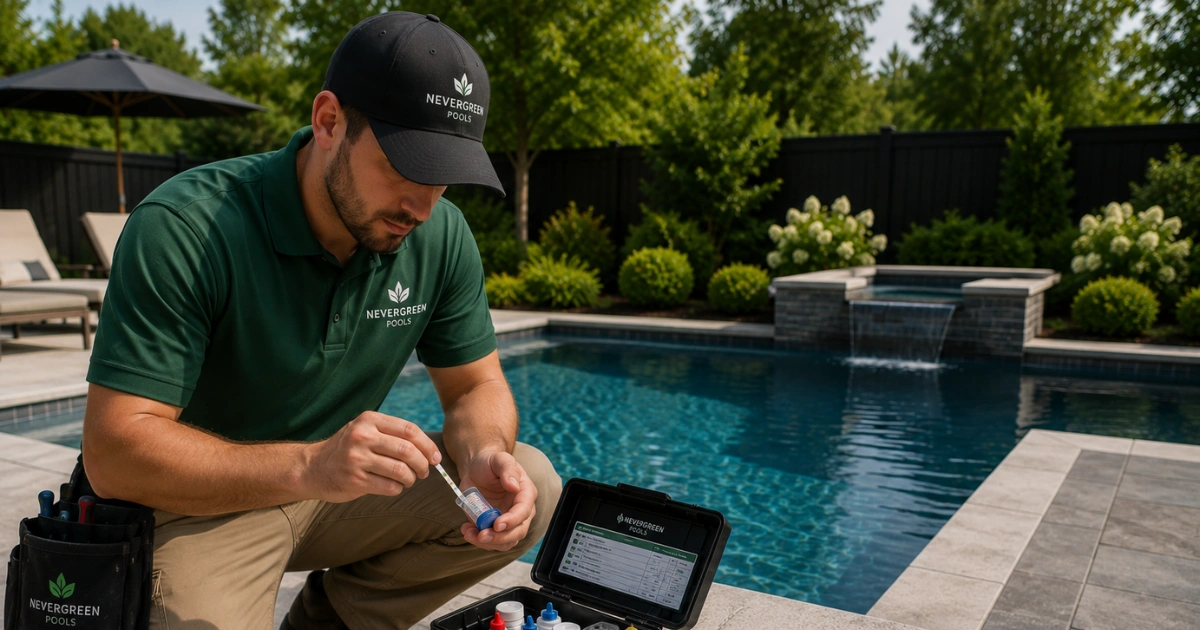
Corrective chemical treatment is the work of reading what the water is actually doing and fixing it in the right order. That means a full test on site: free and total chlorine, pH, total alkalinity, calcium hardness, cyanuric acid, and phosphates, plus a look at metals if the plaster is showing gray or rust colored shadows. Then the dosing gets calculated against your gallon count and your readings, not against habit or a bottle label. Shocking a pool that is carrying 120 parts per million of stabilizer is throwing money in the water. Pouring acid into a pool sitting at 40 parts per million alkalinity will drop the pH through the floor by morning, and you will be chasing it back up for a week.
Nevergreen Pools serves this area in partnership with Vintage Pool Service, a longtime Central Valley company running routes out of Manteca, with crews who know what the fill water in this part of San Joaquin County does to plaster over time. Between the two, chemical treatment in Lodi gets handled by people who have corrected these exact problems on these exact pools.
Cloudiness with a normal chlorine reading is usually a calcium and pH problem, not a sanitizer problem. Hard fill water plus a long hot summer is a concentrating machine. A pool loses roughly a quarter inch a day when afternoons run in the high 90s and low 100s, which is most of June through September here. The calcium stays behind and you top it off with more calcium. Once hardness climbs and the pH drifts above 8.0, the water starts shedding calcium carbonate as a fine haze, and you see it later as scale at the tile line and a chalky feel on the plaster steps. The filter does not catch it, because it is dissolved rather than suspended. The fix is to bring pH back to 7.4 to 7.6 and alkalinity to 80 to 120 parts per million with acid, hold them there, and then decide whether hardness above 400 needs a partial drain and refill or can be carried with a sequestrant and a slightly lower pH target.
The other common cause is phosphate load. Orchard and vineyard dust off tilling and harvest, plus leaf drop in fall, all end up in the water. Organic debris breaks down into phosphate, phosphate feeds algae, and algae burns chlorine faster than a tab feeder can replace it. A pool can test at 2 parts per million free chlorine and still be losing that fight every afternoon. Anything over about 500 parts per billion is worth removing. A lanthanum based remover binds it into a precipitate that the filter catches, so the water clouds for a day or two and the filter needs cleaning after. That takes the food source away instead of just adding more chlorine at the symptom.
Everything is driven by the test results, and the order matters so that each step does not undo the last one. A typical corrective visit runs like this:


Often, yes, if the stain is metal and not damage. Local groundwater carries iron, and older plaster pools show it first: rust colored shadows in the corners, gray streaks under the returns, brown patches where well water or an old heater core left iron behind. The test is simple. Hold a vitamin C tablet against the stain for thirty seconds. If the spot lightens, it is metal, and metal is treatable.
Treating it means dropping chlorine down near zero first, running the pump with the heater off, using an ascorbic acid based remover to lift the metal into solution, then immediately locking it there with a sequestering agent so it does not fall right back onto the plaster when chlorine comes back up. Sequestrant breaks down in sunlight, so it needs a maintenance dose monthly after that. Skipping it is the most common mistake, and it is why homeowners watch a stain return within a week. Calcium scale is a different animal. It does not dissolve out of the water with an acid dose and needs mechanical removal or a bead blast, which is a separate job, and a straight answer about which one you have should come before anyone sells you either.
Corrective treatment is a response, not a schedule. Most pools need it after something specific: a green pool after a week away, a spring opening on water that sat unattended through the winter fog, a heavy harvest season that loaded the surface with dust and organics, a heater or filter repair that let chemistry slide for a few weeks, or a refill that reset every number at once. Weekly service is built to hold a balanced pool balanced. It is not designed to pull water back from 8.2 pH, 600 parts per million hardness, and a stabilizer reading off the top of the chart. That situation needs a targeted correction first, usually one visit with a follow up test three to five days later once the doses have circulated and settled, and then routine care has something worth maintaining.
The same crews cover Stockton, Manteca, and Copperopolis, so a Lodi pool sits on a route that works this water every day rather than an occasional stop from out of the area. If your readings are off and you are tired of guessing at doses, chemical treatment in Lodi starts with a real test and a plan built from the numbers on the kit, not from what happened to work on somebody else's pool.
Related services in Lodi: Pool Rebalance in Lodi and Algae Removal in Lodi.