Professional Pool Service
Weekly Pool Maintenance in Lodi
Weekly pool service in Lodi, CA on a set day: water testing, brushing, vacuuming, chemical dosing, and equipment checks tuned to hard Valley groundwater.
Professional Pool Service
Weekly pool service in Lodi, CA on a set day: water testing, brushing, vacuuming, chemical dosing, and equipment checks tuned to hard Valley groundwater.
The groundwater under Lodi is hard. Fill a pool from a hose here and you are adding calcium, and in some parts of town iron, right along with the water. Summer heat pushes evaporation past a quarter inch a day, and every gallon that leaves as vapor leaves its minerals behind. Calcium hardness climbs, and if pH and alkalinity drift up with it, that calcium comes out of solution and plates onto the surface as a gray crust at the tile line and a sandpaper feel on the steps. On older plaster pools in the established parts of Lodi, scale is the most common reason a surface starts looking tired years before it should.
That is the real backdrop for weekly pool maintenance in Lodi. The job is not just netting leaves. It is holding water chemistry inside a range narrow enough that hard fill water never gets a chance to deposit, while the pool is also collecting vineyard pollen in spring, fine dust off tilled rows and harvest traffic in late summer, and cottonwood fluff and leaf litter that drift in on the breeze off the Mokelumne and Lodi Lake. Nevergreen Pools runs that route work in partnership with Vintage Pool Service, a longtime Central Valley company operating out of Manteca on East Yosemite Avenue that knows exactly what this water does over a season.
Below are the questions homeowners here ask most often about recurring service, answered the way a tech would answer them standing at your equipment pad.
Because the numbers move fast here, and they move in one direction. A Lodi summer week in the high 90s and low 100s can drop your water level well over an inch through evaporation alone. The delta breeze cools things off at night, which is pleasant for you and irrelevant to the chemistry, because the minerals left behind are already concentrating. Chlorine burns off under direct sun at a rate that depends on stabilizer level, swimmer load, and how much organic material blew in that week. Guess at any of it and you are either short on sanitizer by day five or you have overshot and started a pH climb.
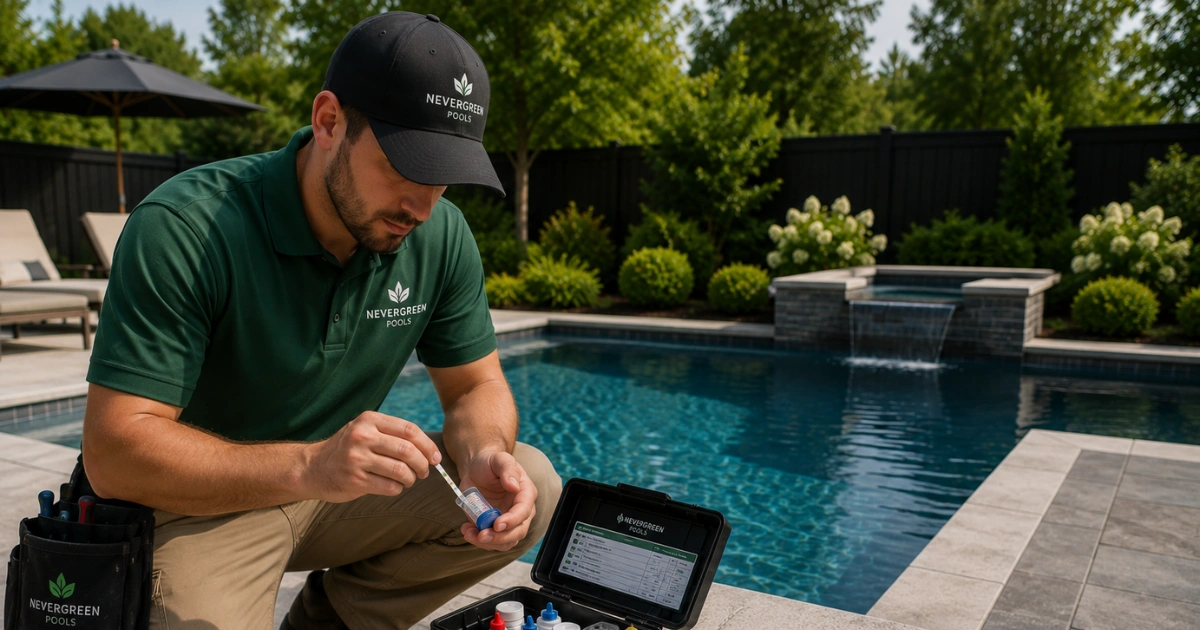
So a visit starts with a test, not with a scoop of shock. We read free chlorine, pH, total alkalinity, cyanuric acid, and calcium hardness, and on plaster pools in this valley the hardness and alkalinity readings get as much attention as the chlorine does. The target is a saturation balance where the water is neither hungry enough to etch plaster nor loaded enough to scale it. On hard Lodi fill water that usually means holding pH toward the low end of the acceptable range and keeping alkalinity from creeping, since that is the lever that keeps dissolved calcium dissolved. Every dose after that is calculated from the reading and the pool's actual gallonage, not poured by habit.
The physical half of weekly pool maintenance in Lodi follows the same order every time, and the order matters. Skim the surface first, because anything floating will sink once you disturb the water and then you are vacuuming what you could have netted in thirty seconds. Then brush: walls, steps, the tanning shelf, behind the ladder, and every corner the return jets never reach. Brushing is the step homeowners underestimate. It breaks up the film algae starts under, and it keeps fresh mineral deposit from setting on plaster before it hardens into something that needs acid and a pumice stone to remove.
Vacuuming comes next, and the debris load here is seasonal and predictable. Spring lays down a yellow film of vineyard pollen that clouds the surface and packs skimmer socks solid. Late summer and harvest bring fine dust off worked ground that settles as gray silt in the deep end. Fall brings oak and sycamore drop from the mature trees shading so many older Lodi yards, plus cottonwood fluff that mats against the weir door. Baskets get emptied at the skimmer and at the pump, and the pump basket is opened and cleared, not glanced at through the lid.


In this climate, yes, and the reason is arithmetic rather than opinion. Chlorine has a half life measured in days under a Central Valley July sun. Stretch service to fourteen days and the back half of that gap runs on whatever residual is left, which is usually not much. Algae does not need long. A pool that tested fine on day one can be hazy by day nine and green in the corners by day twelve, and at that point the visit is not maintenance anymore, it is a recovery with shock, extra brushing, and a filter that has to be pulled and cleaned early.
The mineral side is worse on a two week cycle. Evaporation does not pause. Two weeks of high heat concentrate the water noticeably and let pH drift up unchecked, which is precisely the condition that puts calcium on plaster. Correcting a pH that has been high for ten days also means a larger acid dose all at once, which is harder on the surface than small weekly corrections. Weekly service keeps every adjustment small, and small adjustments are what keep plaster smooth and water clear. That is the main reason weekly pool maintenance in Lodi costs less across a season than a biweekly plan plus the repairs it eventually produces.
The same day every week matters too. A fixed service day means the interval is genuinely seven days rather than five one time and eleven the next, and it gives the tech a clean baseline. If chlorine reads low on a Tuesday route, we know it drifted over exactly seven days and can raise the dose or the feed rate with confidence. It also tells you when to expect someone, which matters for gate access, dogs, and pool covers.
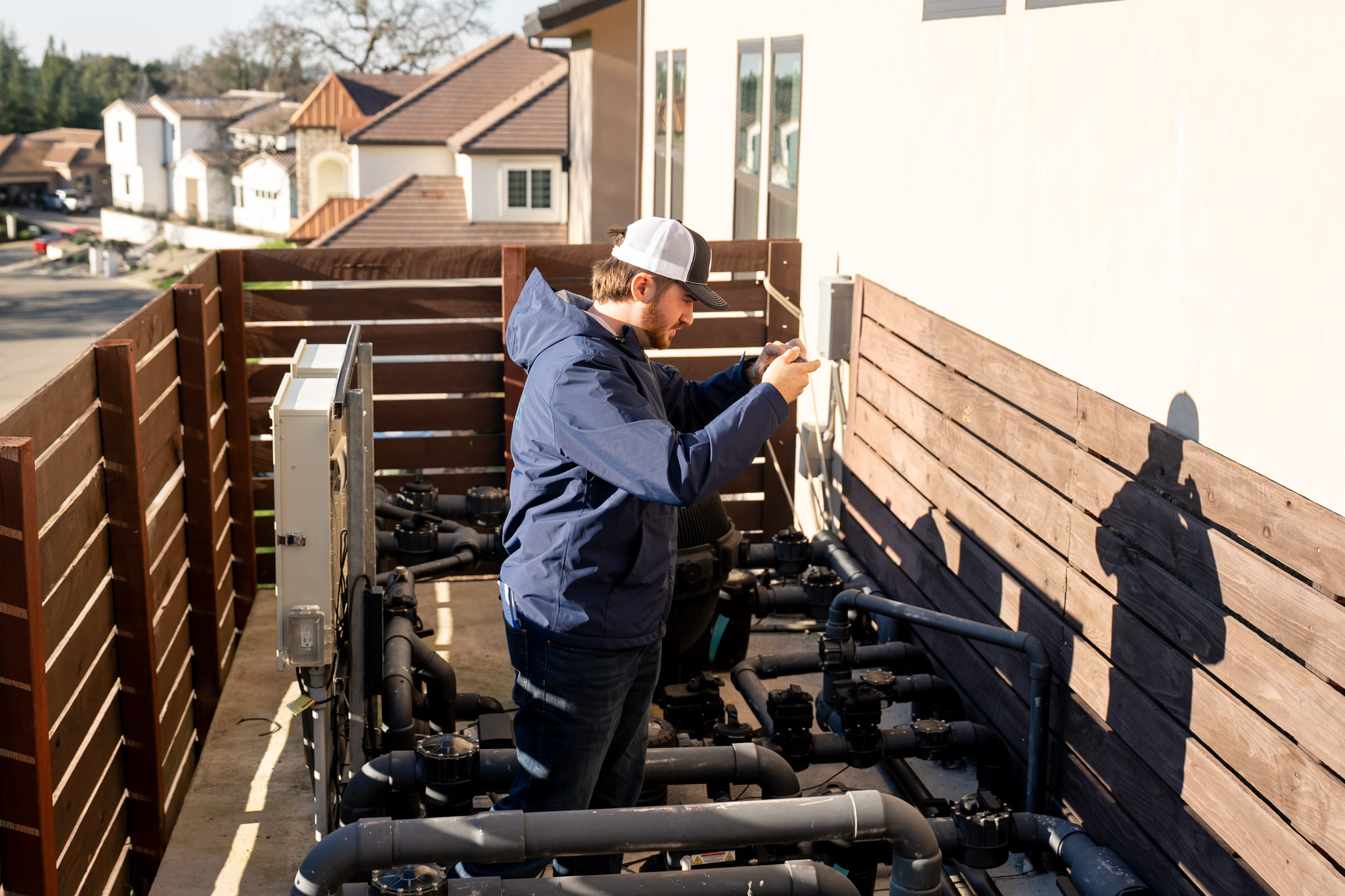
Every visit ends at the pad. Filter pressure gets read and written down, because the number alone means little and the trend means everything. A cartridge or DE filter that runs at a known clean baseline and climbs eight to ten pounds is telling you it is loaded and due for a cleaning, and after a heavy pollen or harvest dust week in Lodi it can get there fast. We confirm the pump primes fully with no air in the lid, listen for bearing noise, check the lid o ring for the dry cracking valley summers cause, and verify the timer or automation is running enough hours for a full turnover, which is a longer day in July than in February.
Heaters, cleaners, and salt cells get a look as well, and anything trending the wrong way gets reported to you before it strands the pool without circulation in the middle of a heat run. Winter changes the work without ending it. Tule fog keeps the water cold and slows chlorine demand, so dosing drops, but debris keeps falling, and a pool left alone through a foggy Lodi winter is a green pool by March. Nevergreen serves Lodi along with Stockton, Manteca, and Copperopolis, and routes are built so the same tech sees your pool week after week and carries its history with them.
Related services in Lodi: Pool Maintenance in Lodi and Chemical Treatment in Lodi.