Professional Pool Service
Chlorinators and Chemical Feeders in Lodi
Chlorinator and chemical feeder repair in Lodi, CA. We clear clogged feeders, stuck check valves, calcified dosing lines and pump tubing on hard water.
Professional Pool Service
Chlorinator and chemical feeder repair in Lodi, CA. We clear clogged feeders, stuck check valves, calcified dosing lines and pump tubing on hard water.
Lodi fill water is hard. Calcium and magnesium come in with every top off, and when that water passes through a tablet chlorinator or a liquid feeder the minerals do not stay dissolved for long. Trichlor tablets sitting in a warm in-line body turn the water around them acidic and mineral loaded, and that water scales the walls of the housing, the check valve seat, and the short run of tubing between the feeder and the return line. Acid feeders have the opposite chemistry and the same result: the pump head and the injection fitting take abuse until something cracks or seizes. Either way the pool stops getting the sanitizer it is supposed to get, and you find out when the water turns.
Most of the chlorinator calls we take in Lodi are not really about the chlorinator. They are about a pool that will not hold chlorine, a chemical bill that keeps climbing, or a feed dial that has been turned up so many times it no longer means anything. The mechanical fault is usually small: a calcified check valve, a lid that has gone brittle in the sun, a peristaltic tube that flattened out months ago. Finding it takes a few minutes with the equipment pad open. Fixing it correctly takes knowing what hard water and four months of 95 to 105 degree heat do to these parts.
Nevergreen Pools services chlorinators and chemical feeders in Lodi in partnership with Vintage Pool Service, a longtime Central Valley company running routes out of Manteca on East Yosemite Avenue. That means Lodi pools get technicians who already know which feeders hold up in this water and which ones are better replaced than rebuilt.
An in-line tablet chlorinator is a small pressure vessel with a tablet stack inside and a metering dial that controls how much return water passes over the tablets. Hard fill water plus trichlor is a scaling recipe. As tablets dissolve, undissolved binder and grit settle into the bottom of the housing while calcium builds a crust on the dial stem and the outlet port. Once that port narrows, flow through the feeder drops, the tablets sit in stagnant acidic water, and the erosion pattern gets worse instead of better. Offline feeders mounted beside the pad fail the same way at the check valve, which is the part that keeps chlorinated water from backing up into the pump and the heater.
Debris load makes it worse. Vineyard and orchard dust and pollen get into the water during tilling and harvest, pack the filter, and push pad pressure up. Less flow through the return line means less water moving through the feeder, longer contact time on the tablets, and faster scaling inside the housing. Fall leaf drop does the same thing from the skimmer side. A feeder cannot be judged until the filter is clean and pressure is back at its known starting point, so that is where we start.
When we open a clogged feeder, these are the usual finds:
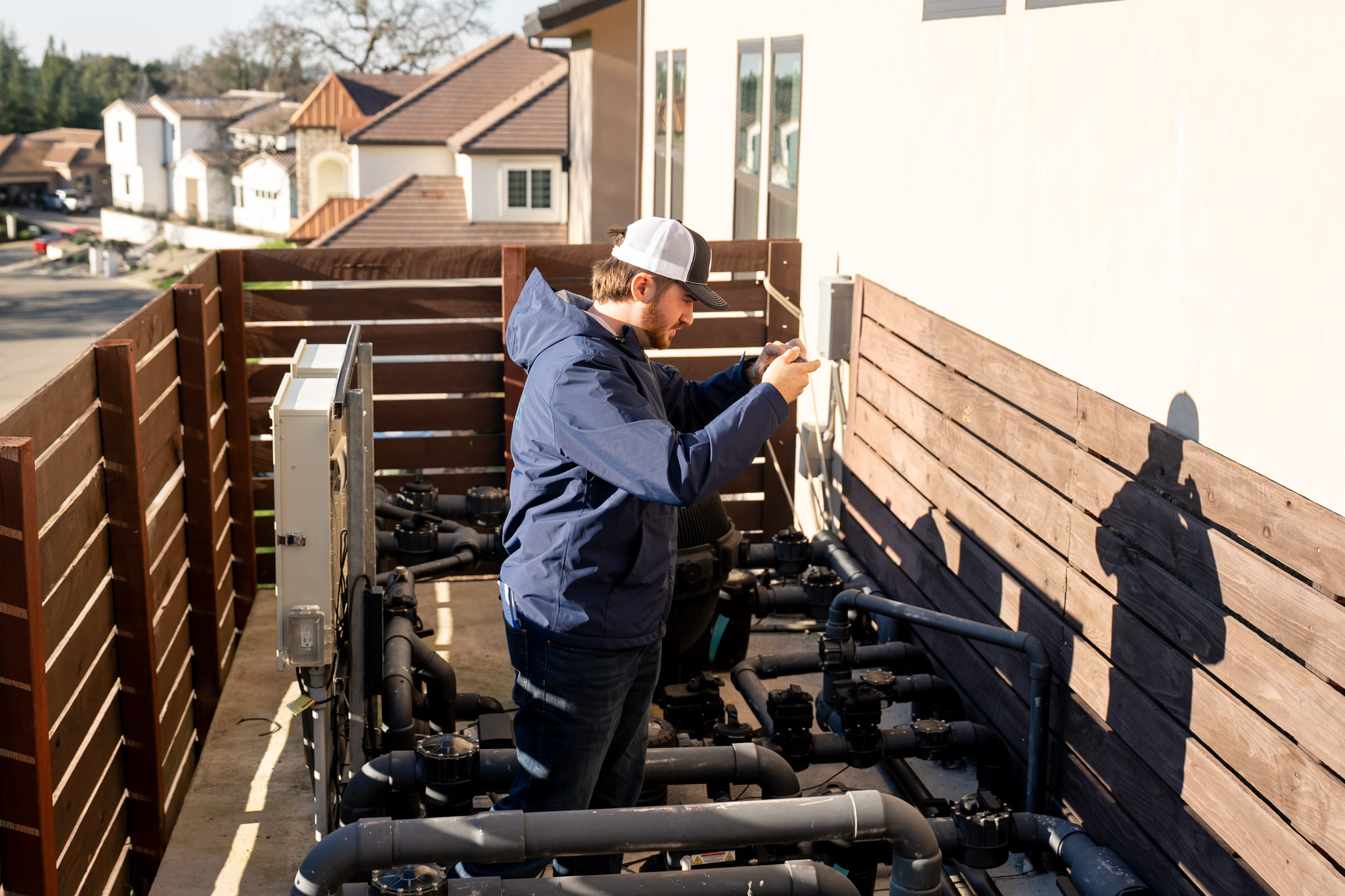
Clearing it is a strip and soak. The housing comes apart, the tablet stack and mush come out, and the body, dial stem, and check valve go into a dilute acid bath until the scale releases. Ports get cleared mechanically, not with a screwdriver that scores the plastic. O-rings and the lid seal get replaced rather than reused, since a seal that has been through a summer at 100 degrees will not seat the same way twice. Then the feeder goes back on line and gets set from a measured chlorine demand, not from where the dial happened to be.
Usually, yes, at least in part. Trichlor tablets are acidic, and every pound that dissolves also adds cyanuric acid to the water. A feeder stuck wide open, or one that has been cranked up to compensate for a partial clog, will drive pH down toward the range where plaster starts to etch and metal components corrode. Meanwhile cyanuric acid climbs, and it does not leave on its own. It only comes down by draining and refilling, which here means bringing in more hard water and starting the calcium problem over again. Once cyanuric acid gets high enough, the chlorine reading on a test kit looks acceptable while the water behaves like it has almost none. Homeowners respond by adding more tablets, which makes the underlying problem worse. If a pool is fighting algae in August with a full chlorinator, the dial is rarely the answer. The chemistry is.


Peristaltic pumps fail quietly. The tube inside gets squeezed thousands of times a day by the roller head, and through a summer of high 90s and low 100s it loses its round shape and its ability to spring back. Output drops off long before the pump stops running, so the pool slides out of range while the motor still hums and the indicator light still blinks. Tubing is a wear part. On a pool running hard through July and August, it should be replaced on a schedule, not after it splits and dumps chemical onto the pad.
Downstream of the pump, the injection fitting is where hard water shows up again. Acid or chlorine entering a return line full of mineral heavy water builds deposits right at the tip, and the duckbill check valve inside stiffens until it either stays shut or stops sealing. A check valve that stops sealing lets pool water siphon backward toward the tank, which is how people end up with an empty jug, a chemical smell at the pad, and no idea where it went. Suction side problems are just as common: a foot valve sitting in sediment at the bottom of a tank, a crimped suction tube, or an acid line that has gassed off and lost prime. Any one of those makes the dial setting meaningless, which is why we verify real output with a draw down test instead of trusting the number printed on the front of the pump.
A draw down takes a graduated cylinder, a measured interval, and the pump running at its set speed. That gives actual milliliters per minute, which we convert to daily output and compare against the pool volume and its measured demand. If the pump is rated for more than it delivers, the fault is tubing, roller head, or a restriction in the line, and each of those is checked in order.
Most of the time it can be repaired. Housings, dials, check valves, lids, O-rings, tubing, and injection fittings are all serviceable parts, and an acid soak clears scale out of a chlorinator body and dosing line when the plastic underneath is still sound. Replacement makes sense when a housing has hairline cracks around the threads, when the lid seat is chewed up enough that no O-ring will seal, or when a feeder was undersized for the pool it sits on and has been running at maximum since the day it went in. Older plaster pools often have feeders that predate the current filter or pump, and a mismatch there wastes chemical every day it runs.
Winter matters too. Pools that get left alone through the fog months still need a low steady feed, and a chlorinator shut off in November with tablets still in the body will be scaled solid by spring. If the pool is going to sit, the feeder should be emptied, rinsed, and left open, and the run time cut back rather than killed. That is cheaper than a spring rebuild and a green pool at the same time.
Service for chlorinators and chemical feeders in Lodi follows the same order every time: read the water, check flow and pressure at the pad, open the feeder, and measure what it is actually delivering. Then we correct calcium hardness, pH, and cyanuric acid so the repair holds through the summer heat and the winter months instead of scaling shut again by next season. Pools in Lodi, Stockton, Manteca, and out toward Copperopolis all get the same approach.
Related services in Lodi: Chemical Treatment in Lodi and Sanitizer Systems in Lodi.