Professional Pool Service
Sanitizer Systems (UV & Chlorination) in Lodi
UV, ozone, salt and tablet sanitizer systems installed in Lodi, CA. Sized to your pool's gallons and flow, plumbed after the filter and heater.
Professional Pool Service
UV, ozone, salt and tablet sanitizer systems installed in Lodi, CA. Sized to your pool's gallons and flow, plumbed after the filter and heater.
Water out of the ground around Lodi is hard. Whether your pool is filled off city supply or off a well, you are adding calcium and often a little iron every time the autofill runs. Summers that sit in the high 90s and low 100s pull water off the surface through evaporation all day, and while the cooler delta nights slow that down, the minerals never leave. They stay behind and concentrate. Calcium hardness climbs season after season even though the water level looks the same every morning. That one fact drives most of what we recommend when a homeowner here asks about changing how their pool is sanitized.
Hard water is rough on sanitizing equipment because almost all of it works by moving water across a surface that has to stay clean. A salt chlorine generator makes chlorine on coated titanium plates, and calcium plates out on those blades first, cutting output before anything else fails. A UV sterilizer works by shining light through a quartz sleeve, and a haze of scale on that sleeve blocks the light long before the lamp is actually worn out. An in-line tablet chlorinator does not scale the same way, but trichlor tablets are acidic and push pH and alkalinity down steadily, and in water already loaded with calcium, correcting that every week is how plaster surfaces get etched and streaked. There is no system that ignores Lodi water. There is only the trade off you would rather manage.
Nevergreen Pools installs sanitizer systems (UV & chlorination) in Lodi in partnership with Vintage Pool Service, a longtime Central Valley company that has run service routes out of East Yosemite Avenue in Manteca for years and knows exactly what this water does to equipment. Here is what homeowners in Lodi ask us most often before they commit to a system.
That smell is not free chlorine working. It is chloramine, which forms when chlorine binds with ammonia and nitrogen from sweat, sunscreen, and decaying organic material. Once chlorine is bound up that way it is mostly spent, so you get a strong odor, stinging eyes, and a test kit that shows a number without much sanitizing behind it. Pools in Lodi carry a heavy organic load compared to a lot of the state. Vineyard pollen and the fine dust kicked up by tilling and harvest drift in from spring through fall. Mature oaks and sycamores over the older homes near downtown and the east side drop leaves and tannin into the water. Cottonwood fluff off the Mokelumne and Lodi Lake rides the afternoon breeze and lands on the surface in sheets. All of it feeds chloramine production.
The traditional fix is to shock the pool and burn the chloramine off, which means more chemical, more cost, and a pool you cannot swim in for a day. A UV sterilizer handles it differently. Water passes through a chamber where a low pressure or medium pressure lamp breaks the chemical bonds in combined chlorine as it goes by, so chloramine is destroyed on every turnover instead of building up between shock treatments. UV also inactivates chlorine resistant organisms that shrug off normal chlorine levels, which matters on a pool that hosts a lot of kids. It does not leave a residual, so you still need chlorine in the water. What it does is cut how hard that chlorine has to work.


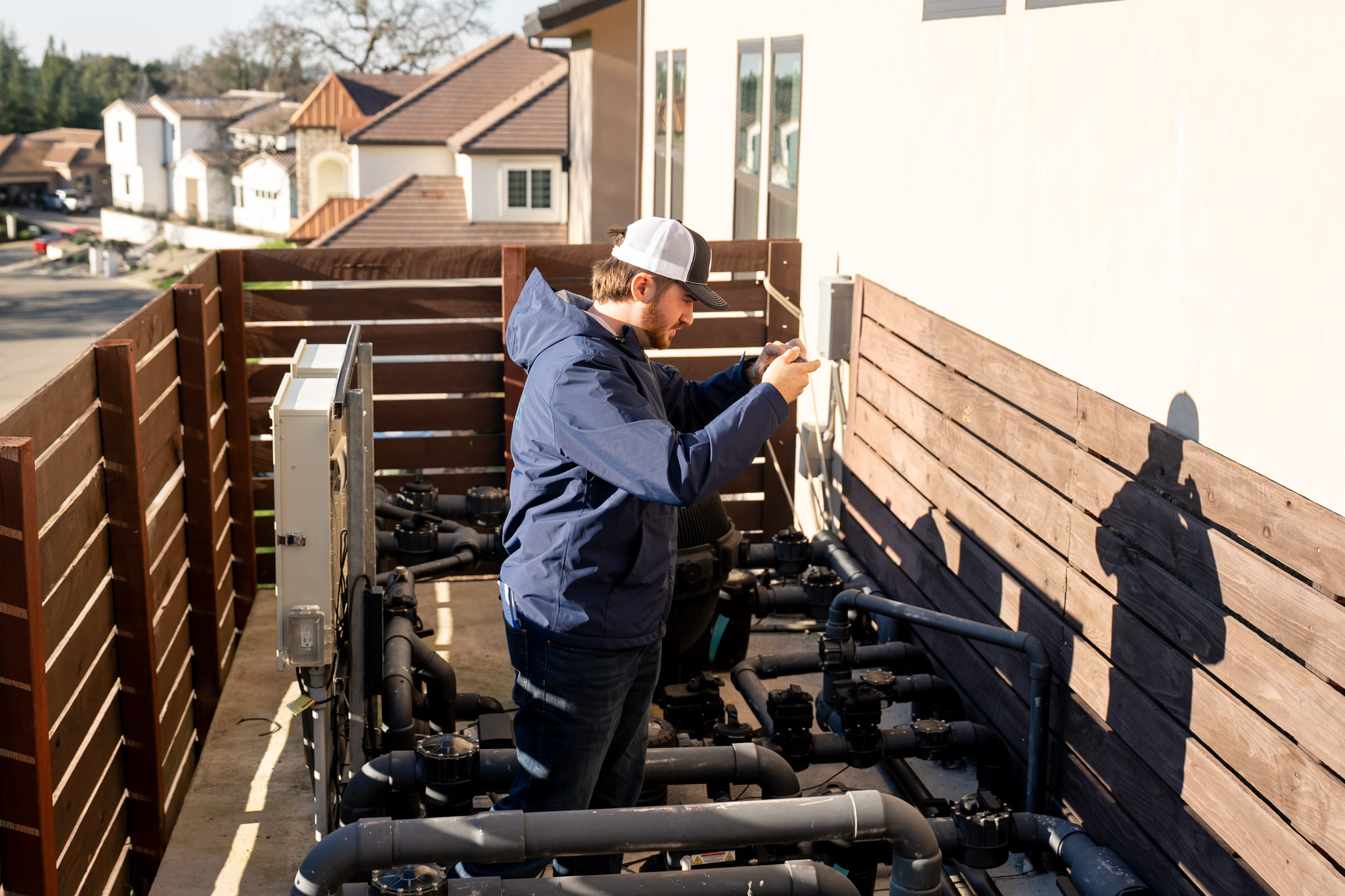
Plumbing order is not a detail, and getting it wrong is the most common problem we find on pads somebody else assembled. Water leaves the pump, goes through the filter, then the heater, and the sanitizer goes last, downstream of both. Filtering first means the salt cell or the UV chamber sees clean water instead of grinding leaf bits and vineyard grit across a cell plate or a quartz sleeve. Putting the sanitizer after the heater keeps concentrated chlorine and acidic feeder water away from the heat exchanger, which is the most expensive part on the pad and the one that corrodes fastest.
A few specifics matter beyond the order. A check valve belongs between the heater and any tablet feeder so acidic water and gas cannot migrate backward into the heater when the pump shuts off, which is exactly how copper heat exchangers get eaten from the inside. The feeder itself should sit at the lowest point on the pad and be plumbed so it drains rather than holding a slug of saturated tablet water. Salt cells need unions on both sides for service, a straight run of pipe ahead of the flow switch so the switch reads correctly, and a proper bond to the pool's bonding grid. UV chambers need clearance above or beside them for lamp and sleeve removal, which is easy to forget on a tight pad crowded against a fence.
Sizing sets that answer more than brand does. A salt cell should be rated for at least half again the actual gallons in your pool, so a cell rated for 40,000 gallons on a 25,000 gallon pool runs at a lower duty cycle and lasts considerably longer than a cell pushed to its limit every day. UV is sized by flow rate in gallons per minute, not by pool volume, because the water needs enough dwell time in the chamber to take a full dose. On a variable speed pump that means the UV has to match the speed you actually run, and we set that speed at install rather than leaving it to chance.
In practice, a well sized salt cell runs three to five years in Lodi water, closer to the low end if nobody ever inspects it. Scale on the plates shows up as reduced output and a low salt reading on the controller when the salt level is actually fine, and a soak in a diluted acid solution once or twice a season keeps it honest. UV lamps hold useful output for roughly nine to thirteen thousand hours, which for most pools here is about a swim season and change, and the quartz sleeve needs wiping more often than that because of the mineral film. Ozone generators typically go two to four years. None of that is difficult work, and it is all part of a maintained pool, but it is real work and worth knowing about before you buy.
If chemical costs keep climbing, if the water smells sharp the day after you shock it, or if the pool clouds up every time the wind comes off the river, a sanitizer upgrade usually fixes more than one problem at once. We size and install sanitizer systems (UV & chlorination) in Lodi against the local water chemistry in front of us instead of a generic spec sheet, and the same crews cover Stockton, Manteca, and Copperopolis.
Related services in Lodi: Salt Cell Replacement in Lodi and Chlorinators & Feeders in Lodi.