Nevergreen Pools provides pool pump repair in Granite Bay, covering shaft seal leaks, worn bearings, motors that won't start, lost prime, cracked pump housings, clogged impellers, and air leaks at the lid o-ring, along with motor swaps and full pump replacement when a variable-speed unit makes more sense.
Call us if you already swapped the capacitor and the motor still won't start, if the pump is humming or grinding without turning, if there's a steady drip under the pump housing where the motor meets the wet end, if the pump loses prime overnight and needs priming again every morning, if the pump housing has a crack weeping water at the seam, if flow feels weak even after you've cleaned the skimmer and pump baskets, or if you hear air hissing at the pump lid and see bubbles coming back out of the jets.
Nevergreen Pools is a licensed pool company based in Shingle Springs, serving the Sacramento region. Call to get a technician scheduled, or book your first visit online.
Diagnosing and Fixing the Pump
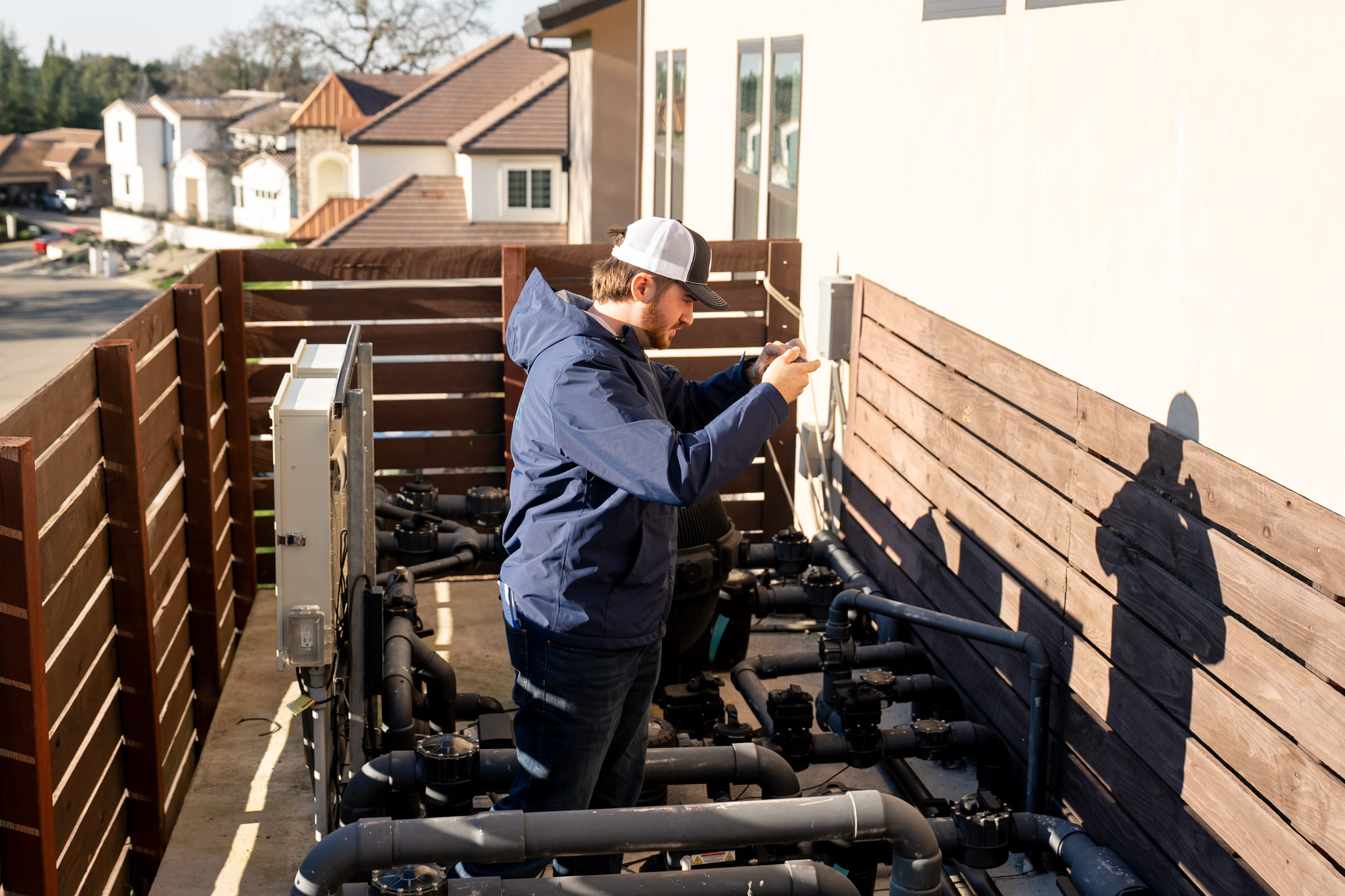
We start at the equipment pad with the pump off and ask what you already tried, since a part that was already replaced tells us where not to look. A bad capacitor leaves the motor humming without turning the shaft, and if the shaft still spins freely by hand, swapping the capacitor is usually a same-visit fix. Worn bearings sound different, a continuous grinding or whine that gets louder the longer the pump runs, and once bearings have gone that far the motor itself is usually not worth saving, so we replace the motor rather than just the bearings.
A pump that won't hold prime is almost always pulling air somewhere between the skimmer and the pump, not failing internally. We check the lid o-ring first, since it hardens and shrinks with age and is the most common leak point, then work back through the unions and the suction line. On pools where the equipment pad sits well away from the house, the suction run is longer, so a small air leak that a nearby pad could prime through on its own becomes a pump that won't hold prime at all. A shaft seal that's leaking shows up as a steady drip or a wet spot on the pump housing between the motor and the wet end, and it's a straightforward seal replacement if we catch it before the leaking water gets into the motor and takes out the bearings too. A cracked housing, usually from age or settling, can't be patched reliably and means replacing the wet end or the whole pump.
Oak leaves and acorns are a steady source of clogged impellers here. Debris gets past the skimmer basket, packs into the impeller vanes, and restricts flow, which also makes the motor run hotter than it should. We pull the impeller, clear it, and check the diffuser and seal plate for wear while the pump is open, since those wear at the same rate as the impeller and are easy to replace while we're already in there.
- Test the capacitor and confirm the motor shaft turns freely by hand
- Listen for bearing wear and check motor housing temperature after a run cycle
- Check the lid o-ring, unions, and suction line for air leaks
- Inspect the shaft seal area and pump housing for leaks or cracks
- Pull and clear the impeller, and check the diffuser and seal plate
- Confirm the pump's size and speed settings match the pool's actual plumbing and equipment
Most of the pumps we find still running are single-speed units from the 1980s through the early 2000s that were never upgraded. On those, we give a straight answer on motor swap versus full replacement. If the housing, seal plate, and wiring are in good shape and only the motor failed, a motor swap is the faster and cheaper fix. If the pump has already had more than one motor, or parts are getting hard to source for that model, we replace the whole pump with a variable-speed unit instead and program separate speeds for filtration, the spa, and any water feature on the system, since running everything on one fixed speed wastes electricity and wears out the rest of the equipment faster than it needs to. Before installing a variable-speed pump, we also check that the existing wiring at the pad can support it, since that pump draws and controls power differently than the single-speed motor it's replacing.
What You Get Back
A repaired or replaced pump means steady flow to the spa, any water feature, and the in-floor cleaning system, all running on schedule without you having to check on it. Filtration holds the turnover rate the pool actually needs, which matters more once summer heat pushes into the high 90s and above, since chlorine burns off faster and bather load goes up at the same time.
Left alone, a failing pump gets worse on its own schedule, not yours. A slow seal leak eventually lets water into the motor and takes out the bearings along with it. A clogged impeller forces the motor to run hotter until it fails outright. A pump that's lost prime and gets run dry, even briefly, can burn out for good and need full replacement instead of a repair. Call Nevergreen Pools to get a technician out, or book your first visit online and we'll have someone at the pad.
Related services in Granite Bay: Pool Repair in Granite Bay and Weekly Pool Service in Granite Bay.