Green water in a Modesto pool almost always traces back to orchard debris. Bloom pollen lands in February and harvest dust lands in August, and both feed algae directly. That organic load also burns through free chlorine fast enough that a pool holding a normal reading on Monday can be hazy by Thursday.
Algae removal here is a seasonal job more than an emergency one. The species that takes hold in March is not the one that takes hold in September, and the treatment changes with it. Green algae blooms fast in warm water with weak sanitizer. Mustard algae, the yellowish film that settles on shaded steps and behind ladders, survives chlorine levels that would wipe out green. Black algae roots into plaster and gunite, and older pools with decades of surface wear are the ones it grabs.
Water source changes the chemistry too. Modesto Irrigation District water runs softer than the well water outlying properties pull, so calcium hardness and pH behave differently from one address to the next. A soft fill needs hardness brought up toward 200 to 400 ppm so the water stops pulling calcium out of the plaster, and a hard well fill needs watching for scale on the tile line and inside a salt cell. Both get tested before any treatment plan gets set.
Nevergreen Pools serves this area in partnership with Vintage Pool Service, a longtime Central Valley company that has run routes out of Manteca on East Yosemite Avenue. That means the crews treating your pool already know how the local water behaves in a vessel and which month brings which mess.
Spring and Summer: Pollen, Heat, and the Fast Blooms
Orchard bloom starts in February and the pollen keeps coming through spring. It lands as a fine yellow film on the water, sinks, and becomes food. Chlorine demand climbs while water temperature is still climbing too, and that gap is where the first green bloom of the year usually happens. The pool looks fine one week and the plaster looks fuzzy the next.
Clearing a green bloom is straightforward if the sequence is right. Brush every surface first, walls, steps, the light niche, and the tight radius where the wall meets the floor, because algae shielded under a layer of its own dead cells will not absorb chemical. Then shock. Green algae dies at roughly 10 to 12 ppm free chlorine held long enough to stay there overnight, which usually means several gallons of liquid chlorine rather than one bag of granular. Drop pH toward 7.2 first, since chlorine at 7.8 does a fraction of the work it does at 7.2. Run the filter continuously through the treatment instead of on a timer.
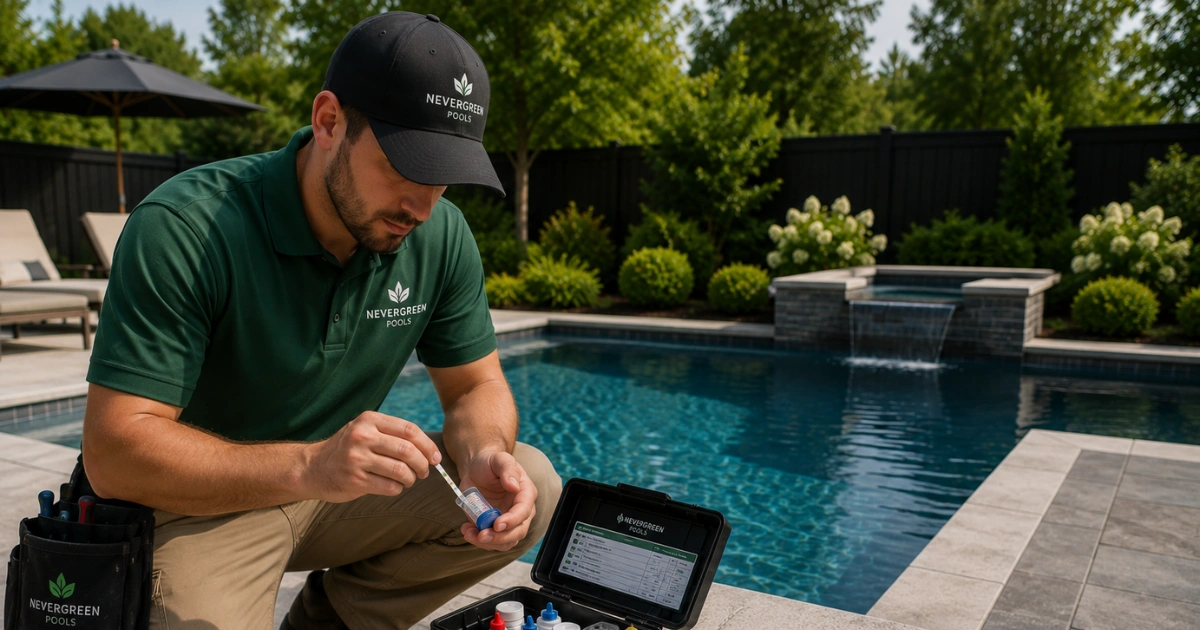
Test before dosing and test again the next morning. If free chlorine reads zero the next day, the demand is still there and the pool needs another full round, not a partial dose. Set total alkalinity into the 80 to 120 ppm range before the shock so pH does not swing while the chlorine is working, and use a test kit that reads free chlorine high rather than strips that top out at 5 ppm.
By June the water in Modesto is warm enough that mustard algae becomes the more common call. It hides where the sun does not reach, comes back a day after it looks handled, and shrugs off a normal shock. It needs a higher hold, usually 20 to 30 ppm, plus every piece of equipment sanitized at the same time. One dirty pole brush, a vacuum head, or a pair of swim trunks left wet in the sun will reseed the whole pool by the weekend.
Heat is the other half of the summer problem. Air temperatures here sit above 95 degrees for weeks at a stretch, water climbs into the mid 80s, and warm water both consumes sanitizer faster and lets algae reproduce faster. Cyanuric acid between 30 and 50 ppm protects chlorine from UV without locking it up. Above roughly 80 ppm the chlorine you add stops doing much and blooms start in water that tests fine on paper, which is when a partial drain and refill becomes the cheaper fix. On salt pools, output gets turned up for summer and the cell gets pulled and checked for scale, since a scaled cell can read as producing when it is not.
Almond harvest in August and September drops a heavy dust load across Stanislaus County for weeks, and that dust settles into pools all over Modesto:
- Skimmer baskets fill faster than usual and starve circulation if nobody empties them
- Filter pressure climbs, flow drops, and dead spots form where algae takes hold
- Phosphates rise as organic debris breaks down, feeding whatever survived the last treatment
- Chlorine demand spikes at exactly the point where water temperature peaks
Phosphate control matters most in these weeks. Algae needs phosphate to grow, and orchard debris delivers it steadily. Test phosphates after a treatment and dose a remover to pull the level under 200 ppb, which takes out the fuel instead of just burning off the current crop. Dose it with the filter running and expect the water to cloud for a day while the filter catches what drops out.
Fall and Winter: Leaf Drop, Fog, and Black Algae
Leaf drop is heavy in October and November on the older streets. Leaves that sit on the floor stain plaster and decay into more phosphate, and a pool that gets covered and forgotten in December often opens green in March. Winters are wet and cool, water temperature falls, and owners cut pump runtime to save power. Circulation is what keeps sanitizer moving into corners, so cutting it too far is the single most common reason a pool that was clean in November is not clean in February. Fog weeks make it worse only in that nobody walks out to look at the water, and an unattended winter pool is the expensive kind of algae job.
Winter maintenance is short. Run the pump long enough to turn the water over once a day, hold free chlorine at 1 to 3 ppm even with nobody swimming, brush weekly, and skim or net the leaves before they sink. If the pool is under a cover, pull it and test at least monthly.
Winter is also when black algae shows itself for what it is. It is not a film. It is a colony with roots down into the pore structure of plaster and gunite, protected by a waxy cap that chlorine will not penetrate. Killing it takes mechanical work first, a stainless brush or a pumice stone on the visible spots to break that cap open, then a chlorine hold, then more brushing, every few days for a couple of weeks. A chlorine tablet held against a spot with a brush can finish off the stubborn heads. Anyone who says black algae comes out in one visit has not dealt with it. Older gunite pools with worn or etched surfaces are the ones that get it, and the rougher the surface, the more brushing it takes.
Preventing the Next Bloom
Clearing the water is the short part. Keeping it clear through a Central Valley year is the actual service. After any treatment, the filter is holding the dead algae you just killed, so it gets cleaned or backwashed before the pool goes back to a normal schedule. Cartridge elements come out and get broken down and rinsed, and soaked overnight if they are greasy or scaled. DE grids get backwashed and recharged with a full new charge. Skipping that step puts the bloom back in the water within a week.
From there it comes down to circulation and steady sanitizer. Pump runtime long enough to turn the water over completely, returns aimed down and around so the whole vessel moves instead of one loop across the surface, a stable cyanuric acid level so chlorine survives the summer sun, and regular brushing of the spots that never see direct light. Watch filter pressure and clean at 8 to 10 psi over the clean starting pressure rather than on a calendar. Chemistry gets set to the water source, since MID water runs softer than the well water outlying properties pull, and calcium hardness and pH follow from that. Done consistently, algae removal in Modesto becomes something you handle once and then prevent, rather than a call you make every August.
Related services in Modesto: Green Pool Clean-Up in Modesto and Chemical Treatment in Modesto.