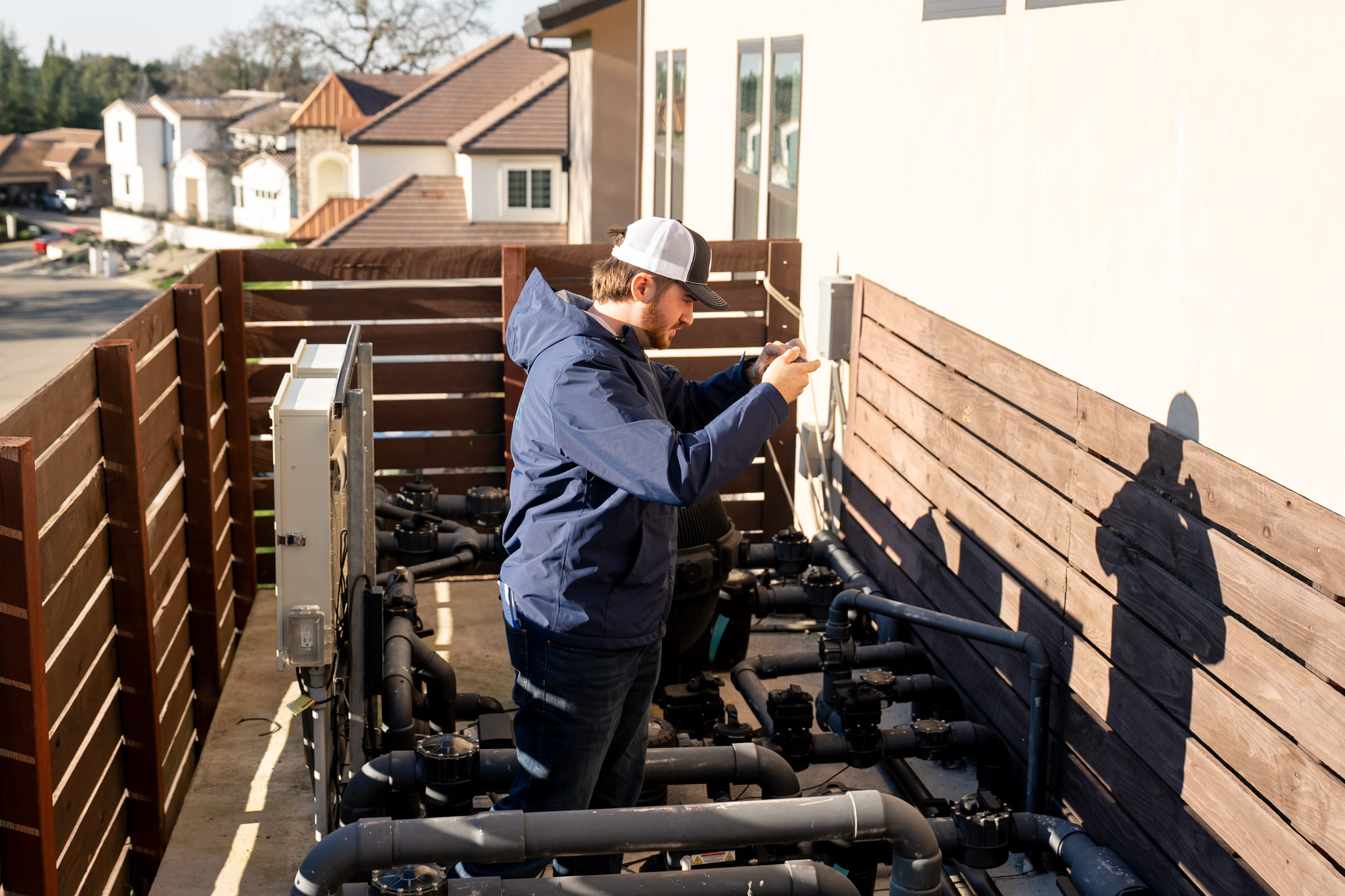
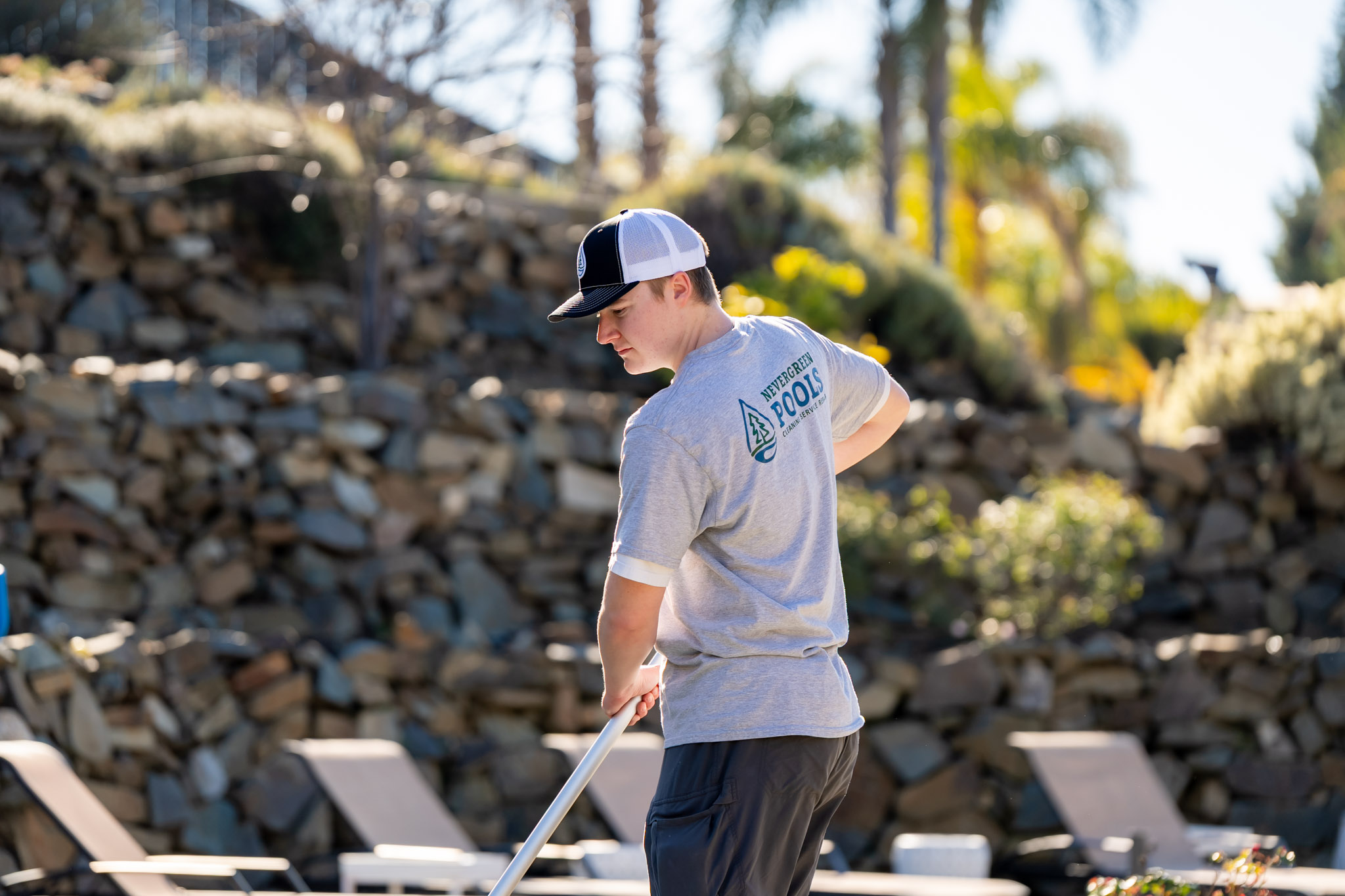
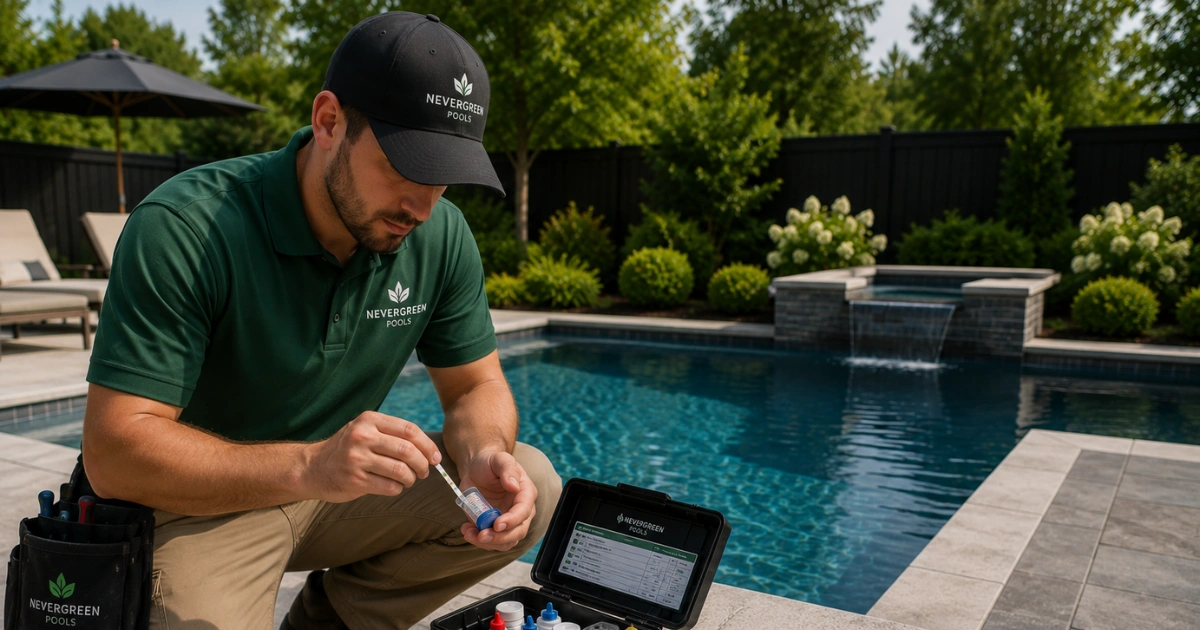
A salt pool in Modesto does not run itself. The chlorine generator makes chlorine from dissolved salt, which takes the weekly job of hauling tabs and jugs off your hands, but everything else about water chemistry stays on the table and a few things actually get harder. Salt levels drift as rain dilutes and evaporation concentrates. Stabilizer burns off under Central Valley sun. pH climbs on its own because of how the cell works. And the cell itself collects calcium, slowly, until output falls off and the panel starts reporting low salt that has nothing to do with how much salt is actually in the water.
What makes Modesto different from a generic salt route is the calendar. This is Stanislaus County farm ground. Almond, walnut, and peach orchards ring the city, and the pool takes something different from them in every season: bloom pollen in February and March, dust when the shakers run in August and September, then heavy leaf drop from the mature street trees along the McHenry corridor and around Graceada Park through November. Add hot summers from May into October and wet, foggy winters along the Tuolumne River, and you get a service year with four distinct personalities.
Our saltwater pool service in Modesto is built around that calendar rather than a fixed checklist. Nevergreen Pools serves the area in partnership with Vintage Pool Service, a longtime Central Valley company working out of East Yosemite Avenue in Manteca, so these routes are run by techs who have been on Modesto pools through many bloom seasons and many harvests.
Spring: Orchard Bloom and Getting the Cell Ready
February and March lay a fine yellow film on the water from the almond and walnut bloom. Pollen is organic, so it drives chlorine demand at exactly the time of year when a salt cell is producing the least. Cold water slows the reaction at the plates, and most systems are still set to a low winter output percentage. The result we see over and over on spring startups in Modesto is a pool that looks fine on Monday and turns dull green by Friday.
Spring is when we pull and inspect the cell. The plates get a visual check for calcium scale, which shows up as a white crust bridging the blades. Light scale comes off in a mild acid solution, but the dilution and the rinse matter more than the soak time, and a cell scrubbed with anything abrasive loses its coating and never comes back. We also verify salt with a real titration instead of trusting the panel, because a scaled or aging cell under reports salt, and homeowners end up dumping bags into a pool that was already sitting at target.
Stabilizer gets set in spring as well. A salt pool wants cyanuric acid higher than a tab pool, generally in the 60 to 80 range, because the generator feeds chlorine continuously at low concentration and needs the extra sun protection to keep any of it in the water. Testing matters here, since stabilizer only leaves through splash out, backwash, and drain down. It can quietly stack up over several years until chlorine stops working at any level, and no amount of raising output will fix that.
- Titrated salt test, with the panel reading compared against it
- Cell removed and inspected, acid cleaned only when scale is actually present
- Stabilizer set before the sun gets strong
- Output percentage stepped up as water temperature climbs
- Baskets and pump lid cleared on every visit while bloom is dropping
Summer: High Output, Rising pH, and Scale
From May through October the water is warm, the days are long, and the generator runs hard. Two things follow. First, pH climbs. The cell releases hydrogen gas as it produces, and the aeration at the returns pushes pH up further. Left alone, a Modesto salt pool will sit at 8.0 or higher by mid summer, where chlorine goes lazy and calcium starts dropping out of solution. We dose acid on a schedule keyed to how fast that particular pool drifts, not a fixed amount per visit.
Second, high pH plus hot water plus hard fill water is the exact recipe for scale. Water source matters here. Much of the city runs Modesto Irrigation District treated surface water off the Tuolumne, which is moderately soft and forgiving. Properties out toward the county on well water are considerably harder, and those pools scale faster on the cell plates, at the tile line, and inside the heater. We track calcium hardness and saturation by property, not by city, because two pools a few miles apart can need completely different acid and hardness handling.
Harvest Dust, Then the Leaves
August and September are the hardest months of the year on a Modesto pool, and it has very little to do with the heat. When the shakers move through the almond orchards, the dust travels. It settles on the surface, sinks, and works its way into the filter. On a salt pool the effect is doubled, because that fine organic load raises chlorine demand right when the cell is already near full output and has nothing left to give. Filter pressure climbs faster than usual. Skimmer baskets fill with a gray silt instead of leaves.
Through harvest we brush more, clean filters on pressure rather than on the calendar, and watch free chlorine closely instead of assuming the generator is keeping up. If a pool cannot hold a residual with the cell at full output, that is useful information. Either the cell is near the end of its service life or demand is temporarily beyond what it was sized for, and a short supplemental dose of liquid chlorine is far cheaper than chasing an algae bloom for three weeks.
Then fall arrives and the old sycamores and liquidambars along the tree lined streets near Graceada Park drop everything at once. Leaves left sitting in a skimmer decay, which drives chlorine demand and stains plaster. The older gunite and plaster shells in the established parts of town stain more readily than the newer surfaces on recent builds out toward the edges of the city, so we keep baskets clear, brush the walls and steps, and begin walking cell output back down as the water cools.
Winter and What Carries Into the Next Year
Winter here is wet and foggy, and the water gets cold enough that most cells barely produce. Running a generator at high output in cold water does not help and shortens cell life, so output comes down and, through a cold stretch, a small amount of liquid chlorine does the work instead. Rain dilutes both salt and stabilizer, so both get retested after a wet run rather than assumed. Freeze protection on the automation gets verified before the first hard fog settles in for the season.
None of this is complicated on its own, but all of it is timing, and timing is the real product. Skipping a spring cell inspection shows up as a July algae problem. Ignoring pH drift in August shows up as a scaled cell in October and a replacement the following spring. That is why our saltwater pool service in Modesto is scheduled around the orchard year, and why the same tech runs the same pools long enough to learn how each one drifts.
Related services in Modesto: Salt Cell Replacement in Modesto and Chemical Treatment in Modesto.