Professional Pool Service
Chemical Treatment in Modesto
One-time pool chemical treatment in Modesto, CA. We test first, then correct pH, alkalinity, calcium, stabilizer, and phosphates. Nevergreen Pools.
Professional Pool Service
One-time pool chemical treatment in Modesto, CA. We test first, then correct pH, alkalinity, calcium, stabilizer, and phosphates. Nevergreen Pools.
Pool water in Modesto changes with the orchards. Almond bloom in late winter lays a fine yellow film across the surface. Harvest in August and September puts dust in the water. Mature street trees unload leaves through October and November. Every one of those loads is organic material, and organic material eats chlorine. By the time a homeowner notices the water has gone dull or the chlorine reading has flatlined, the chemistry has usually been drifting for weeks.
A one-time corrective chemical treatment is the fix for that drift. It is not a maintenance visit and it is not a guess. We test the water first and read the actual numbers for free chlorine, combined chlorine, pH, total alkalinity, calcium hardness, cyanuric acid, and phosphates, then dose against those numbers. Dosing by habit is how a pool ends up carrying 120 ppm of stabilizer and chlorine that will not hold no matter how much gets added.
The sample matters as much as the test. We pull water elbow deep away from the return jets, not off the top step where a tablet floater or a fresh dose of acid has been sitting, and we test it the same day. Strips are fine for a rough chlorine check between visits, but they will not give you a usable cyanuric acid or calcium number, and those two are usually what decides whether the pool needs product or needs water replaced.
Nevergreen Pools works in Modesto in partnership with Vintage Pool Service, a longtime Central Valley company based on East Yosemite Avenue in Manteca. That partnership means the crews running chemical treatment in Modesto have been reading Stanislaus County water for years, and they know that the same pool behaves one way in April and a completely different way in September.
Almond bloom runs late February into March, and the pollen it throws is fine enough to slip past a skimmer basket and stay suspended in the water column. Because it is organic, chlorine has to burn through it. A pool that came out of winter on a short pump schedule is usually already short on free chlorine when that load lands. Spring is also when phosphate readings run highest. Pollen, blown orchard soil, and lawn fertilizer all feed that number, and phosphate is exactly what algae lives on once the water climbs past about 70 degrees.
A spring correction generally means a shock to burn off the combined chlorine that accumulated over winter, a phosphate remover if the reading comes back above roughly 500 ppb, and a serious look at pH and alkalinity. Water that sat still for months tends to drift high on pH as carbon dioxide leaves the surface, and high pH makes whatever chlorine is in the pool far less effective. We bring pH back down with muriatic acid, set total alkalinity in the 80 to 120 ppm range so it stops swinging on its own, and only then judge what the chlorine is actually doing. Order matters here. Alkalinity first, pH second, chlorine last, because correcting them out of sequence means chasing the same two numbers twice in one visit.
From May through October the water is hot, the sun is direct, and chlorine burns off fast. Cyanuric acid, the stabilizer that shields chlorine from UV, becomes the number that decides everything else. Too little and a pool gives up most of its chlorine by mid afternoon. Too much, which is the more common problem in pools run on stabilized tablets year after year, and the chlorine that is present stops doing its job. We hold 30 to 50 ppm on a chlorine pool and 60 to 80 ppm on a saltwater pool. Past roughly 100 ppm the only honest fix is draining and replacing part of the water, and that is a decision worth making deliberately instead of adding more tablets and hoping.
Almond harvest dust starts in August and September and lands as a gray film that flattens the water. That dust is mineral and organic at the same time. It drives chlorine demand up, dulls the finish, and combines with heavy summer bather load to produce chloramines, which are what actually cause the sharp smell people mistake for too much chlorine. Superchlorination is the answer, taking free chlorine to roughly ten times the combined chlorine reading to break those bonds apart, and it only works if pH and stabilizer are already in range. We dose at dusk so the sun does not strip half of it before it finishes working, and the filter runs continuously until free chlorine falls back under 5 ppm.


Leaf drop runs hard from October into December. Leaves that sit on the bottom release tannins, which stain plaster brown, pull pH down, and push chlorine demand up on a pool most people have already stopped watching. Rain and tule fog then dilute whatever is left. Alkalinity and calcium both fall, chlorine thins out, and the pool coasts into January with almost nothing protecting it. Cold water slows algae down, but it does not stop it, and one warm week in February will green a Modesto pool in three days if the chemistry is empty. Pools left unattended through fog season are the single most common reason we get a spring call.
Winter is also the right time to deal with the water source, because that is a longer conversation than a single shock. Much of Modesto runs on treated surface water from the Modesto Irrigation District, which is softer than the groundwater used elsewhere in the valley. Soft fill water is easy on tile and hard on plaster. When calcium hardness sits below about 200 ppm, the water pulls calcium out of the surface itself, and on older plaster and gunite pools that shows up as etching, roughness underfoot, and a chalky feel on the walls. We correct it with calcium chloride and hold hardness in the 200 to 400 ppm band, adding it in stages with the pump running so it dissolves instead of settling on the floor. Properties on hard well water have the opposite problem: scale at the waterline, cloudiness after every shock, and sometimes iron or manganese that stains the moment chlorine hits it. Those pools need a sequestering agent added before any superchlorination, not after.
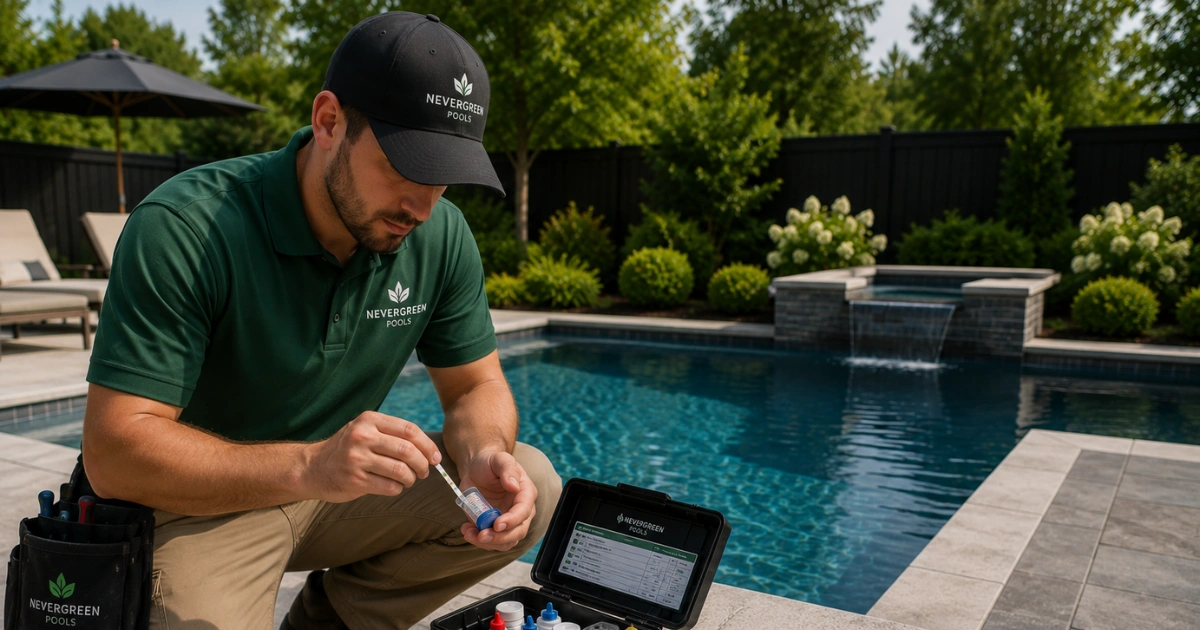
Every chemical treatment in Modesto starts with a full panel on a fresh sample, not a strip dipped at the edge of the steps. What gets added depends on what the numbers say.
Products go in with the pump running, in an order that keeps them from cancelling each other out. Acid and chlorine never go in together. Calcium and acid get separated by several hours. After the treatment the pool needs a full turnover before the numbers mean anything, so we retest at the end of the visit only for chlorine and pH, and give you the target range to check again in a day or two.
One visit brings the water back into range. Holding it there takes brushing, adequate filter run time through the hot months, and a check on the numbers every week or two, and we will tell you plainly which of those the pool needs. A chemical treatment in Modesto is a reset, not a subscription. If the pool is fighting something structural, a failing filter, a leak feeding it constant fresh water, or a surface that has etched past the point chemistry can help, we say so instead of pouring product at it.
Related services in Modesto: Pool Rebalance in Modesto and Algae Removal in Modesto.